
Advertisement


Sections
Pluto's more prominent surface features get official names honouring yesteryear's pioneers
The Working Group for Planetary System Nomenclature (WGSPN) has officially named some of the more prominent surface features on the planet.

For decades, Pluto was merely a blip on telescopes and a familiar name when discussing the Solar System. A while after that, Pluto got demoted from planetary status and joined several Kuiper Belt objects as a dwarf planet.[caption id="attachment_4021393" align="alignleft" width="380"]![An image of Pluto as captured by the New Horizons spacecraft]() An image of Pluto as captured by the New Horizons spacecraft[/caption]As sad as it was, the ninth planet (Hey, we’re not going to disown the little fella just ‘cause he’s a dwarf.) in the solar system still remained a mystery. We knew that it existed, but little else; even its mass was being debated well into 2006.Hubble’s observations in 2002 through to 2003 didn’t reveal much more than a brightness map of the surface. It wasn’t till the New Horizons flyby in 2015 that we received our first, high-resolution images of the planet’s surface. The images captured by New Horizons revealed stunning details and features on Pluto’s surface, including what appeared to be an atmosphere of sorts.Pluto was no longer a faceless dwarf. In fact, New Horizons found that it even had a heart.Now, more than two years since New Horizons beamed back revelatory images of the planet, The Working Group for Planetary System Nomenclature (WGSPN) has officially named some of the more prominent surface features on the planet.The International Astronomical Union (IAU) — the WGSPN is a part of the IAU — reveals that some of the names were suggested by members of the public and that others were “informally used” by the New Horizons science team to describe some regions.“We’re very excited to approve names recognising people of significance to Pluto and the pursuit of exploration as well as the mythology of the underworld. These names highlight the importance of pushing to the frontiers of discovery,” said Rita Schulz, chair of IAU’s WGSPN, in a press release.[caption id="attachment_4021397" align="alignnone" width="1280"]
An image of Pluto as captured by the New Horizons spacecraft[/caption]As sad as it was, the ninth planet (Hey, we’re not going to disown the little fella just ‘cause he’s a dwarf.) in the solar system still remained a mystery. We knew that it existed, but little else; even its mass was being debated well into 2006.Hubble’s observations in 2002 through to 2003 didn’t reveal much more than a brightness map of the surface. It wasn’t till the New Horizons flyby in 2015 that we received our first, high-resolution images of the planet’s surface. The images captured by New Horizons revealed stunning details and features on Pluto’s surface, including what appeared to be an atmosphere of sorts.Pluto was no longer a faceless dwarf. In fact, New Horizons found that it even had a heart.Now, more than two years since New Horizons beamed back revelatory images of the planet, The Working Group for Planetary System Nomenclature (WGSPN) has officially named some of the more prominent surface features on the planet.The International Astronomical Union (IAU) — the WGSPN is a part of the IAU — reveals that some of the names were suggested by members of the public and that others were “informally used” by the New Horizons science team to describe some regions.“We’re very excited to approve names recognising people of significance to Pluto and the pursuit of exploration as well as the mythology of the underworld. These names highlight the importance of pushing to the frontiers of discovery,” said Rita Schulz, chair of IAU’s WGSPN, in a press release.[caption id="attachment_4021397" align="alignnone" width="1280"]![Pluto’s first official surface-feature names are marked on this map. Image: IAU]() Pluto’s first official surface-feature names are marked on this map. Image: IAU[/caption]The approved surface feature names are as follows:
Pluto’s first official surface-feature names are marked on this map. Image: IAU[/caption]The approved surface feature names are as follows:
 An image of Pluto as captured by the New Horizons spacecraft[/caption]As sad as it was, the ninth planet (Hey, we’re not going to disown the little fella just ‘cause he’s a dwarf.) in the solar system still remained a mystery. We knew that it existed, but little else; even its mass was being debated well into 2006.Hubble’s observations in 2002 through to 2003 didn’t reveal much more than a brightness map of the surface. It wasn’t till the New Horizons flyby in 2015 that we received our first, high-resolution images of the planet’s surface. The images captured by New Horizons revealed stunning details and features on Pluto’s surface, including what appeared to be an atmosphere of sorts.Pluto was no longer a faceless dwarf. In fact, New Horizons found that it even had a heart.Now, more than two years since New Horizons beamed back revelatory images of the planet, The Working Group for Planetary System Nomenclature (WGSPN) has officially named some of the more prominent surface features on the planet.The International Astronomical Union (IAU) — the WGSPN is a part of the IAU — reveals that some of the names were suggested by members of the public and that others were “informally used” by the New Horizons science team to describe some regions.“We’re very excited to approve names recognising people of significance to Pluto and the pursuit of exploration as well as the mythology of the underworld. These names highlight the importance of pushing to the frontiers of discovery,” said Rita Schulz, chair of IAU’s WGSPN, in a press release.[caption id="attachment_4021397" align="alignnone" width="1280"]
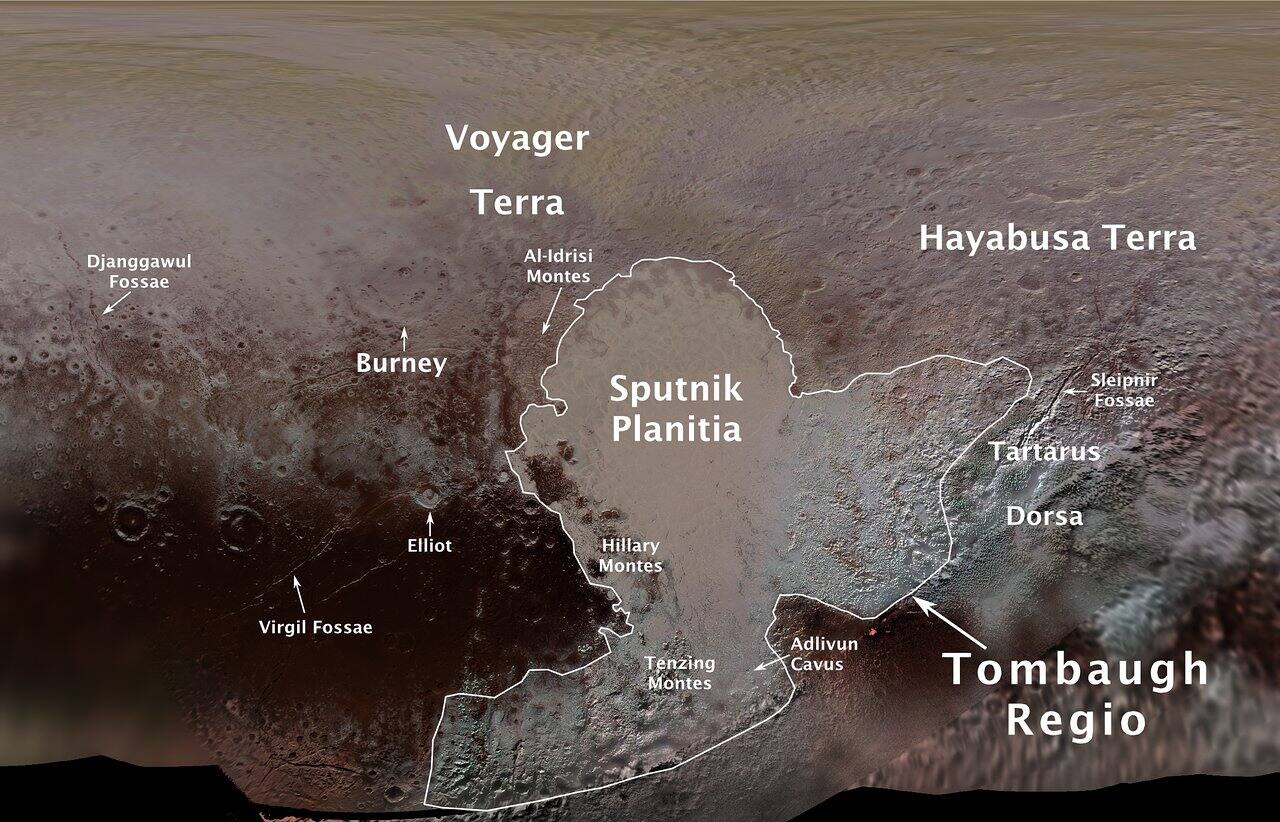 Pluto’s first official surface-feature names are marked on this map. Image: IAU[/caption]The approved surface feature names are as follows:
Tombaugh Regio honours Clyde Tombaugh (1906–1997), the US astronomer who discovered Pluto in 1930 from Lowell Observatory in Arizona. Burney crater honours Venetia Burney (1918–2009), who as an 11-year-old schoolgirl suggested the name “Pluto” for Clyde Tombaugh’s newly discovered planet. Later in life she taught mathematics and economics. Sputnik Planitia is a large plain named after Sputnik 1, the first space satellite, launched by the Soviet Union in 1957. Tenzing Montes and Hillary Montes are mountain ranges honouring Tenzing Norgay (1914–1986) and Sir Edmund Hillary (1919–2008), the Indian/Nepali Sherpa and New Zealand mountaineer who were the first to reach the summit of Mount Everest and return safely. Al-Idrisi Montes honours Ash-Sharif al-Idrisi (1100–1165/66), a noted Arab mapmaker and geographer whose landmark work of medieval geography is sometimes translated as “The Pleasure of Him Who Longs to Cross the Horizons.” Djanggawul Fossae defines a network of long, narrow depressions named for the Djanggawuls, three ancestral beings in indigenous Australian mythology who travelled between the island of the dead and Australia, creating the landscape and filling it with vegetation. Sleipnir Fossa is named for the powerful, eight-legged horse of Norse mythology that carried the god Odin into the underworld. Virgil Fossae honours Virgil, one of the greatest Roman poets and Dante’s fictional guide through hell and purgatory in the Divine Comedy. Adlivun Cavus is a deep depression named for Adlivun, the underworld in Inuit mythology. Hayabusa Terra is a large land mass saluting the Japanese spacecraft and mission (2003–2010) that returned the first asteroid sample. Voyager Terra honours the pair of NASA spacecraft, launched in 1977, that performed the first “grand tour” of all four giant planets. The Voyager spacecraft are now probing the boundary between the Sun and interstellar space. Tartarus Dorsa is a ridge named for Tartarus, the deepest, darkest pit of the underworld in Greek mythology. Elliot crater recognises James Elliot (1943–2011), an MIT researcher who pioneered the use of stellar occultations to study the Solar System — leading to discoveries such as the rings of Uranus and the first detection of Pluto's thin atmosphere.
First Published:Sep 08, 2017, 08:54:46 IST
Advertisement
Advertisement

Why AI notetakers are raising serious privacy and security concerns
AI notetakers promise effortless meeting summaries, but experts warn they could expose confidential conversations, corporate secrets and personal voiceprints. As businesses increasingly adopt AI-powered meeting assistants, questions over data storage, privacy, consent and legal risks are becoming impossible to ignore
5 min read
China's low-cost AI models are changing the global AI race. Here's why Silicon Valley is worried
As Chinese firms continue to improve performance while keeping prices low, the AI race is no longer just about building the smartest model—it is increasingly becoming a battle over who can deliver the best value
2 min read
China's Kimi K3 challenges US AI leaders with frontier-level performance at lower cost
Chinese artificial intelligence startup Moonshot AI has unveiled its latest open-weight AI model, Kimi K3, with early results suggesting it could compete with some of the world's most advanced AI systems developed by leading US companies
2 min read
How did Instagram run ads promoting child abuse in India?
India has issued a notice to Meta after an investigation alleged that Instagram displayed paid advertisements promoting child sexual abuse material. MeitY ordered Meta to remove such Instagram ads and explain within seven days how they were approved
8 min read
Why has India halted WhatsApp’s username feature before launch?
India has halted WhatsApp’s planned username feature, citing concerns about cybercrime, impersonation, and law enforcement challenges. As Meta races to address security concerns, here’s why MeitY has paused the rollout, what the feature does, and how it could influence privacy and online safety in India
3 min read
Advertisement
Advertisement