
Advertisement


Sections
Paytm slams Google for 'arm-twisting' after the app was pulled out of Play Store
After being pulled down last week, the Paytm app has now been restored on Google Play Store.

Last week, Google kicked out Paytm from the Play Store for "repeated policy violations". Two days after the temporary ban, Paytm has now finally opened up about the incident accusing Google of 'arm-twisting.Paytm says, "we were forced to comply with Google’s mandate of removing our UPI cashback offer and scratch cards to get re-listed." The blog states that suddenly UPI cashback is now being termed as an "online casino" by Google.The Paytm app has since been restored. However, the Paytm First Games app is still off the list. Paytm had to remove the cashback campaign which was subject of concern for Google.[caption id="attachment_5429981" align="alignnone" width="1280"]![An advertisement board displaying a QR code for Paytm, a digital wallet company, is seen placed amidst vegetables at a roadside vendor's stall in Mumbai. Reuters]() Paytm had launched a campaign that allowed users to collect stickers and scratch cards that further resulted in UPI cashback. Image: Reuters[/caption]The blog further explained that on 11 September, Paytm had launched a campaign that allowed users to collect stickers and scratch cards that further resulted in UPI cashback. This was applicable on recharge, utility payments, UPI money transfers and adding money to Paytm wallet.[caption id="attachment_8837201" align="alignnone" width="700"]
Paytm had launched a campaign that allowed users to collect stickers and scratch cards that further resulted in UPI cashback. Image: Reuters[/caption]The blog further explained that on 11 September, Paytm had launched a campaign that allowed users to collect stickers and scratch cards that further resulted in UPI cashback. This was applicable on recharge, utility payments, UPI money transfers and adding money to Paytm wallet.[caption id="attachment_8837201" align="alignnone" width="700"]![paytmaa]() Paytm campaign.[/caption]On 18 September at 11.30 AM, Paytm received an email from Google Play Support informing them that the Paytm app has been taken down from the platform. The email read, "Your app contains content that doesn’t comply with the Gambling policy as it offers games with “loyalty” (e.g. engagement or activity) points that (1) are accrued or accelerated via real-money purchases which (2) can be exchanged for items or prizes of real-world monetary value."According to Paytm, this was the first time that Google had approached it regarding UPI cashback and scratch card campaigns. Moreover, it was not given an opportunity to respond to the concern raised. As per the Paytm blog, "We maintain that our cashback campaign was within guidelines, as well as all laws of the land. We did not break any rules and there was no violation. It is not related to gambling in any manner whatsoever."Paytm also responded regarding the "repeated" policy violation. It said, "The Google Play Support team had written to us on 3 occasions (on 20 August, 28 August and 1 September) with some concerns on a separate matter of Paytm First Games’ promotion through the Paytm app. While we strenuously disagreed with the allegation that we are breaching the policy (and we disagree with the policy itself too), we immediately complied with the diktat that barred us from promoting our gaming subsidiary."Paytm also stated that since Google owns Android, it owns 95 percent of smartphones in India and hence, it has "enormous control" overs apps via its Play Store policies.The blog added, "There is a bigger question here that the Indian startup ecosystem and developers should think about. As a startup, we are running law-abiding businesses and building for India. Google and its employees are making policies which are over and above the laws of our country, and are arbitrarily implementing them."
Paytm campaign.[/caption]On 18 September at 11.30 AM, Paytm received an email from Google Play Support informing them that the Paytm app has been taken down from the platform. The email read, "Your app contains content that doesn’t comply with the Gambling policy as it offers games with “loyalty” (e.g. engagement or activity) points that (1) are accrued or accelerated via real-money purchases which (2) can be exchanged for items or prizes of real-world monetary value."According to Paytm, this was the first time that Google had approached it regarding UPI cashback and scratch card campaigns. Moreover, it was not given an opportunity to respond to the concern raised. As per the Paytm blog, "We maintain that our cashback campaign was within guidelines, as well as all laws of the land. We did not break any rules and there was no violation. It is not related to gambling in any manner whatsoever."Paytm also responded regarding the "repeated" policy violation. It said, "The Google Play Support team had written to us on 3 occasions (on 20 August, 28 August and 1 September) with some concerns on a separate matter of Paytm First Games’ promotion through the Paytm app. While we strenuously disagreed with the allegation that we are breaching the policy (and we disagree with the policy itself too), we immediately complied with the diktat that barred us from promoting our gaming subsidiary."Paytm also stated that since Google owns Android, it owns 95 percent of smartphones in India and hence, it has "enormous control" overs apps via its Play Store policies.The blog added, "There is a bigger question here that the Indian startup ecosystem and developers should think about. As a startup, we are running law-abiding businesses and building for India. Google and its employees are making policies which are over and above the laws of our country, and are arbitrarily implementing them."
 Paytm had launched a campaign that allowed users to collect stickers and scratch cards that further resulted in UPI cashback. Image: Reuters[/caption]The blog further explained that on 11 September, Paytm had launched a campaign that allowed users to collect stickers and scratch cards that further resulted in UPI cashback. This was applicable on recharge, utility payments, UPI money transfers and adding money to Paytm wallet.[caption id="attachment_8837201" align="alignnone" width="700"]
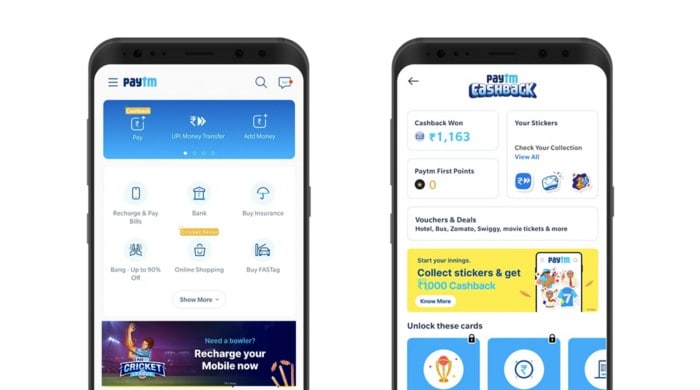 Paytm campaign.[/caption]On 18 September at 11.30 AM, Paytm received an email from Google Play Support informing them that the Paytm app has been taken down from the platform. The email read, "Your app contains content that doesn’t comply with the Gambling policy as it offers games with “loyalty” (e.g. engagement or activity) points that (1) are accrued or accelerated via real-money purchases which (2) can be exchanged for items or prizes of real-world monetary value."According to Paytm, this was the first time that Google had approached it regarding UPI cashback and scratch card campaigns. Moreover, it was not given an opportunity to respond to the concern raised. As per the Paytm blog, "We maintain that our cashback campaign was within guidelines, as well as all laws of the land. We did not break any rules and there was no violation. It is not related to gambling in any manner whatsoever."Paytm also responded regarding the "repeated" policy violation. It said, "The Google Play Support team had written to us on 3 occasions (on 20 August, 28 August and 1 September) with some concerns on a separate matter of Paytm First Games’ promotion through the Paytm app. While we strenuously disagreed with the allegation that we are breaching the policy (and we disagree with the policy itself too), we immediately complied with the diktat that barred us from promoting our gaming subsidiary."Paytm also stated that since Google owns Android, it owns 95 percent of smartphones in India and hence, it has "enormous control" overs apps via its Play Store policies.The blog added, "There is a bigger question here that the Indian startup ecosystem and developers should think about. As a startup, we are running law-abiding businesses and building for India. Google and its employees are making policies which are over and above the laws of our country, and are arbitrarily implementing them."
First Published:Sep 21, 2020, 18:33:00 IST
Advertisement
Advertisement

Why AI notetakers are raising serious privacy and security concerns
AI notetakers promise effortless meeting summaries, but experts warn they could expose confidential conversations, corporate secrets and personal voiceprints. As businesses increasingly adopt AI-powered meeting assistants, questions over data storage, privacy, consent and legal risks are becoming impossible to ignore
5 min read
China's low-cost AI models are changing the global AI race. Here's why Silicon Valley is worried
As Chinese firms continue to improve performance while keeping prices low, the AI race is no longer just about building the smartest model—it is increasingly becoming a battle over who can deliver the best value
2 min read
China's Kimi K3 challenges US AI leaders with frontier-level performance at lower cost
Chinese artificial intelligence startup Moonshot AI has unveiled its latest open-weight AI model, Kimi K3, with early results suggesting it could compete with some of the world's most advanced AI systems developed by leading US companies
2 min read
How did Instagram run ads promoting child abuse in India?
India has issued a notice to Meta after an investigation alleged that Instagram displayed paid advertisements promoting child sexual abuse material. MeitY ordered Meta to remove such Instagram ads and explain within seven days how they were approved
8 min read
Why has India halted WhatsApp’s username feature before launch?
India has halted WhatsApp’s planned username feature, citing concerns about cybercrime, impersonation, and law enforcement challenges. As Meta races to address security concerns, here’s why MeitY has paused the rollout, what the feature does, and how it could influence privacy and online safety in India
3 min read
Advertisement
Advertisement