
Advertisement


Sections
NASA's Hubble telescope captures an exploding star 70-million light-years from Earth
The supernova was observed by Hubble astronomers to “precisely measure the expansion rate of the universe”.

NASA’s Hubble telescope has captured a supernova from a nearby galaxy as it shone brighter than other stars before fading out completely. Now astronomers have stitched together the consecutive photos taken over a year in a time-lapse sequence. The supernova 2018gv was first detected in mid-January by amateur astronomer Koichi Itagaki, said NASA. A few weeks later, in February, Hubble began observing the supernova. The supernova is located in the spiral galaxy NGC 2525, which is 70 million light-years away from Earth.The supernova was observed by Hubble astronomers to “precisely measure the expansion rate of the universe”. As supernovae can serve as accurate markers of measuring galaxy distances, these galactic blasts can give a “fundamental value needed for measuring the expansion of space”.[caption id="attachment_8881291" align="alignnone" width="1280"]![Image:NASA]() Image:NASA[/caption]This means that by knowing the “actual brightness” of the supernova, astronomers are able to calculate the distances of their host galaxies. This in turn helps astronomers to measure the expansion rate of the universe.It was in January, 2018 that the initial blast took place. This blast was not recorded by Hubble but it captured consecutive pictures of the 2018gv from 2018 to 2019 as the supernova became brighter than the brightest stars of the spiral galaxy to only lose its light and fade out ultimately. The report explained the particular case of supernova. The 2018gv had originated from a burned-out white dwarf that was part of a close binary system. “When the white dwarf reaches a critical mass, its core becomes hot enough to ignite nuclear fusion, turning it into a giant atomic bomb. This thermonuclear runaway process tears the dwarf apart. The opulence is short-lived as the fireball fades away,” read the report from the space agency.Nobel laureate Adam Riess, who is associated with the Space Telescope Science Institute (STScI) and Johns Hopkins University in Baltimore, said that no Earthly fireworks can compete with the supernova that was captured by the Hubble Space Telescope even as it faded. Riess is also the leader of the High-z Supernova Search Team and the Supernovae H0 for the Equation of State (SH0ES) Team to measure the universe’s expansion rate.Watch the time-lapse video created from the several snapshots captured by Hubble here.
Image:NASA[/caption]This means that by knowing the “actual brightness” of the supernova, astronomers are able to calculate the distances of their host galaxies. This in turn helps astronomers to measure the expansion rate of the universe.It was in January, 2018 that the initial blast took place. This blast was not recorded by Hubble but it captured consecutive pictures of the 2018gv from 2018 to 2019 as the supernova became brighter than the brightest stars of the spiral galaxy to only lose its light and fade out ultimately. The report explained the particular case of supernova. The 2018gv had originated from a burned-out white dwarf that was part of a close binary system. “When the white dwarf reaches a critical mass, its core becomes hot enough to ignite nuclear fusion, turning it into a giant atomic bomb. This thermonuclear runaway process tears the dwarf apart. The opulence is short-lived as the fireball fades away,” read the report from the space agency.Nobel laureate Adam Riess, who is associated with the Space Telescope Science Institute (STScI) and Johns Hopkins University in Baltimore, said that no Earthly fireworks can compete with the supernova that was captured by the Hubble Space Telescope even as it faded. Riess is also the leader of the High-z Supernova Search Team and the Supernovae H0 for the Equation of State (SH0ES) Team to measure the universe’s expansion rate.Watch the time-lapse video created from the several snapshots captured by Hubble here.
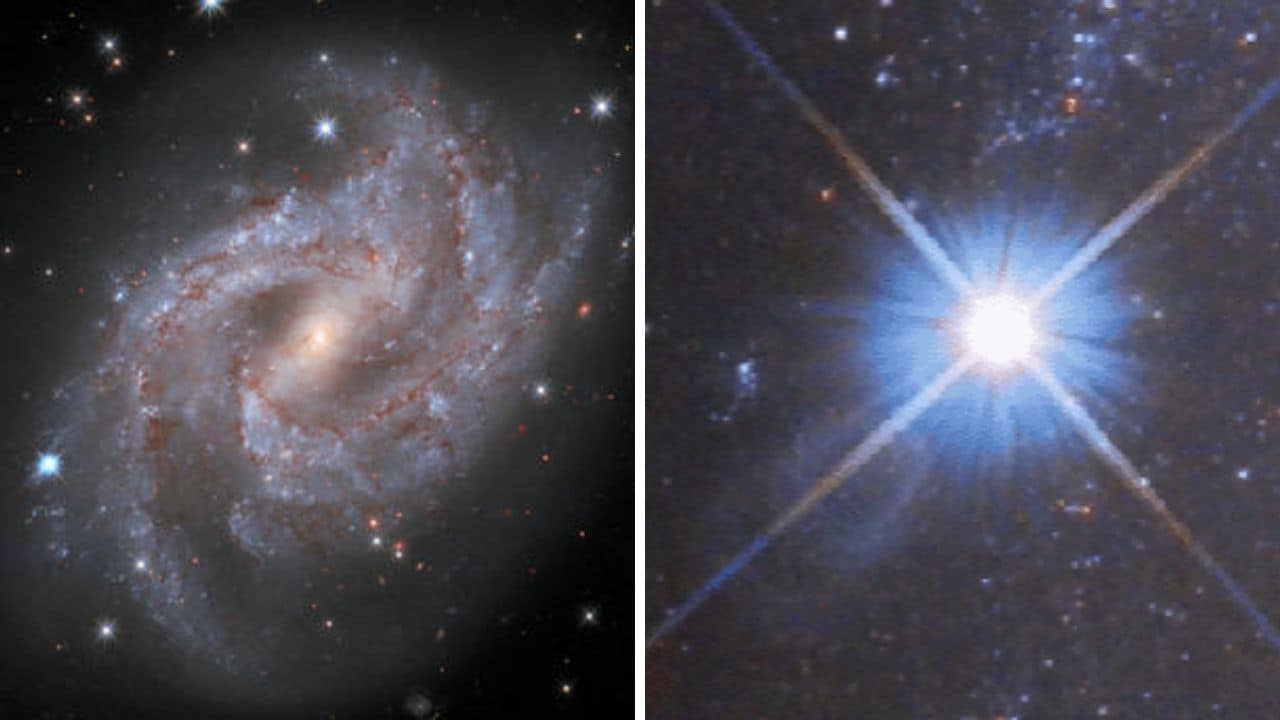 Image:NASA[/caption]This means that by knowing the “actual brightness” of the supernova, astronomers are able to calculate the distances of their host galaxies. This in turn helps astronomers to measure the expansion rate of the universe.It was in January, 2018 that the initial blast took place. This blast was not recorded by Hubble but it captured consecutive pictures of the 2018gv from 2018 to 2019 as the supernova became brighter than the brightest stars of the spiral galaxy to only lose its light and fade out ultimately. The report explained the particular case of supernova. The 2018gv had originated from a burned-out white dwarf that was part of a close binary system. “When the white dwarf reaches a critical mass, its core becomes hot enough to ignite nuclear fusion, turning it into a giant atomic bomb. This thermonuclear runaway process tears the dwarf apart. The opulence is short-lived as the fireball fades away,” read the report from the space agency.Nobel laureate Adam Riess, who is associated with the Space Telescope Science Institute (STScI) and Johns Hopkins University in Baltimore, said that no Earthly fireworks can compete with the supernova that was captured by the Hubble Space Telescope even as it faded. Riess is also the leader of the High-z Supernova Search Team and the Supernovae H0 for the Equation of State (SH0ES) Team to measure the universe’s expansion rate.Watch the time-lapse video created from the several snapshots captured by Hubble here.
First Published:Oct 05, 2020, 16:29:13 IST
Advertisement
Advertisement

Why AI notetakers are raising serious privacy and security concerns
AI notetakers promise effortless meeting summaries, but experts warn they could expose confidential conversations, corporate secrets and personal voiceprints. As businesses increasingly adopt AI-powered meeting assistants, questions over data storage, privacy, consent and legal risks are becoming impossible to ignore
5 min read
China's low-cost AI models are changing the global AI race. Here's why Silicon Valley is worried
As Chinese firms continue to improve performance while keeping prices low, the AI race is no longer just about building the smartest model—it is increasingly becoming a battle over who can deliver the best value
2 min read
China's Kimi K3 challenges US AI leaders with frontier-level performance at lower cost
Chinese artificial intelligence startup Moonshot AI has unveiled its latest open-weight AI model, Kimi K3, with early results suggesting it could compete with some of the world's most advanced AI systems developed by leading US companies
2 min read
How did Instagram run ads promoting child abuse in India?
India has issued a notice to Meta after an investigation alleged that Instagram displayed paid advertisements promoting child sexual abuse material. MeitY ordered Meta to remove such Instagram ads and explain within seven days how they were approved
8 min read
Why has India halted WhatsApp’s username feature before launch?
India has halted WhatsApp’s planned username feature, citing concerns about cybercrime, impersonation, and law enforcement challenges. As Meta races to address security concerns, here’s why MeitY has paused the rollout, what the feature does, and how it could influence privacy and online safety in India
3 min read
Advertisement
Advertisement