
Advertisement


Sections
Microsoft partners with drone maker DJI to create a software development kit for Windows 10 PCs at Build 2018
The SDK will bring full-flight control and real-time data transfer capabilities to over 700 million Windows 10 active devices globally,

Microsoft has announced a unique partnership with China-based DJI, the world's biggest drone company, where DJI will create a new software development kit (SDK) for Windows 10 PCs.[caption id="attachment_4458851" align="alignleft" width="380"]![Microsoft CEO Satya Narayana Nadella speaks at a live Microsoft event. Reuters]() Microsoft CEO Satya Narayana Nadella speaks at a live Microsoft event. Reuters[/caption]The SDK will bring full-flight control and real-time data transfer capabilities to over 700 million Windows 10 active devices globally, it was announced during the jam-packed Build 2018 conference here on 7 May, attended by over 6,000 developers."The era of the Intelligent Cloud and Intelligent Edge is upon us. These advancements create incredible developer opportunity and also come with a responsibility to ensure the technology we build is trusted and benefits all," Microsoft CEO Satya Nadella told the gathering.DJI and Microsoft will co-develop solutions leveraging Azure IoT Edge and Microsoft's Artificial Intelligence (AI) services to enable new scenarios across agriculture, construction, public safety and more.DJI also selected Microsoft Azure as a preferred Cloud provider to improve their commercial drone and Software-As-A-Service (SaaS) solutions. Microsoft also announced a joint effort with chip-maker Qualcomm Technologies to create a vision AI developer kit running the Azure IoT Edge platform.Developers can create solutions that use Azure Machine Learning (ML) services and take advantage of the hardware acceleration available via the Qualcomm "Vision Intelligence Platform" and Qualcomm "AI Engine", the tech giant announced.Microsoft called on the thriving developers' community to build AI, Cloud and Internet of Things (IoT) experiences while embracing Microsoft 365 platform. Microsoft 365 brings together Office 365, Windows 10, and Enterprise Mobility+Security (EMS), delivering a complete and secure solution to empower employees."Microsoft 365 is where the world gets its best work done. With 135 million commercial monthly active users of Office 365 and nearly 700 million Windows 10 connected devices, Microsoft 365 helps developers reach people how and where they work," said Joe Belfiore, Corporate Vice President, Microsoft.Smart devices are proliferating, with more than 20 billion connected devices expected by 2020 globally. To leverage this opportunity, the tech giant announced to open source its "Azure IOT Edge Runtime", allowing customers to modify, debug and have more transparency and control for edge applications.The company unveiled "Project Kinect for Azure", a package of sensors, including a next-generation depth camera with onboard compute designed for AI on the "Edge". 'Project Kinect for Azure' empowers new scenarios for developers working with ambient intelligence to dramatically improve insights and operations.The company also announced, 'Speech Devices SDK' that delivers better audio processing from multi-channel sources for more accurate speech recognition, including noise cancellation, far-field voice and more.With this, developers can build a variety of voice-enabled scenarios like drive-through ordering systems, in-car or in-home assistants, smart speakers, and other digital assistants. The company demonstrated Mixed Reality (MR) capabilities to enable richer experiences that understand the context surrounding people.
Microsoft CEO Satya Narayana Nadella speaks at a live Microsoft event. Reuters[/caption]The SDK will bring full-flight control and real-time data transfer capabilities to over 700 million Windows 10 active devices globally, it was announced during the jam-packed Build 2018 conference here on 7 May, attended by over 6,000 developers."The era of the Intelligent Cloud and Intelligent Edge is upon us. These advancements create incredible developer opportunity and also come with a responsibility to ensure the technology we build is trusted and benefits all," Microsoft CEO Satya Nadella told the gathering.DJI and Microsoft will co-develop solutions leveraging Azure IoT Edge and Microsoft's Artificial Intelligence (AI) services to enable new scenarios across agriculture, construction, public safety and more.DJI also selected Microsoft Azure as a preferred Cloud provider to improve their commercial drone and Software-As-A-Service (SaaS) solutions. Microsoft also announced a joint effort with chip-maker Qualcomm Technologies to create a vision AI developer kit running the Azure IoT Edge platform.Developers can create solutions that use Azure Machine Learning (ML) services and take advantage of the hardware acceleration available via the Qualcomm "Vision Intelligence Platform" and Qualcomm "AI Engine", the tech giant announced.Microsoft called on the thriving developers' community to build AI, Cloud and Internet of Things (IoT) experiences while embracing Microsoft 365 platform. Microsoft 365 brings together Office 365, Windows 10, and Enterprise Mobility+Security (EMS), delivering a complete and secure solution to empower employees."Microsoft 365 is where the world gets its best work done. With 135 million commercial monthly active users of Office 365 and nearly 700 million Windows 10 connected devices, Microsoft 365 helps developers reach people how and where they work," said Joe Belfiore, Corporate Vice President, Microsoft.Smart devices are proliferating, with more than 20 billion connected devices expected by 2020 globally. To leverage this opportunity, the tech giant announced to open source its "Azure IOT Edge Runtime", allowing customers to modify, debug and have more transparency and control for edge applications.The company unveiled "Project Kinect for Azure", a package of sensors, including a next-generation depth camera with onboard compute designed for AI on the "Edge". 'Project Kinect for Azure' empowers new scenarios for developers working with ambient intelligence to dramatically improve insights and operations.The company also announced, 'Speech Devices SDK' that delivers better audio processing from multi-channel sources for more accurate speech recognition, including noise cancellation, far-field voice and more.With this, developers can build a variety of voice-enabled scenarios like drive-through ordering systems, in-car or in-home assistants, smart speakers, and other digital assistants. The company demonstrated Mixed Reality (MR) capabilities to enable richer experiences that understand the context surrounding people.
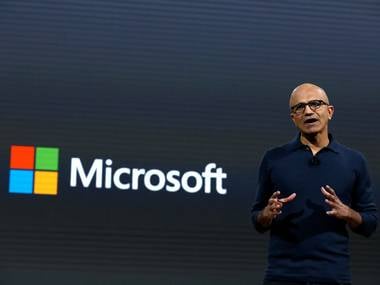 Microsoft CEO Satya Narayana Nadella speaks at a live Microsoft event. Reuters[/caption]The SDK will bring full-flight control and real-time data transfer capabilities to over 700 million Windows 10 active devices globally, it was announced during the jam-packed Build 2018 conference here on 7 May, attended by over 6,000 developers."The era of the Intelligent Cloud and Intelligent Edge is upon us. These advancements create incredible developer opportunity and also come with a responsibility to ensure the technology we build is trusted and benefits all," Microsoft CEO Satya Nadella told the gathering.DJI and Microsoft will co-develop solutions leveraging Azure IoT Edge and Microsoft's Artificial Intelligence (AI) services to enable new scenarios across agriculture, construction, public safety and more.DJI also selected Microsoft Azure as a preferred Cloud provider to improve their commercial drone and Software-As-A-Service (SaaS) solutions. Microsoft also announced a joint effort with chip-maker Qualcomm Technologies to create a vision AI developer kit running the Azure IoT Edge platform.Developers can create solutions that use Azure Machine Learning (ML) services and take advantage of the hardware acceleration available via the Qualcomm "Vision Intelligence Platform" and Qualcomm "AI Engine", the tech giant announced.Microsoft called on the thriving developers' community to build AI, Cloud and Internet of Things (IoT) experiences while embracing Microsoft 365 platform. Microsoft 365 brings together Office 365, Windows 10, and Enterprise Mobility+Security (EMS), delivering a complete and secure solution to empower employees."Microsoft 365 is where the world gets its best work done. With 135 million commercial monthly active users of Office 365 and nearly 700 million Windows 10 connected devices, Microsoft 365 helps developers reach people how and where they work," said Joe Belfiore, Corporate Vice President, Microsoft.Smart devices are proliferating, with more than 20 billion connected devices expected by 2020 globally. To leverage this opportunity, the tech giant announced to open source its "Azure IOT Edge Runtime", allowing customers to modify, debug and have more transparency and control for edge applications.The company unveiled "Project Kinect for Azure", a package of sensors, including a next-generation depth camera with onboard compute designed for AI on the "Edge". 'Project Kinect for Azure' empowers new scenarios for developers working with ambient intelligence to dramatically improve insights and operations.The company also announced, 'Speech Devices SDK' that delivers better audio processing from multi-channel sources for more accurate speech recognition, including noise cancellation, far-field voice and more.With this, developers can build a variety of voice-enabled scenarios like drive-through ordering systems, in-car or in-home assistants, smart speakers, and other digital assistants. The company demonstrated Mixed Reality (MR) capabilities to enable richer experiences that understand the context surrounding people.
First Published:May 08, 2018, 11:28:40 IST
Advertisement
Advertisement

Why AI notetakers are raising serious privacy and security concerns
AI notetakers promise effortless meeting summaries, but experts warn they could expose confidential conversations, corporate secrets and personal voiceprints. As businesses increasingly adopt AI-powered meeting assistants, questions over data storage, privacy, consent and legal risks are becoming impossible to ignore
5 min read
China's low-cost AI models are changing the global AI race. Here's why Silicon Valley is worried
As Chinese firms continue to improve performance while keeping prices low, the AI race is no longer just about building the smartest model—it is increasingly becoming a battle over who can deliver the best value
2 min read
China's Kimi K3 challenges US AI leaders with frontier-level performance at lower cost
Chinese artificial intelligence startup Moonshot AI has unveiled its latest open-weight AI model, Kimi K3, with early results suggesting it could compete with some of the world's most advanced AI systems developed by leading US companies
2 min read
How did Instagram run ads promoting child abuse in India?
India has issued a notice to Meta after an investigation alleged that Instagram displayed paid advertisements promoting child sexual abuse material. MeitY ordered Meta to remove such Instagram ads and explain within seven days how they were approved
8 min read
Why has India halted WhatsApp’s username feature before launch?
India has halted WhatsApp’s planned username feature, citing concerns about cybercrime, impersonation, and law enforcement challenges. As Meta races to address security concerns, here’s why MeitY has paused the rollout, what the feature does, and how it could influence privacy and online safety in India
3 min read
Advertisement
Advertisement