
Advertisement


Sections
Lockheed Martin shares updates to its Mars Base Camp plan at the International Astronautical Congress
The Mars Base Camp will be built in a low gravity environment at the Deep Space Gateway, before making the hop to Mars.

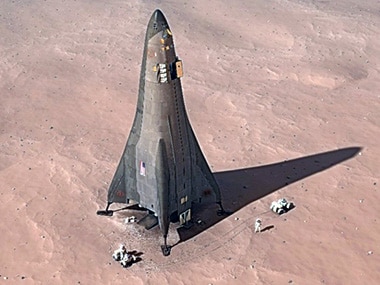
Lockheed Martin has revealed new details of its Mars Base Camp vision, a station in orbit around Mars that will allow scientists to conduct experiments. The details were revealed at the International Astronautical Congress (IAC) in Adelaide, Australia. The Mars Base Camp is a human outpost on the Red Planet, and is aligned with NASA's Deep Space Gateway in orbit around the Moon. The Deep Space gateway will act as a staging area for missions into the outer solar system, as well as provide valuable experience to spacefarers for staying in space for extended periods.[caption id="attachment_4099529" align="alignleft" width="380"]![The reusable Mars lander. Image: Lockheed Martin]() The reusable Mars lander. Image: Lockheed Martin[/caption]Lisa Callahan, vice president and general manager of Commercial Civil Space at Lockheed Martin says, "Sending humans to Mars has always been a part of science fiction, but today we have the capability to make it a reality. Partnered with NASA, our vision leverages hardware currently in development and production. We're proud to have Orion powered-on and completing testing in preparation for its Exploration Mission-1 flight and eventually its journey to Mars."The Mars Base Camp mission hopes to send humans to Mars in about a decade. The Mars Base Camp will be built in a low gravity environment at the Deep Space Gateway, before making the hop to Mars, a three year journey. Once in orbit, a re-usable landing craft will fuel up at the base camp, land on Mars carrying up to four humans at a time, and then take off from the Martian surface, back to the Base Camp. Once docked with the orbiting station, the landing craft can be re-fueled for further missions to the surface of the Red planet.The Base Camp has been designed with redundancy in mind in case something goes wrong, and there are two copies of almost all the components. The spacecraft is powered by electricity generated by four large circular solar arrays. Liquid oxygen and liquid hydrogen is used for the propulsion system, stored in two tank farms. The ride home after the mission will be provided by the Orion spacecraft, which is integrated into the Base Camp. A video released by Lockheed Martin is embedded below:
The reusable Mars lander. Image: Lockheed Martin[/caption]Lisa Callahan, vice president and general manager of Commercial Civil Space at Lockheed Martin says, "Sending humans to Mars has always been a part of science fiction, but today we have the capability to make it a reality. Partnered with NASA, our vision leverages hardware currently in development and production. We're proud to have Orion powered-on and completing testing in preparation for its Exploration Mission-1 flight and eventually its journey to Mars."The Mars Base Camp mission hopes to send humans to Mars in about a decade. The Mars Base Camp will be built in a low gravity environment at the Deep Space Gateway, before making the hop to Mars, a three year journey. Once in orbit, a re-usable landing craft will fuel up at the base camp, land on Mars carrying up to four humans at a time, and then take off from the Martian surface, back to the Base Camp. Once docked with the orbiting station, the landing craft can be re-fueled for further missions to the surface of the Red planet.The Base Camp has been designed with redundancy in mind in case something goes wrong, and there are two copies of almost all the components. The spacecraft is powered by electricity generated by four large circular solar arrays. Liquid oxygen and liquid hydrogen is used for the propulsion system, stored in two tank farms. The ride home after the mission will be provided by the Orion spacecraft, which is integrated into the Base Camp. A video released by Lockheed Martin is embedded below:
 The reusable Mars lander. Image: Lockheed Martin[/caption]Lisa Callahan, vice president and general manager of Commercial Civil Space at Lockheed Martin says, "Sending humans to Mars has always been a part of science fiction, but today we have the capability to make it a reality. Partnered with NASA, our vision leverages hardware currently in development and production. We're proud to have Orion powered-on and completing testing in preparation for its Exploration Mission-1 flight and eventually its journey to Mars."The Mars Base Camp mission hopes to send humans to Mars in about a decade. The Mars Base Camp will be built in a low gravity environment at the Deep Space Gateway, before making the hop to Mars, a three year journey. Once in orbit, a re-usable landing craft will fuel up at the base camp, land on Mars carrying up to four humans at a time, and then take off from the Martian surface, back to the Base Camp. Once docked with the orbiting station, the landing craft can be re-fueled for further missions to the surface of the Red planet.The Base Camp has been designed with redundancy in mind in case something goes wrong, and there are two copies of almost all the components. The spacecraft is powered by electricity generated by four large circular solar arrays. Liquid oxygen and liquid hydrogen is used for the propulsion system, stored in two tank farms. The ride home after the mission will be provided by the Orion spacecraft, which is integrated into the Base Camp. A video released by Lockheed Martin is embedded below:
First Published:Oct 01, 2017, 14:03:35 IST
Advertisement
Advertisement

Why AI notetakers are raising serious privacy and security concerns
AI notetakers promise effortless meeting summaries, but experts warn they could expose confidential conversations, corporate secrets and personal voiceprints. As businesses increasingly adopt AI-powered meeting assistants, questions over data storage, privacy, consent and legal risks are becoming impossible to ignore
5 min read
China's low-cost AI models are changing the global AI race. Here's why Silicon Valley is worried
As Chinese firms continue to improve performance while keeping prices low, the AI race is no longer just about building the smartest model—it is increasingly becoming a battle over who can deliver the best value
2 min read
China's Kimi K3 challenges US AI leaders with frontier-level performance at lower cost
Chinese artificial intelligence startup Moonshot AI has unveiled its latest open-weight AI model, Kimi K3, with early results suggesting it could compete with some of the world's most advanced AI systems developed by leading US companies
2 min read
How did Instagram run ads promoting child abuse in India?
India has issued a notice to Meta after an investigation alleged that Instagram displayed paid advertisements promoting child sexual abuse material. MeitY ordered Meta to remove such Instagram ads and explain within seven days how they were approved
8 min read
Why has India halted WhatsApp’s username feature before launch?
India has halted WhatsApp’s planned username feature, citing concerns about cybercrime, impersonation, and law enforcement challenges. As Meta races to address security concerns, here’s why MeitY has paused the rollout, what the feature does, and how it could influence privacy and online safety in India
3 min read
Advertisement
Advertisement