


Japan's Hayabusa2 to drop an explosive on an asteroid to study its history
Hayabusa2 is scheduled to leave the asteroid at the end of 2019 and bring underground samples.

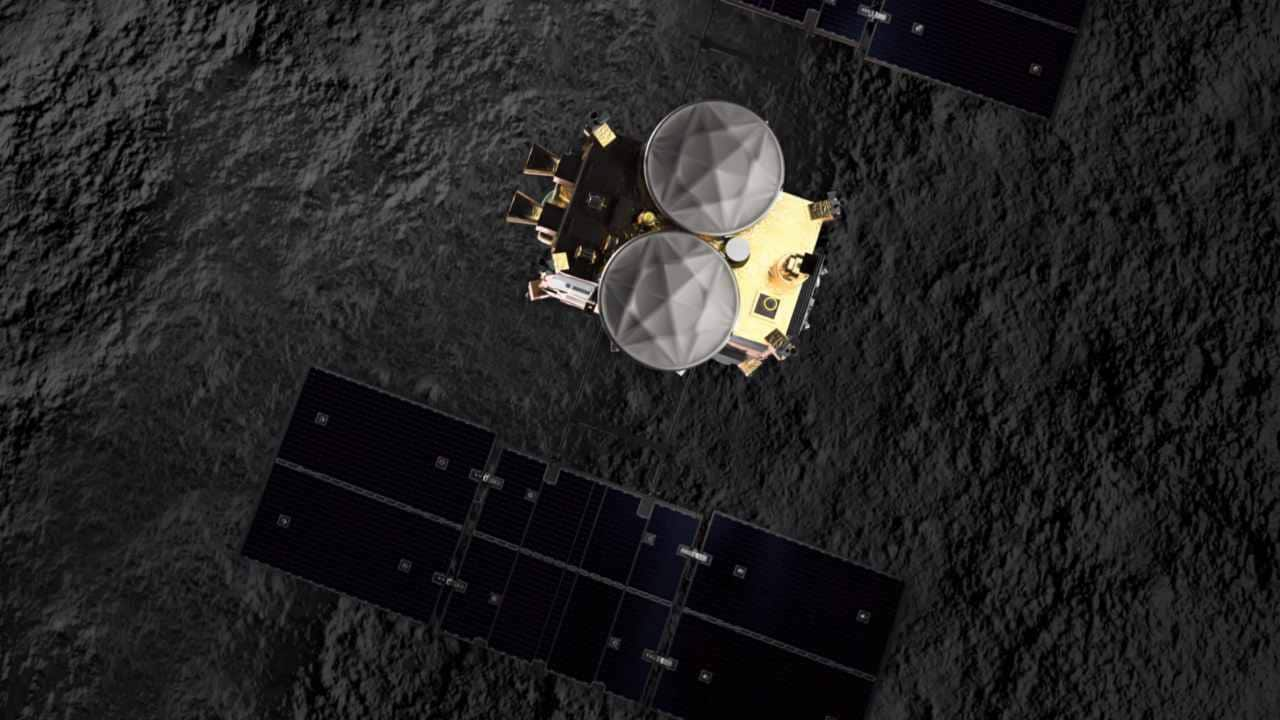
Representational image of Hayabusa-2 attempting to touchdown on Ryugu. DLR[/caption]While moving away, Hayabusa2 will leave a camera to capture the outcome. The spacecraft is to wait a few weeks before returning to the area above the crater for observations.The mission will allow JAXA scientists to analyze details of the crater to determine the history of the asteroid, said Koji Wada, who is in charge of the project.A day before the mission, Hayabusa2 will start descending to the asteroid from its home position of 20 kilometres (12 miles) away. It will drop a cone-shaped piece of equipment containing explosives that will blast off a copper plate on its bottom. That will turn into a ball and slam into the asteroid at 2 kilometres (1.2 miles) per second.JAXA projects it will create a crater of up to 10 meters (32 feet) in diameter with a depth of 1 meter (3.3 feet) if the underground structure is soft. A crater created on a rock-like structure would be smaller.During its February touchdown, Hayabusa2 extended a sampler pipe and shot a pinball-like bullet into the asteroid surface to collect dust and tiny fragments.JAXA plans to have Hayabusa2 briefly land in the crater, but agency researcher Takashi Kubota said they may prioritize safety for the spacecraft and not do so. If it is successful, it would be the first time for a spacecraft to take materials from underground, Kubota said.Hayabusa2 is scheduled to leave the asteroid at the end of 2019 and bring surface fragments and underground samples back to Earth in late 2020 for analysis.In a 2005 “deep impact” mission to a comet, NASA observed fragments after blasting the surface but did not collect them.The asteroid, named Ryugu after an undersea palace in a Japanese folktale, is about 900 meters (3,000 feet) in diameter and about 300 million kilometres (180 million miles) from Earth.

Why AI notetakers are raising serious privacy and security concerns
China's low-cost AI models are changing the global AI race. Here's why Silicon Valley is worried
China's Kimi K3 challenges US AI leaders with frontier-level performance at lower cost
How did Instagram run ads promoting child abuse in India?
Why has India halted WhatsApp’s username feature before launch?