


ISRO develops algorithm to clear out haze from images captured by Earth observation satellites
The last CartoSat placed into orbit was a CartoSat 2 series satellite, one of the 31 satellites on board the PSLV-C38 mission launched on 23 June.

One of the many facilities of ISRO across the country, the Space Applications Centre in Ahmedabad has come up with an algorithm that clears the haze from images captured by Earth observation satellites such as the CartoSat series of satellites.[caption id="attachment_3987203" align="aligncenter" width="734"]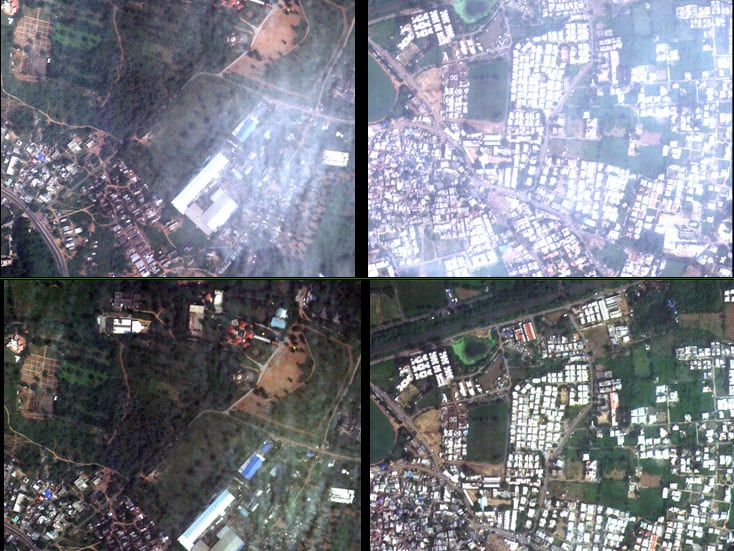 The haze removal algorithm at work. Image: ISRO.[/caption]Existing approaches requires simultaneous processing information from visible and short-wave infrared channels simultaneously, which was not possible with the visible and near-infrared range sensors used in the CartoSat series of satellites. The approach by ISRO uses the data captured by the visible and near-infrared range sensors and compares it to available datasets of the optical properties of aerosols, the particles that cause the haze. This information is used to remove the haze from images, providing clear images.ISRO explains the process as, "The algorithm uses lookup tables generated with vector radiative transfer calculations. Derived aerosol information and pre-computed lookup tables are employed to derive surface reflectance. Good quality surface reflectances have been obtained when this algorithm was applied on Cartosat-2 Series Satellite data."(Also Read: Spellbinding images captured by ISRO's Earth observation satellites, India's "eyes in the skies")The CartoSat series of satellites provide multi-spectral images in the visible and near-infrared range, with a resolution of a few meters to even sub-meter resolution images. The satellites allows the country to monitor changes on the surface of the Earth. The last CartoSat placed into orbit was a CartoSat 2 series satellite, one of the 31 satellites on board the PSLV-C38 mission launched on 23 June.The next launch by ISRO is scheduled on 31 August, where a PSLV will place into orbit the IRNSS-1H, a replacement satellite for a malfunctioning one in the Indian NavIC constellation for navigational purposes.

Why AI notetakers are raising serious privacy and security concerns
China's low-cost AI models are changing the global AI race. Here's why Silicon Valley is worried
China's Kimi K3 challenges US AI leaders with frontier-level performance at lower cost
How did Instagram run ads promoting child abuse in India?
Why has India halted WhatsApp’s username feature before launch?