


Intel shrinks its chips as transistors go 3D
After 3D movies, 3D TV, 3D printing, it is now time for 3D transistors.

The chipmaker says it was needed to continue Moore's Law, but more importantly, it was needed to get Intel its competitive edge back.
After 3D movies, 3D TV, 3D printing, it's now time for 3D transistors. Ushering in a historic moment for the microprocessor technology -- that still follows Moore's Law of packing more computing power in silicon almost every 24 months -- Intel said on May 4/5 (depending on which side of the Atlantic you live) it has introduced a fundamental change in the chip design, a 3D transistor.
[caption id="attachment_4527" align="alignleft" width="380" caption="Tech traffic: Intel-3D."]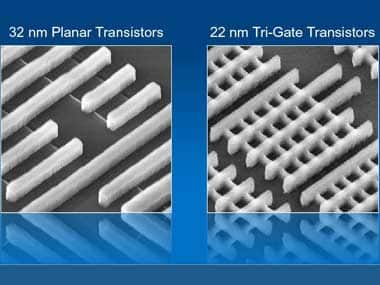 [/caption]
A transistor is the most basic building block of a chip and this 3D one allows Intel's microprocessors to not only shrink in size but offer better performance and much reduced power consumption. In fact, moving from 32 nm planar chips to 22 nm 3D chips, the power saving is as much as 50%.
 More from News Analysis
It's terrific news for electronics equipment makers who strive to satisfy consumer preference for long-lasting batteries, especially in mobile devices. Intel's new chips, 22 nanometer (nm), with 3D tri-gate transistors will start rolling out by the end of the year and you will find them in desktops, notebooks, tablets and smart phones sometime next year.
A research that started in 2002 will culminate in a product mid 2012 -- a decadal progress it might seem but the chipmaker has consistently shrunk its chip size - from 90 nm in 2003 to 22 nm in 2011, with changes in materials, and now in structures.
Apart from consumer electronics, one of the biggest beneficiaries would be cloud servers in data centers where the struggle for power saving and cooling is perpetual. In fact, often times data centers are located near rivers to provide sufficient cooling. Even designed in a way, as Yahoo CEO Carol Bartz once said, that data centers in places like New York (which experience winter for a good part of the year) depend on the icy winter breeze to get natural cooling and save power.
What does Tri-Gate mean for the industry? Does AMD have a similar technology in pipeline? If not, then it's not good news. Competition is always healthy. And we needn't look further than the chip industry for examples.
In the teleconference today, we didn't get a sense of what Intel's strategy is in getting this design to its popular Atom architecture or whether it'll license it to other companies.
Whatever its market strategy may be, 3D transistors show once again that the microprocessor lead that Gordon Moore gave Intel 42 years ago remains unbeaten even today!
From her perch in Bangalore as a Senior Editor at Forbes India, Seema usually writes about science and technology. She believes that while we may have settled into consuming the nicely packaged final products of science -- technology being a hand maiden of science -- we are distancing ourselves from all the effort that goes into it. This blog is an attempt to bring an occasional peek into those efforts and ideas.

Why AI notetakers are raising serious privacy and security concerns
China's low-cost AI models are changing the global AI race. Here's why Silicon Valley is worried
China's Kimi K3 challenges US AI leaders with frontier-level performance at lower cost
How did Instagram run ads promoting child abuse in India?
Why has India halted WhatsApp’s username feature before launch?