
Advertisement


Sections
How could a semi-autonomous Tesla Model S not see a massive, red fire truck that was just sitting across the road?
Most radar implementations take advantage of the doppler shift to only detect objects that are moving. Stationary objects — like a fire-engine — are ignored

On 22 January, a Tesla Model S slammed into the back of a stationary fire truck at over 65 mph (around 104 kph). While it’s certainly thankful that nobody was injured, it’s scary that a vehicle that’s labelled as “semi-autonomous” can’t see a big, red fire engine just parked across a highway.[caption id="attachment_4321353" align="alignleft" width="380"]![A Tesla Model 3 ploughed into the back of a stationary fire truck. Image: twitter/@CC_Firefighters]() A Tesla Model S ploughed into the back of a stationary fire truck. Image: Twitter/@CC_Firefighters[/caption]What’s even more scary is the fact that this behaviour isn’t unusual. Most purportedly “self-driving” capable vehicles will make the same mistake, and quite often at that.Vehicles claiming to be semi-autonomous today are largely using radar-based technology for scanning the surroundings and detecting obstacles. For radar to work, a pre-configured radio pulse is sent out via an antenna. These radio waves will bounce off obstacles and get reflected, and a tuned antenna will pick up the reflections. The reflections are processed by an onboard computer and a map of the surroundings is created from the data.This sounds amazing, and it is, but the biggest problem with radar is that everything will reflect the radio waves and the signal will echo. If you’ve ever tried shouting in a large cave, say, you’ll know how hard it is to determine the source of the sound. That’s exactly what happens when a radar detects an echo. Since the radar doesn’t “see” the world and only interprets incoming radio signals, it’s not very good at understanding the world around it.One solution for this problem, which automakers have adopted, is to filter out the reflections from stationary objects. Automotive radar of the type used in Tesla vehicles looks for something called doppler-shifted signals.[caption id="attachment_4321335" align="alignnone" width="465"]
A Tesla Model S ploughed into the back of a stationary fire truck. Image: Twitter/@CC_Firefighters[/caption]What’s even more scary is the fact that this behaviour isn’t unusual. Most purportedly “self-driving” capable vehicles will make the same mistake, and quite often at that.Vehicles claiming to be semi-autonomous today are largely using radar-based technology for scanning the surroundings and detecting obstacles. For radar to work, a pre-configured radio pulse is sent out via an antenna. These radio waves will bounce off obstacles and get reflected, and a tuned antenna will pick up the reflections. The reflections are processed by an onboard computer and a map of the surroundings is created from the data.This sounds amazing, and it is, but the biggest problem with radar is that everything will reflect the radio waves and the signal will echo. If you’ve ever tried shouting in a large cave, say, you’ll know how hard it is to determine the source of the sound. That’s exactly what happens when a radar detects an echo. Since the radar doesn’t “see” the world and only interprets incoming radio signals, it’s not very good at understanding the world around it.One solution for this problem, which automakers have adopted, is to filter out the reflections from stationary objects. Automotive radar of the type used in Tesla vehicles looks for something called doppler-shifted signals.[caption id="attachment_4321335" align="alignnone" width="465"]![Doppler-shifted radar]() Doppler-shifted radar tracking[/caption]Imagine you’re at a train station. A train is coming to you at high speed with its horn at full blast. In this case, the horn sounds much stronger and maybe shriller because the sound is getting compressed. As it moves away from you, the note of the horn is much lower and continues to reduce as the train recedes into the distance. In this case, the pressure wave of the sound is expanding. This is the doppler effect.Most radar implementations take advantage of the doppler shift to only detect objects that are moving. Stationary objects — like a fire-engine — are ignored. This technique eases the workload on the processor but could also result in accidents like the one that occurred on 22 January. This is not a new issue and engineers have been struggling with it since World War II, when radar was first implemented. Even America’s most effective fighter plane, the F-15 Eagle, struggled with the issue.[caption id="attachment_4321337" align="alignnone" width="800"]
Doppler-shifted radar tracking[/caption]Imagine you’re at a train station. A train is coming to you at high speed with its horn at full blast. In this case, the horn sounds much stronger and maybe shriller because the sound is getting compressed. As it moves away from you, the note of the horn is much lower and continues to reduce as the train recedes into the distance. In this case, the pressure wave of the sound is expanding. This is the doppler effect.Most radar implementations take advantage of the doppler shift to only detect objects that are moving. Stationary objects — like a fire-engine — are ignored. This technique eases the workload on the processor but could also result in accidents like the one that occurred on 22 January. This is not a new issue and engineers have been struggling with it since World War II, when radar was first implemented. Even America’s most effective fighter plane, the F-15 Eagle, struggled with the issue.[caption id="attachment_4321337" align="alignnone" width="800"]![The doppler effect]() The doppler effect[/caption]Speaking to experts, Wired has reported that this is indeed the most likely explanation for the crash. To the radar, the truck was invisible. The report also indicates that LiDAR — a mechanism that uses light the same way radar uses radio waves — to map the environment. This technique is far more reliable than radar and isn’t as easily blinded by “echoes”. Google’s self-driving car project uses LiDAR for exactly this reason. Unfortunately, Wired reports that LiDAR is still too expensive and the hardware too unreliable to implement at scale.The Tesla Model S uses one camera that's used primarily for lane-detection and determining the speed limit, a GPS unit that assists in this and a dozen or so ultrasonic sensors for parking assistance. The only unit that's looking at the road and monitoring traffic is a radar mounted in the nose. That's it. A radar that can, in all likelihood, only track moving objects. If a vehicle in front of you were to pull out, your vehicle will, in all likelihood, speed up.Clearly, it is absolutely ESSENTIAL for the driver behind the to remain alert. As usual, the bigger problem right now isn’t that the technology is still too crippled, it’s that the messaging around “self-driving” and “autonomous” vehicles is very misleading.Yes, the technology is amazing and yes, it will save — and probably has saved — a lot of lives. However, it’s also far from perfect. People have been misusing Tesla’s semi-autonomous features from day one, and that’s not going to change any time soon.When developing its own self-driving cars, Google discovered that humans can’t be trusted to handle semi-autonomous cars. “Human drivers can’t always be trusted to dip in and out of the task of driving when the car is encouraging them to sit back and relax”, said Google’s Chris Urmson in a Reuters interview.Another Wired report also highlights this fact, pointing out that many automakers, including Volvo — a company with a reputation for making some of the world’s safest cars — are moving on from semi-autonomous vehicles and focussing on fully autonomous ones.Humans either need to be completely attentive to the needs of the vehicle or completely left out of the picture. A semi-attentive state will simply not work. How attentive would you be to your semi-autonomous vehicle when you're busy playing Candy Crush on your phone?Semi-autonomous vehicles will inevitably lull its human cargo into a false sense of security. Sure, the vehicles will work fine 99 percent of the time, but that 1 percent of time they fail can be utterly disastrous.For some reason Tesla, and Elon Musk by extension, are simply refusing to accept this truth.
The doppler effect[/caption]Speaking to experts, Wired has reported that this is indeed the most likely explanation for the crash. To the radar, the truck was invisible. The report also indicates that LiDAR — a mechanism that uses light the same way radar uses radio waves — to map the environment. This technique is far more reliable than radar and isn’t as easily blinded by “echoes”. Google’s self-driving car project uses LiDAR for exactly this reason. Unfortunately, Wired reports that LiDAR is still too expensive and the hardware too unreliable to implement at scale.The Tesla Model S uses one camera that's used primarily for lane-detection and determining the speed limit, a GPS unit that assists in this and a dozen or so ultrasonic sensors for parking assistance. The only unit that's looking at the road and monitoring traffic is a radar mounted in the nose. That's it. A radar that can, in all likelihood, only track moving objects. If a vehicle in front of you were to pull out, your vehicle will, in all likelihood, speed up.Clearly, it is absolutely ESSENTIAL for the driver behind the to remain alert. As usual, the bigger problem right now isn’t that the technology is still too crippled, it’s that the messaging around “self-driving” and “autonomous” vehicles is very misleading.Yes, the technology is amazing and yes, it will save — and probably has saved — a lot of lives. However, it’s also far from perfect. People have been misusing Tesla’s semi-autonomous features from day one, and that’s not going to change any time soon.When developing its own self-driving cars, Google discovered that humans can’t be trusted to handle semi-autonomous cars. “Human drivers can’t always be trusted to dip in and out of the task of driving when the car is encouraging them to sit back and relax”, said Google’s Chris Urmson in a Reuters interview.Another Wired report also highlights this fact, pointing out that many automakers, including Volvo — a company with a reputation for making some of the world’s safest cars — are moving on from semi-autonomous vehicles and focussing on fully autonomous ones.Humans either need to be completely attentive to the needs of the vehicle or completely left out of the picture. A semi-attentive state will simply not work. How attentive would you be to your semi-autonomous vehicle when you're busy playing Candy Crush on your phone?Semi-autonomous vehicles will inevitably lull its human cargo into a false sense of security. Sure, the vehicles will work fine 99 percent of the time, but that 1 percent of time they fail can be utterly disastrous.For some reason Tesla, and Elon Musk by extension, are simply refusing to accept this truth.
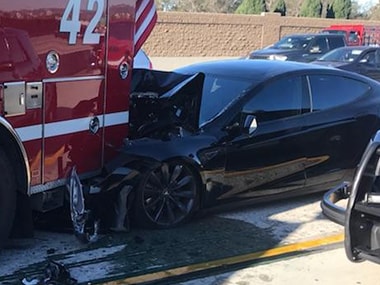 A Tesla Model S ploughed into the back of a stationary fire truck. Image: Twitter/@CC_Firefighters[/caption]What’s even more scary is the fact that this behaviour isn’t unusual. Most purportedly “self-driving” capable vehicles will make the same mistake, and quite often at that.Vehicles claiming to be semi-autonomous today are largely using radar-based technology for scanning the surroundings and detecting obstacles. For radar to work, a pre-configured radio pulse is sent out via an antenna. These radio waves will bounce off obstacles and get reflected, and a tuned antenna will pick up the reflections. The reflections are processed by an onboard computer and a map of the surroundings is created from the data.This sounds amazing, and it is, but the biggest problem with radar is that everything will reflect the radio waves and the signal will echo. If you’ve ever tried shouting in a large cave, say, you’ll know how hard it is to determine the source of the sound. That’s exactly what happens when a radar detects an echo. Since the radar doesn’t “see” the world and only interprets incoming radio signals, it’s not very good at understanding the world around it.One solution for this problem, which automakers have adopted, is to filter out the reflections from stationary objects. Automotive radar of the type used in Tesla vehicles looks for something called doppler-shifted signals.[caption id="attachment_4321335" align="alignnone" width="465"]
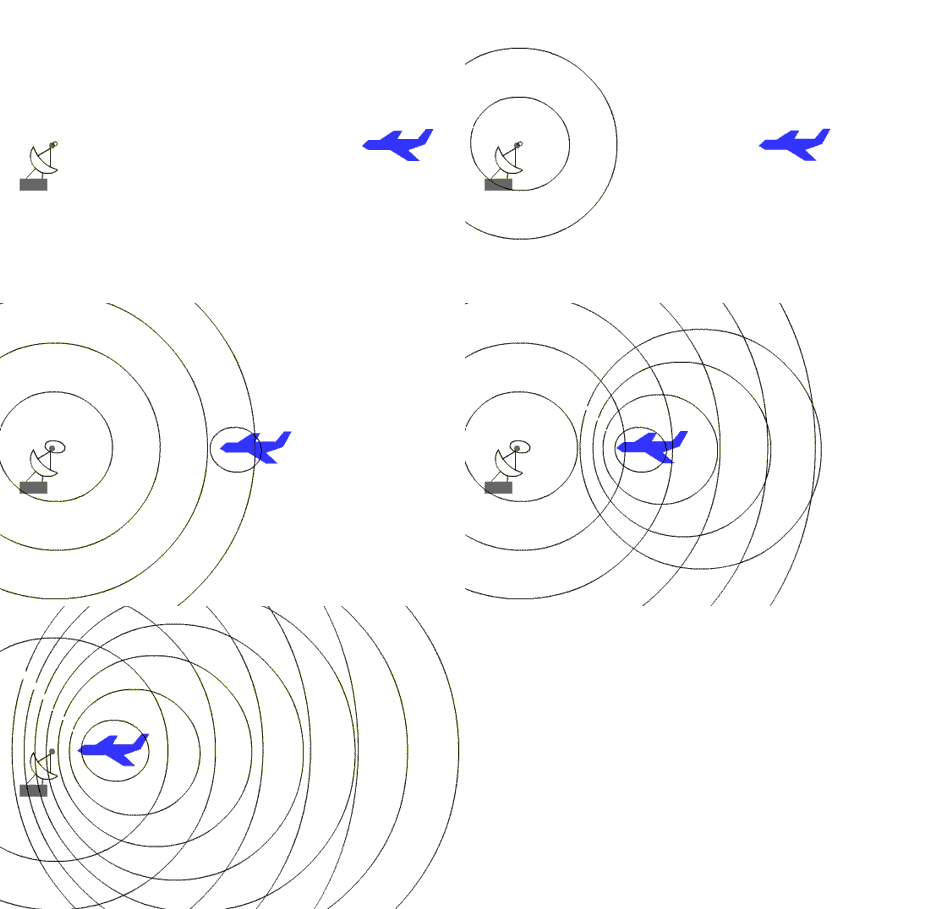 Doppler-shifted radar tracking[/caption]Imagine you’re at a train station. A train is coming to you at high speed with its horn at full blast. In this case, the horn sounds much stronger and maybe shriller because the sound is getting compressed. As it moves away from you, the note of the horn is much lower and continues to reduce as the train recedes into the distance. In this case, the pressure wave of the sound is expanding. This is the doppler effect.Most radar implementations take advantage of the doppler shift to only detect objects that are moving. Stationary objects — like a fire-engine — are ignored. This technique eases the workload on the processor but could also result in accidents like the one that occurred on 22 January. This is not a new issue and engineers have been struggling with it since World War II, when radar was first implemented. Even America’s most effective fighter plane, the F-15 Eagle, struggled with the issue.[caption id="attachment_4321337" align="alignnone" width="800"]
 The doppler effect[/caption]Speaking to experts, Wired has reported that this is indeed the most likely explanation for the crash. To the radar, the truck was invisible. The report also indicates that LiDAR — a mechanism that uses light the same way radar uses radio waves — to map the environment. This technique is far more reliable than radar and isn’t as easily blinded by “echoes”. Google’s self-driving car project uses LiDAR for exactly this reason. Unfortunately, Wired reports that LiDAR is still too expensive and the hardware too unreliable to implement at scale.The Tesla Model S uses one camera that's used primarily for lane-detection and determining the speed limit, a GPS unit that assists in this and a dozen or so ultrasonic sensors for parking assistance. The only unit that's looking at the road and monitoring traffic is a radar mounted in the nose. That's it. A radar that can, in all likelihood, only track moving objects. If a vehicle in front of you were to pull out, your vehicle will, in all likelihood, speed up.Clearly, it is absolutely ESSENTIAL for the driver behind the to remain alert. As usual, the bigger problem right now isn’t that the technology is still too crippled, it’s that the messaging around “self-driving” and “autonomous” vehicles is very misleading.Yes, the technology is amazing and yes, it will save — and probably has saved — a lot of lives. However, it’s also far from perfect. People have been misusing Tesla’s semi-autonomous features from day one, and that’s not going to change any time soon.When developing its own self-driving cars, Google discovered that humans can’t be trusted to handle semi-autonomous cars. “Human drivers can’t always be trusted to dip in and out of the task of driving when the car is encouraging them to sit back and relax”, said Google’s Chris Urmson in a Reuters interview.Another Wired report also highlights this fact, pointing out that many automakers, including Volvo — a company with a reputation for making some of the world’s safest cars — are moving on from semi-autonomous vehicles and focussing on fully autonomous ones.Humans either need to be completely attentive to the needs of the vehicle or completely left out of the picture. A semi-attentive state will simply not work. How attentive would you be to your semi-autonomous vehicle when you're busy playing Candy Crush on your phone?Semi-autonomous vehicles will inevitably lull its human cargo into a false sense of security. Sure, the vehicles will work fine 99 percent of the time, but that 1 percent of time they fail can be utterly disastrous.For some reason Tesla, and Elon Musk by extension, are simply refusing to accept this truth.
First Published:Jan 26, 2018, 17:02:29 IST
Advertisement
Advertisement

Why AI notetakers are raising serious privacy and security concerns
AI notetakers promise effortless meeting summaries, but experts warn they could expose confidential conversations, corporate secrets and personal voiceprints. As businesses increasingly adopt AI-powered meeting assistants, questions over data storage, privacy, consent and legal risks are becoming impossible to ignore
5 min read
China's low-cost AI models are changing the global AI race. Here's why Silicon Valley is worried
As Chinese firms continue to improve performance while keeping prices low, the AI race is no longer just about building the smartest model—it is increasingly becoming a battle over who can deliver the best value
2 min read
China's Kimi K3 challenges US AI leaders with frontier-level performance at lower cost
Chinese artificial intelligence startup Moonshot AI has unveiled its latest open-weight AI model, Kimi K3, with early results suggesting it could compete with some of the world's most advanced AI systems developed by leading US companies
2 min read
How did Instagram run ads promoting child abuse in India?
India has issued a notice to Meta after an investigation alleged that Instagram displayed paid advertisements promoting child sexual abuse material. MeitY ordered Meta to remove such Instagram ads and explain within seven days how they were approved
8 min read
Why has India halted WhatsApp’s username feature before launch?
India has halted WhatsApp’s planned username feature, citing concerns about cybercrime, impersonation, and law enforcement challenges. As Meta races to address security concerns, here’s why MeitY has paused the rollout, what the feature does, and how it could influence privacy and online safety in India
3 min read
Advertisement
Advertisement