


Have scientists found a new spiral galaxy using the Hubble telescope?
The galaxy ESO 499-G37 lies in the southern border of the constellation of Hydra, which is shared with Antlia, NASA said.

Washington: Astronomers claim to have spotted a new loose spiral galaxy filled with gas and dust, using the NASA/ESA Hubble Space Telescope.
The galaxy ESO 499-G37 lies in the southern border of the constellation of Hydra, which is shared with Antlia, NASA said in a statement.
[caption id="attachment_536006" align="alignleft" width="380"]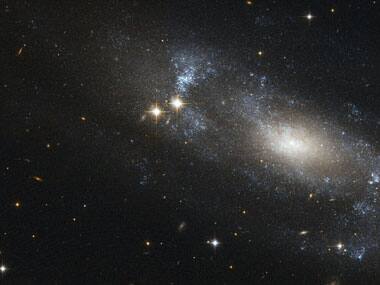 One feature common to many spiral galaxies is the presence of a bar running across the centre. Reuters[/caption]
The arms of a spiral galaxy have large amounts of gas and dust, and are often areas where new stars are constantly forming.
The galaxy's most characteristic feature is a bright elongated nucleus. The bulging central core usually contains the highest density of stars in the galaxy, where typically a large group of comparatively cool old stars are packed in this compact, spheroidal region.
One feature common to many spiral galaxies is the presence of a bar running across the centre of the galaxy. These bars are thought to act as a mechanism that channels gas from the spiral arms to the center, enhancing the star formation.
 More from News Analysis
Recent studies suggest that ESO 499-G37's nucleus sits within a small bar up to a few hundreds of light-years along, about a tenth the size of a typical galactic bar.
Astronomers think that such small bars could be important in the formation of galactic bulges since they might provide a mechanism for bringing material from the outer regions down to the inner ones.
However, the connection between bars and bulge formation is still not clear since bars are not a universal feature in spiral galaxies.
This was a joint project undertaken by the European Southern Observatory (ESO) and the Uppsala Observatory, which used the ESO 1-metre Schmidt telescope at La Silla Observatory, Chile, to map a large portion of the southern sky looking for stars, galaxies, clusters, and planetary nebulae.
The galaxy was imaged using visible and infrared exposures taken with the Wide Field Channel of the Advanced Camera for Surveys. The field of view is approximately 3.4 arcminutes wide.
PTI

Why AI notetakers are raising serious privacy and security concerns
China's low-cost AI models are changing the global AI race. Here's why Silicon Valley is worried
China's Kimi K3 challenges US AI leaders with frontier-level performance at lower cost
How did Instagram run ads promoting child abuse in India?
Why has India halted WhatsApp’s username feature before launch?