
Advertisement


Sections
Google now lets Android phones serve as a physical security key for logging in
The advantage of a physical security key is that they’re less vulnerable to spoofing.

Most of us are familiar with what Google's two-step authentication feature is all about, only that we don't really use it. That's mostly because of how inconvenient it is to wait for an OTP every time you need to log into a Google app.Google is just made the switch to two-factor authentication (which is far more secure) much simpler.The tech giant has just announced that one can now use an Android smartphone as a physical security key, offering you a more convenient way to log into Google apps with the security of two-factor authentication.[caption id="attachment_6427931" align="alignnone" width="1024"]![Your Android phone is your new yubikey. Image: Google]() As of now, the service is only available on Android phones, and it works only for logins to Google services, not to third-party sites. Other browsers besides Chrome could gain support in the future, but we'll have to wait for that to happen.
As of now, the service is only available on Android phones, and it works only for logins to Google services, not to third-party sites. Other browsers besides Chrome could gain support in the future, but we'll have to wait for that to happen.
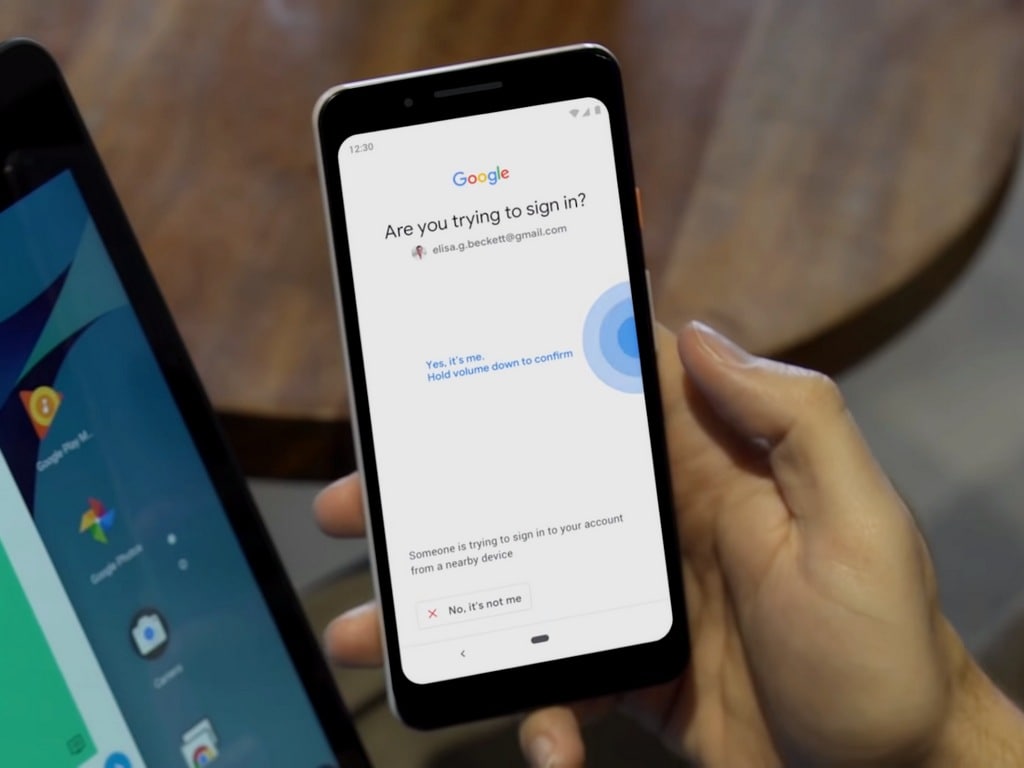
Your Android phone is your new yubikey. Image: Google[/caption]Using the feature for 2FA is fairly simple. All you'll have to do is connect your phone over Bluetooth to a Chrome browser and verify your logins. The only prerequisite here is that your phone has to run on Android Nougat 7.0 at the least.Announcing the feature at its Cloud Next conference, Google mentioned that the feature includes the same WebAuthn and FIDO APIs, used in company's Titan Security Key.
Using 2FA, essentially means a hacker can’t use phishing to trick you into handing over your online credentials. Similarly, FIDO security keys — like the Titan Security Key — prevent your account from being phished by requiring you to plug in and tap your physical device. Google wants to bring those benefits to more people by having Android phones act as security keys.Here how you can start using your Android phone as a physical security key:
- Step 1 - Open Google Chrome on your Windows, ChromeOS or macOS device.
- Step 2 - sign in to your Google Account on an Android phone and turn on Bluetooth.
- Step 3 - Open myaccount.google.com/security in Chrome on your device and tap “two-step verification.”
- Step 4 - Select the option to add a security key, and choose your phone from the list of devices.
First Published:Apr 11, 2019, 10:54:47 IST
Advertisement
Advertisement

Why AI notetakers are raising serious privacy and security concerns
AI notetakers promise effortless meeting summaries, but experts warn they could expose confidential conversations, corporate secrets and personal voiceprints. As businesses increasingly adopt AI-powered meeting assistants, questions over data storage, privacy, consent and legal risks are becoming impossible to ignore
5 min read
China's low-cost AI models are changing the global AI race. Here's why Silicon Valley is worried
As Chinese firms continue to improve performance while keeping prices low, the AI race is no longer just about building the smartest model—it is increasingly becoming a battle over who can deliver the best value
2 min read
China's Kimi K3 challenges US AI leaders with frontier-level performance at lower cost
Chinese artificial intelligence startup Moonshot AI has unveiled its latest open-weight AI model, Kimi K3, with early results suggesting it could compete with some of the world's most advanced AI systems developed by leading US companies
2 min read
How did Instagram run ads promoting child abuse in India?
India has issued a notice to Meta after an investigation alleged that Instagram displayed paid advertisements promoting child sexual abuse material. MeitY ordered Meta to remove such Instagram ads and explain within seven days how they were approved
8 min read
Why has India halted WhatsApp’s username feature before launch?
India has halted WhatsApp’s planned username feature, citing concerns about cybercrime, impersonation, and law enforcement challenges. As Meta races to address security concerns, here’s why MeitY has paused the rollout, what the feature does, and how it could influence privacy and online safety in India
3 min read
Advertisement
Advertisement