


2019's first Solar Eclipse, Super Blood Wolf Moon: Here's when and how to watch
Neither of them will be fully visible from India, but there's no reason to miss out on the fun, eh?

Stargazers have had a parade of treats welcoming them into the new year with a meteor shower earlier this week, and two eclipses before January ends.Coming up on 6 January is a partial solar eclipse, with the sun and Moon falling into a partial alignment. Just a couple of weeks later, a lunar trifecta will bring us the only total lunar eclipse till 2021 – a Super Blood Wolf Moon, on 20 and 21 January.There are two of six eclipses this year, most of which aren't visible from India.Just so you don't miss either of these celestial sights, here's all you need to know about when and where to watch these events, and what to expect.
Partial solar eclipse on 6 January
When and where to watchOn 6 January, the year's first partial solar eclipse will take place.Starting in early hours around 5 am in the morning till 9 am, the eclipse will be visible to people in North-East Asia, China, parts of Siberia, Korea and Japan, but won't be visible from India.What to expectThe eclipse will be partial, as the alignment between the Sun and the Moon won't be exact. The result is a view of the Moon that covers the Sun only slightly.NASA has created an interactive path of the eclipse using Google Maps to track the trajectory of the eclipse. If you're lucky to be anywhere within the path of the eclipse on 6 January, don't forget to wear protective eyewear when you catch a glimpse of the action![caption id="attachment_5840281" align="alignnone" width="1280"]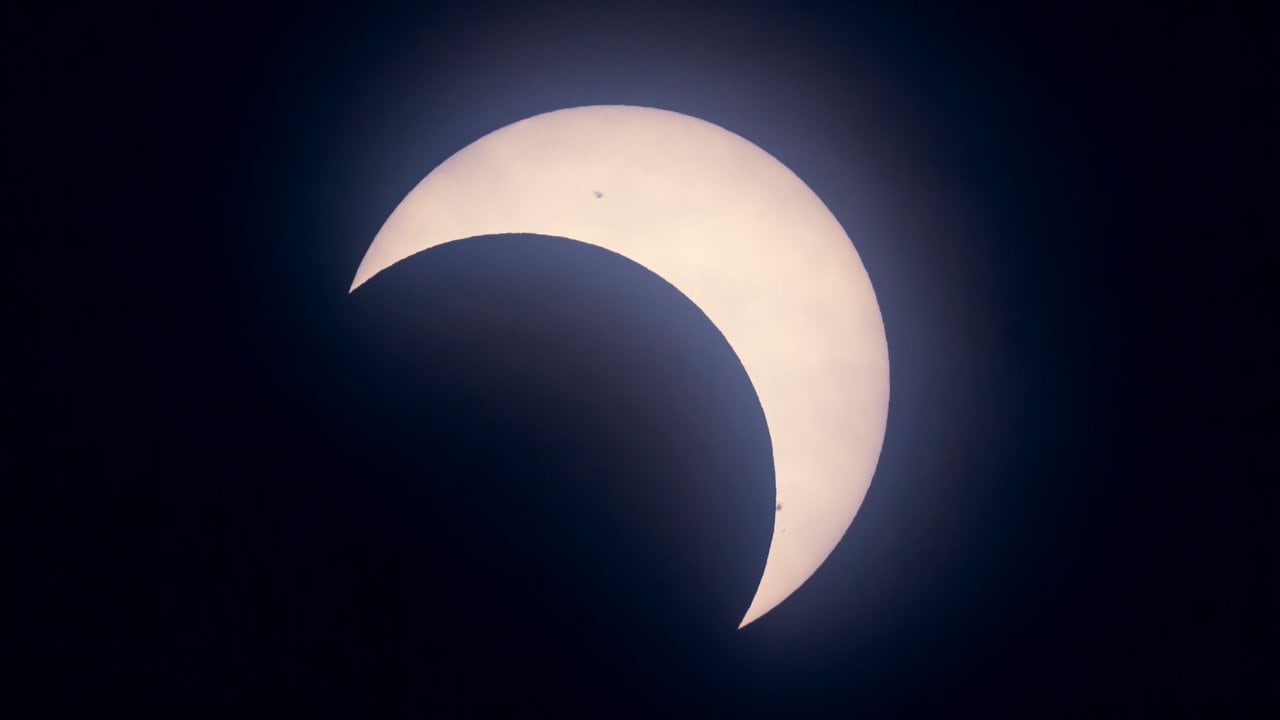
The partial solar eclipse as seen from Calgary, Alberta, on May 20, 2012, captured at maximum eclipse. Image: AmazingSky[/caption]How to view itWatching a solar eclipse can be harmful to the eyes without some safety equipment. Looking right at the Sun can cause permanent eye damage within seconds on any given day, and the eclipse is no different.Seeing the eclipse on an optical instrument through a screen – your mobile phones, televisions or camera screens are perfectly okay. Binoculars, camera viewfinders and telescopes, however, can end up causing instant and permanent blindness.The trust, old-school way to watch an eclipse safely is crafting a DIY solar eclipse viewer, like this one made out of a cereal box:
Super Blood Wolf Moon on 20 and 21 January
On the night of 20-21 January, a lunar trifecta will grace the skies, giving us a glimpse of what people are calling a 'Super Blood Wolf Moon'.The only total lunar eclipse in 2019, too, unfortunately, won't be directly visible to us in India, what with us not being in right half of the world to witness it.[caption id="attachment_5800001" align="alignnone" width="1280"]
What a super wolf blood moon looks like in progress.[/caption]
What is a Super Wolf Blood Moon eclipse?
- When our moon is at its furthest distance from Earth in its orbit and its "full" phase in the cycle, it is called a supermoon.
- Americans traditionally call a full moon that takes place in January, a 'full wolf moon' from early colonial times, according to The Old Farmer's Almanac.
- Any ‘blood moon’ is a colloquial reference to a total lunar eclipse.
When and where is the Super Wolf Blood Moon going to take place?
What happens in a Super Wolf Blood Moon?

Why AI notetakers are raising serious privacy and security concerns
China's low-cost AI models are changing the global AI race. Here's why Silicon Valley is worried
China's Kimi K3 challenges US AI leaders with frontier-level performance at lower cost
How did Instagram run ads promoting child abuse in India?
Why has India halted WhatsApp’s username feature before launch?