
Advertisement


Sections
Chinese phonemakers Xiaomi, Vivo and Oppo dominate shipments in Q1, says Counterpoint
Xiaomi faced fierce competition from Korean giants Samsung, which had about 23 percent market share.

Chinese smartphone makers are continuing to strengthen their grasp on the Indian smartphone market.The market share of Chinese brands has reached a record 66 percent during the first quarter of this year, according to the latest Counterpoint's Market Monitor research report.[caption id="attachment_6507831" align="alignnone" width="1024"]![The Xiaomi Redmi 7. Image: Omkar Patne]() The Xiaomi Redmi 7. Image: Omkar Patne[/caption]Driven by new product launches, Xiaomi remained at the top of the smartphone market share table with a 29 percent share, witnessing a decline of 2 percent in comparison to the same period last year. The Chinese brands grew 20 percent year-on-year (YoY) riding mainly on the growth of smartphones brands such as Vivo, Realme and Oppo. Vivo's volume grew 119 percent whereas Oppo witnessed a growth of 28 percent year on year.[caption id="attachment_6531341" align="alignnone" width="1280"]
The Xiaomi Redmi 7. Image: Omkar Patne[/caption]Driven by new product launches, Xiaomi remained at the top of the smartphone market share table with a 29 percent share, witnessing a decline of 2 percent in comparison to the same period last year. The Chinese brands grew 20 percent year-on-year (YoY) riding mainly on the growth of smartphones brands such as Vivo, Realme and Oppo. Vivo's volume grew 119 percent whereas Oppo witnessed a growth of 28 percent year on year.[caption id="attachment_6531341" align="alignnone" width="1280"]![Feature phone shipments in Q1 2019. Image: Counterpoint]() Feature phone shipments in Q1 2019. Image: Counterpoint[/caption]In the meantime, India's overall smartphone shipments grew 4 percent year-on-year, the report added.Talking about the reasons for the growth of Chinese brands, Associate Director of Counterpoint, Tarun Pathak said that data consumption is on the rise and users are upgrading their phones faster as compared to other regions. This has led to users spending more on their purchase which is driving up the overall average selling price (ASP) in the market.Pathak expects these trends to continue in the future in the mid-tier segment.Xiaomi Redmi 6A remained the top model followed by Xiaomi Note 6 Pro, Redmi Y2, Samsung Galaxy M20, and Galaxy A50. Chinese brand aggressive offline expansion and a strong focus on product build helped to retain its top position in the Indian smartphone market.Earlier in February, Xiaomi India Managing Director Manu Kumar Jain claimed that the Chinese smartphone maker is 54 percent bigger than the second brand.However, Xiaomi faced fierce competition from non-Chinese brand Samsung, which had about 23 percent market share. In the premium segment, Samsung surpassed OnePlus to become the number one player driven by the good response for its newly introduced Galaxy S10 series.In the feature phone segment, Reliance Jio remained the leader, followed by Samsung, with about 30 percent market share.
Feature phone shipments in Q1 2019. Image: Counterpoint[/caption]In the meantime, India's overall smartphone shipments grew 4 percent year-on-year, the report added.Talking about the reasons for the growth of Chinese brands, Associate Director of Counterpoint, Tarun Pathak said that data consumption is on the rise and users are upgrading their phones faster as compared to other regions. This has led to users spending more on their purchase which is driving up the overall average selling price (ASP) in the market.Pathak expects these trends to continue in the future in the mid-tier segment.Xiaomi Redmi 6A remained the top model followed by Xiaomi Note 6 Pro, Redmi Y2, Samsung Galaxy M20, and Galaxy A50. Chinese brand aggressive offline expansion and a strong focus on product build helped to retain its top position in the Indian smartphone market.Earlier in February, Xiaomi India Managing Director Manu Kumar Jain claimed that the Chinese smartphone maker is 54 percent bigger than the second brand.However, Xiaomi faced fierce competition from non-Chinese brand Samsung, which had about 23 percent market share. In the premium segment, Samsung surpassed OnePlus to become the number one player driven by the good response for its newly introduced Galaxy S10 series.In the feature phone segment, Reliance Jio remained the leader, followed by Samsung, with about 30 percent market share.
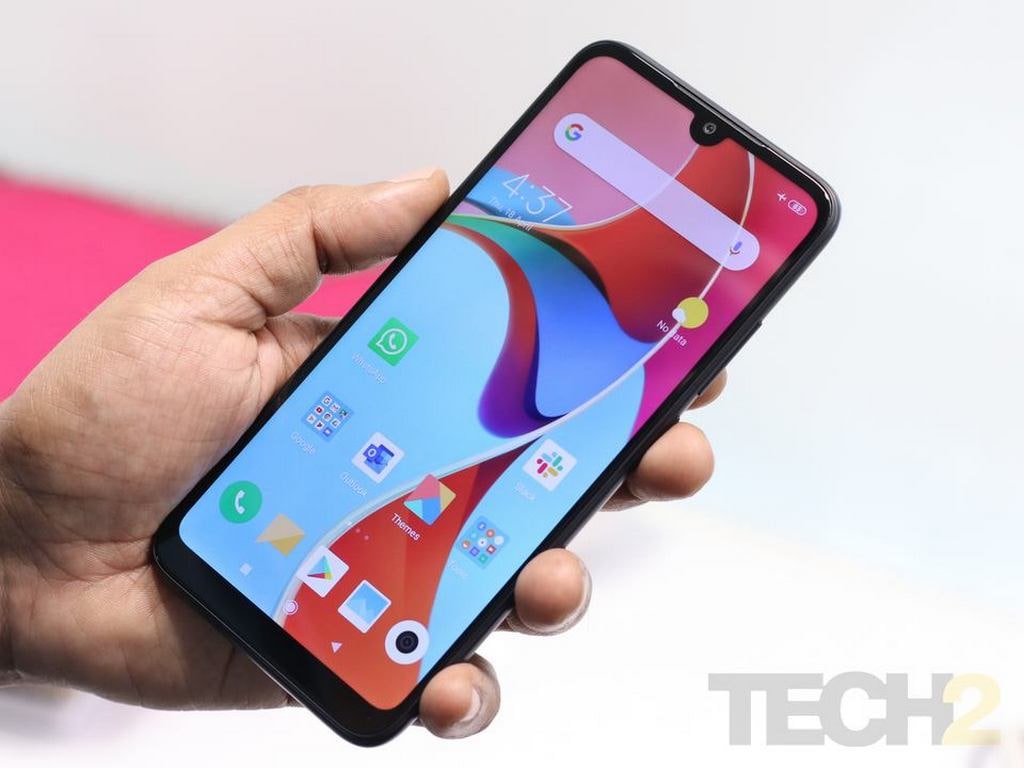 The Xiaomi Redmi 7. Image: Omkar Patne[/caption]Driven by new product launches, Xiaomi remained at the top of the smartphone market share table with a 29 percent share, witnessing a decline of 2 percent in comparison to the same period last year. The Chinese brands grew 20 percent year-on-year (YoY) riding mainly on the growth of smartphones brands such as Vivo, Realme and Oppo. Vivo's volume grew 119 percent whereas Oppo witnessed a growth of 28 percent year on year.[caption id="attachment_6531341" align="alignnone" width="1280"]
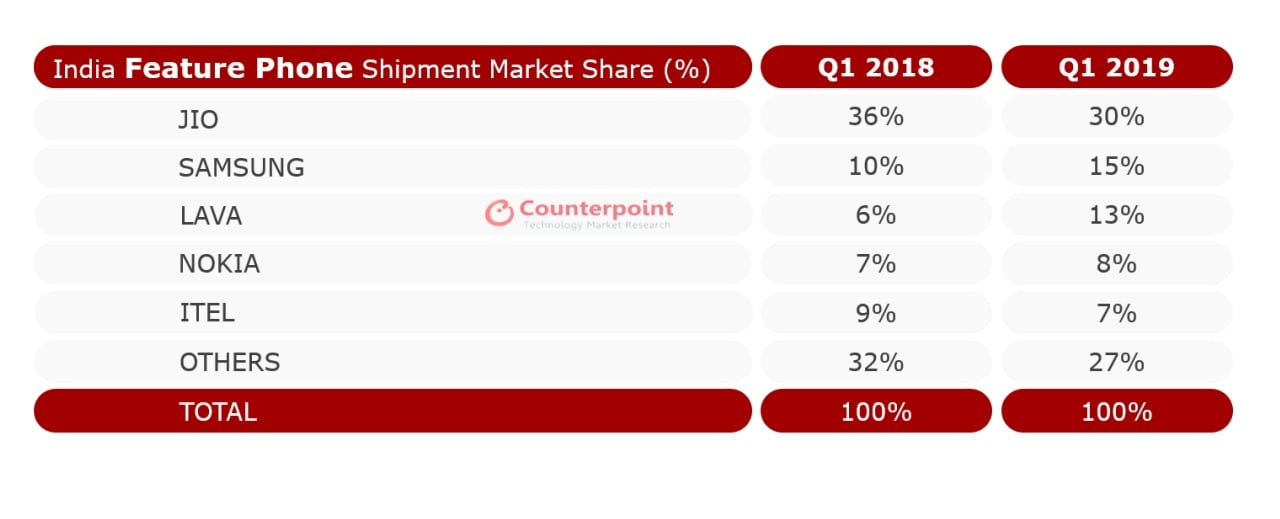 Feature phone shipments in Q1 2019. Image: Counterpoint[/caption]In the meantime, India's overall smartphone shipments grew 4 percent year-on-year, the report added.Talking about the reasons for the growth of Chinese brands, Associate Director of Counterpoint, Tarun Pathak said that data consumption is on the rise and users are upgrading their phones faster as compared to other regions. This has led to users spending more on their purchase which is driving up the overall average selling price (ASP) in the market.Pathak expects these trends to continue in the future in the mid-tier segment.Xiaomi Redmi 6A remained the top model followed by Xiaomi Note 6 Pro, Redmi Y2, Samsung Galaxy M20, and Galaxy A50. Chinese brand aggressive offline expansion and a strong focus on product build helped to retain its top position in the Indian smartphone market.Earlier in February, Xiaomi India Managing Director Manu Kumar Jain claimed that the Chinese smartphone maker is 54 percent bigger than the second brand.However, Xiaomi faced fierce competition from non-Chinese brand Samsung, which had about 23 percent market share. In the premium segment, Samsung surpassed OnePlus to become the number one player driven by the good response for its newly introduced Galaxy S10 series.In the feature phone segment, Reliance Jio remained the leader, followed by Samsung, with about 30 percent market share.
First Published:Apr 28, 2019, 12:19:18 IST
Advertisement
Advertisement

Why AI notetakers are raising serious privacy and security concerns
AI notetakers promise effortless meeting summaries, but experts warn they could expose confidential conversations, corporate secrets and personal voiceprints. As businesses increasingly adopt AI-powered meeting assistants, questions over data storage, privacy, consent and legal risks are becoming impossible to ignore
5 min read
China's low-cost AI models are changing the global AI race. Here's why Silicon Valley is worried
As Chinese firms continue to improve performance while keeping prices low, the AI race is no longer just about building the smartest model—it is increasingly becoming a battle over who can deliver the best value
2 min read
China's Kimi K3 challenges US AI leaders with frontier-level performance at lower cost
Chinese artificial intelligence startup Moonshot AI has unveiled its latest open-weight AI model, Kimi K3, with early results suggesting it could compete with some of the world's most advanced AI systems developed by leading US companies
2 min read
How did Instagram run ads promoting child abuse in India?
India has issued a notice to Meta after an investigation alleged that Instagram displayed paid advertisements promoting child sexual abuse material. MeitY ordered Meta to remove such Instagram ads and explain within seven days how they were approved
8 min read
Why has India halted WhatsApp’s username feature before launch?
India has halted WhatsApp’s planned username feature, citing concerns about cybercrime, impersonation, and law enforcement challenges. As Meta races to address security concerns, here’s why MeitY has paused the rollout, what the feature does, and how it could influence privacy and online safety in India
3 min read
Advertisement
Advertisement