


Boycotting Chinese products: Brands like Vivo, OnePlus unaffected but may severely hurt employment in India
The call to boycott Chinese products in India is irrational, untenable, hypocritical, and ultimately, counter-productive.

Amid the growing India-China conflict, the rhetoric of boycotting Chinese products in India grows commensurately.While we have seen the #BoycottChineseProducts trend previously, this time, China's intrusion at the Line of Actual Control is what fueled the ire of Indians. Sonam Wangchuk, the engineer turned educationist, was the first to call for a boycott late last month.This sentiment has roots in India’s national movement to boycott British goods that took shape in pre-independence India. Many Indians threw away clothes made in Manchester. However, as is inevitable when living in British India, people were coming home to various products that were imported into the country from Britain anyway.
India-China trade
As a result of living in a globalised world, India imports and exports a lot of its products and raw materials from various countries. China happens to be one of the biggest exporters to India. Reportedly, in 2019, India and China’s bilateral trade stood at $92.68 billion, which is more than 60 percent of India’s total trade.As per the Ministry of Commerce and Industry’s Export and Import data, in 2018-19, India’s electronic equipment import from China stood at $20.63 billion. This includes smartphones, TVs, features phones, white goods, among others.The sentiment is not what’s under scrutiny here; the anger is just, but the practicality of a boycott is another matter.[caption id="attachment_8519611" align="alignnone" width="1024"]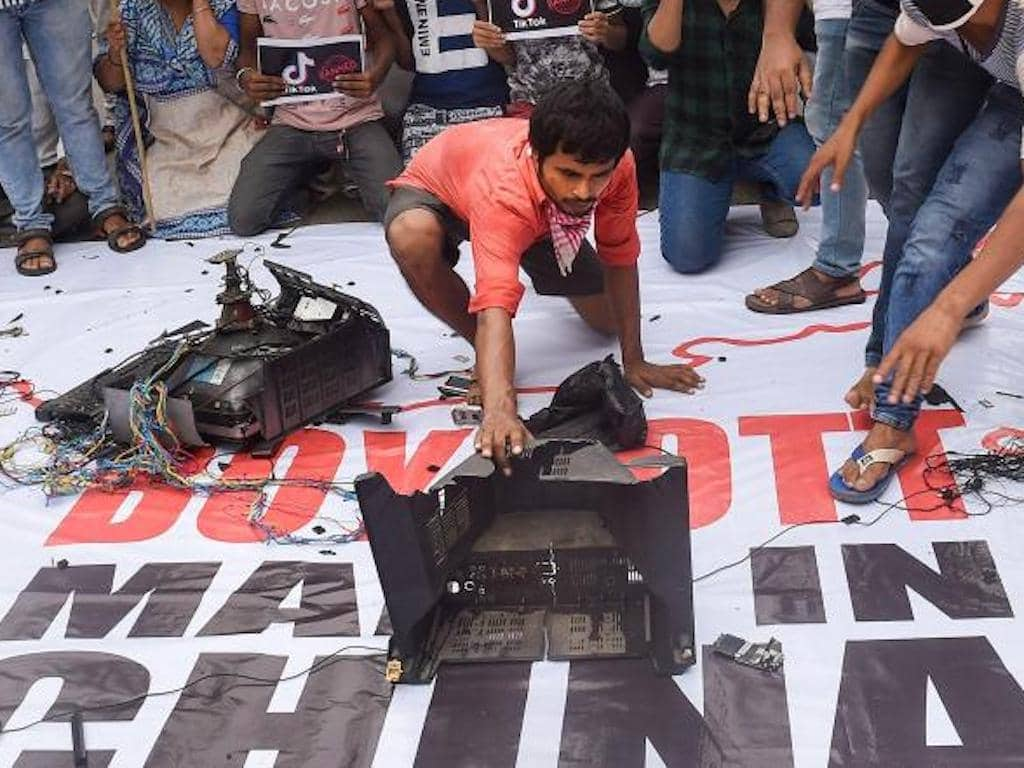 A man in Kolkata participating in protests against Chinese goods sold in India. Image: PTI[/caption]
Is a boycott really the answer?
The irony of the boycott is especially ripe considering that among the top five smartphone brands in the country – the fastest growing mobile market – four places are occupied by a Chinese brands.According to a May 2020 report by Counterpoint Research, in Q1 2020, Xiaomi had the highest market share of 30 percent in the Indian smartphone market, Vivo ranks second occupying 17 percent of the market, Samsung is at number three with 16 percent. Places fourth and fifth are also occupied by Chinese brands Realme and Oppo with 14 and 12 percent market share, respectively.For the uninitiated, Vivo, Realme, Oppo, OnePlus are all owned by BBK Electronics, which is a Chinese MNC specialising in electronics. Xiaomi is also a Beijing-based company. No India-born brand ranks in the top smartphone sellers list.However, for feature phone market share in Q1 2020, Lava and Micromax did make the cut to the second and fifth position, respectively.It’s not just the pricing that makes the Chinese smartphone brands attractive in India – they have a rising graph when it comes to technology, which cannot be ignored. From being famous for just being a mass producer back in the 1970s, China quickly grew into principal designers for various technologies. For instance, China leads lithium-ion battery production with a 73 percent global manufacturing capacity share, followed by the US, far behind with 12 percent of global capacity.Also, how do you really cut off ties with a particular country’s product in a globalised world, where a chip by Intel – an American tech company headquartered in California – is designed in China, manufactured in Taiwan, it’s PCB is assembled in Malaysia before going back to Silicon Valley?While India has been pushing for local manufacturing of most products sold in the country, it is impossible – particularly in electronics – to pluck out every involvement of a Chinese company from the line of local production.If this is the future we want, we must prepare ourselves for a very different experience as consumers in India. We may have to make peace with the vagaries of quality, or with sky-high prices for the next Apple iPhone or Samsung Galaxy flagship.
 More from News Analysis
Chinese brands are trying to prove their 'Indian-ness'
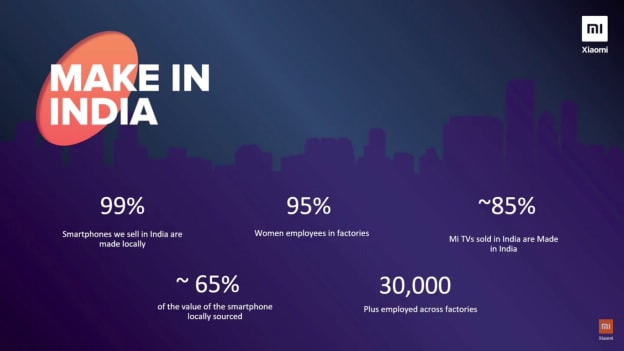 Xiaomi says it employs over 30,000 people across its factories in India.[/caption]Poco also recently took to Twitter to talk about how it’s a Delhi-born brand. The company claims to be #POCOForIndia for life!In May 2020, Vivo also announced its new Make In India logo that it will be printing on smartphone retail boxes sold in India.
The employment that Chinese companies generate in India
Is the Boycott working?
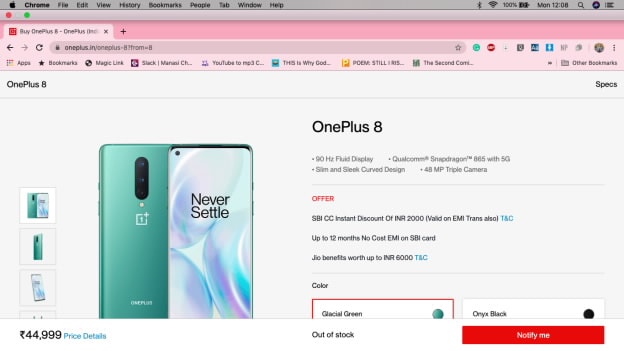 Screenshot was taken on 22 June at 12.08 pm IST.[/caption]A report by Economic Times also revealed that Vivo undertook a consumer study on 16 June through its ‘30,000-strong shop floor executives’, who said that there was no change in purchase patterns so far. The report also quotes ‘a senior executive of a leading e-commerce marketplace’ who confirmed that "there is no dip in sales of Chinese smartphones and electronic products."The Xiaomi Mi NoteBook 14 series also went on sale for the first time on 18 June, and just a day later on 19 June, the Mi NoteBook 14 Intel/Nvidia models with 512 GB storage, were sold out on Amazon India.[caption id="attachment_8519541" align="alignnone" width="624"]
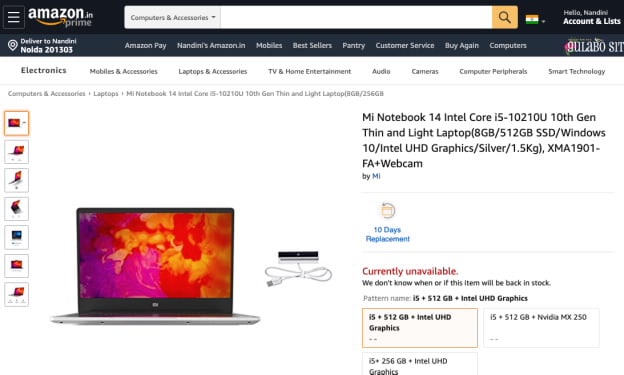 Screenshot was taken on 19 June, a day after the Mi NoteBook went on sale for the first time.[/caption]We also reached out to Pankaj Mohindroo, who is the CEO of India Cellular & Electronics Association, who confirmed that there has been “no impact” of the boycott on the sale of Chinese smartphones in India.
‘India needs to broad base its GDP before engaging in a trade war with China’
What happens to the 5G dream?
In the telecom space, Chinese companies like Huawei and ZTE offer cost-effective, advanced equipment. All this while India has resisted the pressure from the US to ban Huawei and other Chinese companies from supplying 5G equipment, as per a recent report by Economic Times, the Indian government has barred BSNL from sourcing telecom equipment from Huawei and ZTE.Analysts believe that this move could increase gear procurement costs by 10 to 15 percent when sourcing from non-Chinese companies like Ericsson or Alcatel-Lucent.
What happens to Ola, Byju and TikTok?
Most startup unicorns in India like Ola, Paytm, and Byju have heavy investments from Chinese VCs such as Tencent.As per a report by Gateway House, Chinese tech investors have put an estimated $4 billion into India’s leading start-ups. Reportedly, over five years ending March 2020, 18 of India’s 30 unicorns are now Chinese-funded. “TikTok, the video app, has 200 million subscribers and has overtaken YouTube in India. Alibaba, Tencent and ByteDance rival the US penetration of Facebook, Amazon, and Google in India,” the report reveals.Boycotting Chinese products would mean deleting these apps and services from our (Chinese) phones as well.
Aatmanirbhar, eventually
A trade war with China is not the answer. Outraging on social media about boycotting a country and its product is lush with irony, considering the very devices the tweets are posted from are almost entirely Chinese. While India has been actively pushing for local brands to emerge and creating opportunities for global brands to set up manufacturing and increase production in the country, it’s not ready to declare itself entirely self-sufficient just yet.A boycott isn’t a simple restriction on finished products being imported into India, but has an impact on raw material and machinery that enable the production of various Make in India initiatives, and – very significantly – employment in India.With inflamed passions, one seeks easy answers. We’re no strangers to demonisation and othering, and the Chinese ‘boycott’ is just that. Irrational, untenable, hypocritical, and ultimately, counter-productive. If you’re still incensed enough to throw that LCD TV out your first-floor balcony, make sure you follow-through and throw out almost everything else as well. Because you’re almost guaranteed to find a “Made in China” sticker on whatever you touch.

Why AI notetakers are raising serious privacy and security concerns
China's low-cost AI models are changing the global AI race. Here's why Silicon Valley is worried
China's Kimi K3 challenges US AI leaders with frontier-level performance at lower cost
How did Instagram run ads promoting child abuse in India?
Why has India halted WhatsApp’s username feature before launch?