


Australian researchers develop 3D-printed clip-on which turns the smartphone into a microscope
The microscope requires just one assembly step via a 3D printer and no additional illumination optics.

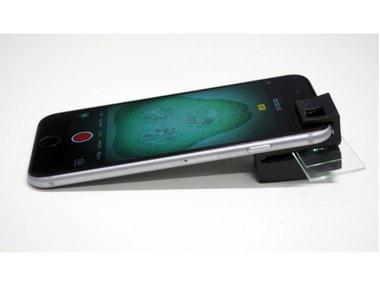
Image: Centre for Nanoscale BioPhotonics[/caption]The "clip-on" microscope, developed by researchers from the ARC Centre of Excellence for Nanoscale BioPhotonics at the University of Adelaid requires no external power or light source to function.Described in the journal Scientific Reports, the device is powerful enough to visualise specimens, including microscopic organisms, animal and plant cells, blood cells and cell nuclei. The "clip-on" has "internal illumination tunnels" that use light from the camera flash to illuminate the sample from behind.According to lead developer Dr Anthony Orth, this feature is an improvement on other phone-based microscopes that use external LEDs and other power sources that are bulkier and difficult to assemble."We have designed a simple mobile phone microscope that takes advantage of the integrated illumination available with nearly all smartphone cameras," Orth said. "Our mobile microscope can be used as an inexpensive and portable tool for all types of onsite or remote-area monitoring," he added.The microscope requires just one assembly step via a 3D printer and no additional illumination optics. The device also has a dark-field microscopy functionality that allows the user to observe samples that are nearly invisible under conventional bright-field operation.According to Orth, the technology could benefit developing countries that lack powerful microscopes and could be used to determine water quality, analyse blood samples for parasites or early disease detection.

Why AI notetakers are raising serious privacy and security concerns
China's low-cost AI models are changing the global AI race. Here's why Silicon Valley is worried
China's Kimi K3 challenges US AI leaders with frontier-level performance at lower cost
How did Instagram run ads promoting child abuse in India?
Why has India halted WhatsApp’s username feature before launch?