
Advertisement


Sections
ALMA captures a bubble of ejected material around U Antliae, an ageing star
The material that makes up the shell was ejected at high speeds around 2700 years ago.

Astronomers have used the Atacama Large Millimeter/submillimeter Array (ALMA) in Chile to capture a breathtaking image of a shell of ejected material around U Antliae, star about 900 light years away from the Earth. The star actually has two shells of ejected material from two events where the ageing star rapidly expelled large amounts of matter. The material that makes up the shell was ejected at high speeds around 2700 years ago.[caption id="attachment_4078553" align="alignleft" width="380"]![Image: ALMA (ESO/NAOJ/NRAO)/F. Kerschbaum]() Image: ALMA (ESO/NAOJ/NRAO)/F. Kerschbaum[/caption]Researchers can study the thin and delicate shell with precision because the ALMA astronomical instrument not only captures images, but also produces a three dimensional dataset known as a data cube. Each slice in the cube represents observations in slightly different wavelengths. The slices show gases moving away or towards the observer at different speeds, and allow scientists to create a 3D map of the shell, similar to the computer tomography of the human body using X-Ray or Ultrasound machines.The shell is remarkably symmetrical and very thin. The shell has a number of chemical compounds based on carbon and other elements. The bubbles of ejected material like the one seen around U Antliae help recycle matter and contribute up to 70 percent of the dust in the interstellar medium. The observations allow scientists to figure out how stars evolved in the early universe, as well as the evolution of galaxies.
Image: ALMA (ESO/NAOJ/NRAO)/F. Kerschbaum[/caption]Researchers can study the thin and delicate shell with precision because the ALMA astronomical instrument not only captures images, but also produces a three dimensional dataset known as a data cube. Each slice in the cube represents observations in slightly different wavelengths. The slices show gases moving away or towards the observer at different speeds, and allow scientists to create a 3D map of the shell, similar to the computer tomography of the human body using X-Ray or Ultrasound machines.The shell is remarkably symmetrical and very thin. The shell has a number of chemical compounds based on carbon and other elements. The bubbles of ejected material like the one seen around U Antliae help recycle matter and contribute up to 70 percent of the dust in the interstellar medium. The observations allow scientists to figure out how stars evolved in the early universe, as well as the evolution of galaxies.
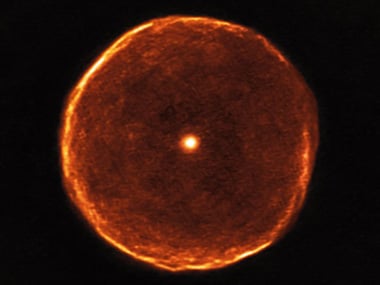 Image: ALMA (ESO/NAOJ/NRAO)/F. Kerschbaum[/caption]Researchers can study the thin and delicate shell with precision because the ALMA astronomical instrument not only captures images, but also produces a three dimensional dataset known as a data cube. Each slice in the cube represents observations in slightly different wavelengths. The slices show gases moving away or towards the observer at different speeds, and allow scientists to create a 3D map of the shell, similar to the computer tomography of the human body using X-Ray or Ultrasound machines.The shell is remarkably symmetrical and very thin. The shell has a number of chemical compounds based on carbon and other elements. The bubbles of ejected material like the one seen around U Antliae help recycle matter and contribute up to 70 percent of the dust in the interstellar medium. The observations allow scientists to figure out how stars evolved in the early universe, as well as the evolution of galaxies.
First Published:Sep 25, 2017, 09:22:25 IST
Advertisement
Advertisement

Why AI notetakers are raising serious privacy and security concerns
AI notetakers promise effortless meeting summaries, but experts warn they could expose confidential conversations, corporate secrets and personal voiceprints. As businesses increasingly adopt AI-powered meeting assistants, questions over data storage, privacy, consent and legal risks are becoming impossible to ignore
5 min read
China's low-cost AI models are changing the global AI race. Here's why Silicon Valley is worried
As Chinese firms continue to improve performance while keeping prices low, the AI race is no longer just about building the smartest model—it is increasingly becoming a battle over who can deliver the best value
2 min read
China's Kimi K3 challenges US AI leaders with frontier-level performance at lower cost
Chinese artificial intelligence startup Moonshot AI has unveiled its latest open-weight AI model, Kimi K3, with early results suggesting it could compete with some of the world's most advanced AI systems developed by leading US companies
2 min read
How did Instagram run ads promoting child abuse in India?
India has issued a notice to Meta after an investigation alleged that Instagram displayed paid advertisements promoting child sexual abuse material. MeitY ordered Meta to remove such Instagram ads and explain within seven days how they were approved
8 min read
Why has India halted WhatsApp’s username feature before launch?
India has halted WhatsApp’s planned username feature, citing concerns about cybercrime, impersonation, and law enforcement challenges. As Meta races to address security concerns, here’s why MeitY has paused the rollout, what the feature does, and how it could influence privacy and online safety in India
3 min read
Advertisement
Advertisement