


Kepler team finds 11 new solar systems
NASA's planet-hunting Kepler space telescope has found 11 new planetary systems, including one with five planets all orbiting closer to their parent star than Mercury circles the Sun, scientists said on Thursday.

Cape Canaveral, Florida: NASA's planet-hunting Kepler space telescope has found 11 new planetary systems, including one with five planets all orbiting closer to their parent star than Mercury circles the Sun, scientists said on Thursday.The discoveries boost the list of confirmed extra-solar planets to 729, including 60 credited to the Kepler team. The telescope, launched in space in March 2009, can detect slight but regular dips in the amount of light coming from stars. Scientists can then determine if the changes are caused by orbiting planets passing by, relative to Kepler's view.Kepler scientists have another 2,300 candidate planets awaiting additional confirmation.None of the newly discovered planetary systems are like our solar system, though Kepler-33, a star that is older and bigger than the Sun, comes close in terms of sheer numbers. It has five planets, compared to our solar system's eight, but the quintet all fly closer to their parent star than Mercury orbits the Sun.[caption id="attachment_195502" align="alignleft" width="380" caption="NASA's planet-hunting Kepler space telescope has found 11 new planetary systems. Reuters"]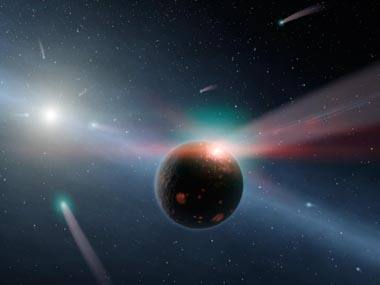 [/caption]The planets range in size from about 1.5 times the diameter of Earth to five times Earth's diameter. Scientists have not yet determined if any are solid rocky bodies like Earth, Venus, Mars and Mercury or if they are filled with gas like Jupiter, Saturn, Uranus and Neptune.The Kepler team previously found one star with six confirmed planets and a second system with five planets, said planetary scientist Jack Lissauer, with NASA's Ames Research Center in Moffett Field, California.Nine of the new systems contain two planets and one has three, bringing the total number of newly discovered planets to 26. All are closer to their host stars than Venus is to the Sun."This has tripled the number of stars which we know have more than one transiting planet, so that's the big deal here," Lissauer told Reuters."We're starting to think in terms of planetary systems as opposed to just planets: Do they all tend to have similar sizes? What's the spacing? Is the solar system unusual in those regards?" he said.Kepler is monitoring more than 150,000 stars in the constellations Cygnus and Lyra.The research is published in four different papers in Astrophysical Journal and the Monthly Notices of the Royal Astronomical Society.Reuters

OpenAI launches Presence to bring AI agents into customer support and enterprise workflows
Samsung Galaxy Fold 8 Ultra, Fold 8, Flip 8 launched: Here is how much it costs in India with discounts
Florida pastor sues OpenAI, says ChatGPT's medical advice delayed emergency treatment: Report
US accuses China's Moonshot AI of using Anthropic's Fable to build K3 model
Apple's biggest Mac refresh in years could bring 11 new models: Report