
Advertisement


Sections
Firstpost Masterclass: Neeraj Chopra breaks down why javelin throwing is as much about strong knees and ankles as about shoulder strength
In this edition of Firstpost Masterclass, Neeraj Chopra talks about why javelin throw is not just about strength, and reveals the importance of strong knees and stronger ankles for a javelin thrower.

If you look at elite javelin throwers of the world, there’s a whole bunch of throwers from Europe. Outside of that, there are Anderson Peters of Grenada, Chao-Tsun Cheng of Chinese Taipei, Julius Yego of Kenya and Keshorn Walcott of Trinidad and Tobago. And then there’s you. Do you ever feel like an outsider in a sport dominated by Europeans?Some countries have a natural affinity towards certain sports. Cricket is massive in India, sprinting is huge in Jamaica. So countries develop a culture of a certain sport.In India, besides cricket, we have a culture of sports like badminton and wrestling now. But we were never big in track and field, barring a few legends like Milkha Singh, PT Usha and Anju Bobby George.Javelin is a technical event. When I started, even I didn’t know how I should go about the sport. When I started, I would mostly see just European throwers competing at the top level. But now I’m starting to get the feeling that even in India there’s some talent in a sport like javelin.If there’s one country that dominates the sport, it’s the Germans. They have at least four throwers at the moment ― Rio Olympics gold medallist Thomas Rohler, World Champion Johannes Vetter, Andreas Hofmann and Julian Weber ― who have breached the 90m mark or are knocking on the doors of the milestone. Have you ever tried asking them what their secret is?It’s not just the current generation of throwers, Germany’s had throwers in the past, too, who have breached 90m. My coach, Uwe Hohn, and Boris Henry, who trains Vetter, have been exceptional throwers to have come out of Germany. And it’s not just the men, the country’s produced exceptional women throwers as well. These guys have been training in javelin since they were 11 or 12 years. And given the previous generation of throwers they’ve had, the current generation has never lacked inspiration. Hopefully, the group of javelin throwers who are representing India at world events at the moment can similarly help mould the next generation of throwers in our country.It’s a sport where your technique has to be crafted at a very young age. After a certain point, it’s difficult to drastically change your throwing technique. If your base is perfect from a young age, it will help you later on in your career. In India, you don’t get proper guidance when you start. When a youngster starts, he or she starts to believe that if they build strength they can throw to a certain distance very quickly in their career. That mindset ends up doing more damage. It’s a sport that demands patience. But Germans and other Europeans benefit from the fact that they have former players and specialist coaches who guide them from a young age about the nuances of the sport. In Europe there is a very conducive mindset for javelin and athletics.[caption id="attachment_8575691" align="alignnone" width="640"]
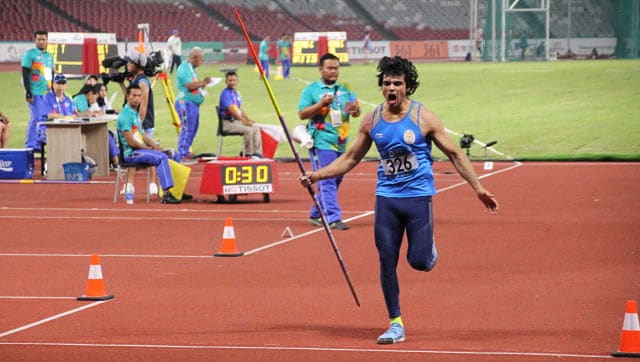 Neeraj Chopra won a gold medal at the 2018 Asian Games in Jakarta. Image courtesy: JSW Sports[/caption]The perception of javelin throw in India is that it’s a sport where success hinges solely on strength: the heftier the thrower, the further they can throw. Could you talk about the role speed and flexibility play in javelin throwing? Is it a sport just about arm strength?When a layman looks at the sport of javelin, he/she will concur that it’s a discipline that only requires a strong arm. When I had started the sport, that was also my first impression of the sport: all you have to do is run and launch the javelin. They say javelin throwers have more use for their legs than their upper bodies. We need to work on strengthening our legs more than our upper bodies. When we block, there’s a lot of pressure on our ankles. Our knees also need to be sturdy because of the pressure they come under when we block. We come running at speed and then brake suddenly, which puts a lot of pressure on the blocking leg. That’s why the glutes, knees and ankles have to be strong. When you block, you also feel a jerk on your back and shoulder. Every joint gets put to use when you block. But for a layman, it will seem like a sport where you just run in and throw.Flexibility is the most important quality for a thrower. And as far as speed is concerned, just having speed is not enough. You need to control your speed on the run-up. That’s why a thrower needs to work on their core strength.You mentioned the pressure on a thrower’s leg during the block. Could you explain the importance of the block to the discipline of javelin throwing?I’ll explain the importance of a block by using the example of a motorbike. The block is like applying brakes to a bike in motion. A javelin thrower doesn’t have the luxury of running on after they have released the javelin. They need to halt quickly after throwing before the scratch line. If your blocking leg is weak, you cannot come running in full steam because you won’t stop before the scratch line. You have to realise that during the block, it’s your blocking leg that will have to bear the entire force of your bodyweight. A weak blocking leg will reduce the distance your javelin flies as the block leg is related to hand speed in the throwing arm.You mentioned that after a certain age, changing your technique can become difficult. Can you elaborate on that? You can tweak small things here and there about your technique. But if you look at some other thrower and try to ape their technique, you’ll end up causing more harm and maybe even picking up an injury. You must have seen that a lot of javelin throwers fall down after throwing. If you look at a javelin throw competition, all throwers seem to have the same kind of action. But there are minor differences between everyone’s throwing actions. In terms of technique, Jan Železný (retired javelin legend from Czech Republic who currently holds the world record) had the best one.You spoke of minor differences between each thrower’s technique. You do a little hop to the left just before you release the javelin. How does that make a difference?A lot of throwers run straight during their run-up. But my style is to go slightly to the left before I open up my body for release. It’s an action that comes naturally to me. But I have to ensure while throwing that I don’t veer too much to the left before throwing because that will affect my release.Magnus Kirt has a very peculiar action. He goes airborne and collapses in a heap each time he throws the javelin. We’ve seen you fall a couple of times as well while throwing. Does that make a difference to the distance of your throw?It’s a very natural thing to fall after throwing. We don’t have anything in our throwing run-ups that is feigned. Nothing artificial. Every javelin thrower in the world falls at one time or another. When I’m training, I never fall after release. But in competitions, I sometimes get overcome by the intensity of the moment so I overdo my action, which ends up with a fall while throwing. I cannot control it.Speaking of intensity of the moment while in competition, we’ve seen that you tend to let out a roar after throwing during competitions. Why do you do that? It seems to serve no practical purpose in javelin, as opposed to a sport like tennis, where players let out shrieks to upset the other player’s concentration and rhythm.It’s just a natural reaction after a high-intensity sporting moment. The nature of our sport is such that you have a short window where you have to deliver. You run, you release the spear and you’re done. Then there’s a break while others are throwing and you just have to sit, watch and wait for your turn to throw again. It’s not like tennis or badminton, where you are constantly in action and where you can raise or lower the attacking intensity depending on the situation. Ours is a sport played in short bursts of high-intensity. So the shouting bit comes naturally after you have released the javelin. Having said that, there are many throwers who are very composed and have a muted reaction after release.During a competition, what do athletes think about between two throws? There seems to be little else to do and you’re by yourself.It’s a very individualistic sport. There’s isn’t anything specific I think of. I usually don’t think of what distance I need to throw in that competition. It’s all about keeping your body warmed up, your mind calm and focussed between attempts. If someone’s thrown well and raised the bar in the competition then your body and mind will also react accordingly and you get pumped up.Do you think a lot about crossing the milestones in your sport? Maybe the 90m mark, which you went tantalisingly close to with your personal best at the Asian Games (88.06m)? Or the elusive 100m mark, which no one has been able to breach since the javelin was redesigned? I never carry the mental burden of distances while going into a competition. When I participated in the Commonwealth Games or the Asian Games or the Diamond League, I didn’t go with a preconceived target in mind. The distance you eventually throw in a competition depends on the conditions on the given day and how your body is responding. Let’s say you go into a competition thinking you want to throw 90m. But your first throw is just 80m because your body is not responding on that day. You will end up hurting your chances because you’re trying too hard, which may make you take your focus off your technique. Of course, it’s a very personal approach. Maybe there are other throwers who go into a competition with a number on their minds.You post a lot of interesting videos of yourself training. One of them has you standing on a gym ball while holding a flexbar and doing squats. There are also clips of you trying slacklining. How do these exercises help a javelin thrower?I don’t do these as part of my training routine. I look at these things merely for fun. I do it in the middle of other routines so that it keeps the mind engrossed and breaks the monotony. If you keep doing the same things in training you’ll get bored. So to spice up training sessions, I do these unique exercises. These, of course, help with improving your balance. The flexbar is particularly used to strengthen small muscles in the shoulder.When you are throwing during a competition, do you aim for a particular spot in the stadium for reference each time?The idea before releasing (when you’re doing the crossover steps) is to keep your eyes in alignment with your left shoulder. That is what acts as a reference point for each throw. If your eyes are looking to the left or right, you can end up sending the spear wide.In almost all sports now, athletes rely on video analysis to help their understanding of the discipline. Do you also do a lot of video analysis to understand what you’re doing wrong or right on a particular day?There’s a lot of video analysis that happens in javelin throwing, particularly when it comes to the German throwers. Every year they have sessions to analyse videos. In India, it has still to catch up. Hopefully, in the future, we can also do video analysis.[caption id="attachment_8575741" align="alignnone" width="640"]
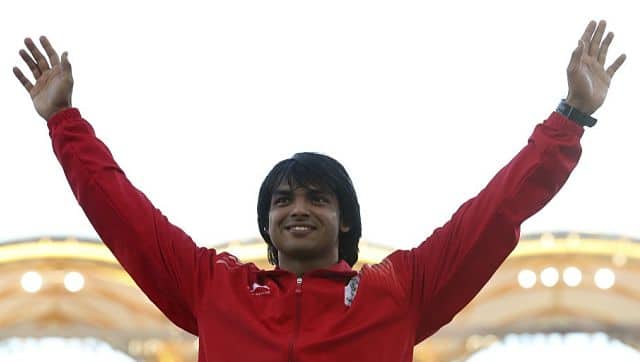 Neeraj Chopra spent all of 2019 out due to an injury. But he's one of the most promising prospects in track and field for India.[/caption]You went off social media completely just before the 2018 Asian Games because you didn’t want your focus to waver. Is that the plan ahead of next year’s Tokyo Olympics too?Giving regular updates on social media for an athlete is good. But I feel that when you’re experiencing something for the first time, like competing at the Olympic Games, everyone tries to get in touch with you. Everyone tries to say things like ‘come back with gold’. Those comments linger in the mind and create unnecessary pressure. Besides, in those times, it’s not possible for an athlete to reply to everyone. That’s why my policy is to minimise use of the cellphone as much as possible.You are one of the few athletes to have never had close relatives watch them competing live at a major competition. When you compete at the Olympics next year, will you make an exception to that rule?I feel slightly uncomfortable with the thought of having my family watch me compete live. At a competition, the athlete is a different person, with adrenaline pumping in the veins. But when I go home, I feel a completely different set of emotions. So I believe if I have to compete before family members, I’ll actually feel conscious. I’ll start to think about how they would feel if they saw me bellowing after a throw. That’s why I’ve never invited them to any of my major competitions. Maybe in the future I’ll change my mind about this. But at least at next year’s Olympics, it’ll be too early. If I try taking them straight to the Olympics, I don’t know how that would affect me. I’ll try and take them to some smaller competition first. Maybe the Nationals.Click here to read other articles in this series.
Amit Kamath is with the sports desk in Mumbai. He covers Olympic sports like wrestling, shooting, and boxing besides also writing about NBA and kabaddi. In 2014, he was declared the runner-up in the sports category at the National RedInk Award for Excellence in Journalism for his story on Sports Authority of India's Kandivli campus where world-class athletes had to put up with appalling conditions. He was a Robert Bosch Media Ambassador in 2019.
First Published:Jul 09, 2020, 10:24:11 IST
Advertisement
Advertisement

Commonwealth Games 2026: Check schedule, star athletes, medal favourites and everything you need to know
Glasgow is set to host the 2026 Commonwealth Games from July 23 to August 2, stepping in after Victoria, Australia, withdrew due to rising costs. The Scottish city has promised a streamlined edition, featuring only ten sports across four venues.
3 min read
High-flying PV Sindhu defeats fellow Indian Unnati Hooda, advances into 2026 China Open round two
Double Olympic medallist PV Sindhu battled past teenage compatriot Unnati Hooda in a hard‑fought opening‑round clash to reach the second round of the China Open.
2 min read
What Is 3x3 Basketball, and why India Is playing It at the 2026 CWG for the first time
The 2026 Commonwealth Games in Glasgow have sparked debate with the exclusion of nine sporting events, but they will mark a historic milestone with India’s maiden appearance in the women’s 3x3 wheelchair basketball competition.
2 min read
Why India may not witness a medal rush at 2026 Commonwealth Games
A 125-strong Indian contingent is in Glasgow for the 2026 Commonwealth Games, starting today (July 23), chasing international glory. However, with a roster of sports such as badminton and wrestling being cut from the event, the country’s medal chances have been drastically reduced
4 min read
MLS probes Inter Miami over Casemiro move despite confirmed signing
Inter Miami have signed Brazil midfielder Casemiro as a free agent, but Major League Soccer has launched an investigation into an alleged tampering issue linked to his move
1 min read
Advertisement
Advertisement