


UP-set on the cards?
The BJP is up against a formidable challenge in the form of the SP-BSP pact in Uttar Pradesh. It will need all of Modi’s trust, and more, to do battle with a united opposition

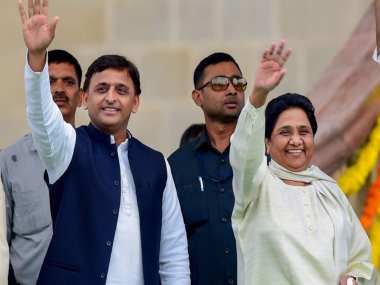
File image of Samajwadi Party leader Akhilesh Yadav with Bahujan Samaj Party leader Mayawati. PTI[/caption]Conventional understanding dictated that in a polarised scenario, the BJP would win hands down on the basis of Hindu consolidation. But that was challenged quite effectively by Mulayam Singh Yadav, who tactically aligned with then-BSP supremo Kanshi Ram. Mayawati was then a marginal player and Kanshi Ram’s understudy. Mulayam was also reduced to a fringe player in the 1991 Assembly elections after his government ordered firing on kar sevaks in Ayodhya a year earlier. But Mulayam had his ear to the ground when he aligned with the BSP.For the first time in the country’s political history, a socially compatible coalition of Other Backward Classes, Dalits and Muslims took the shape of a political formation. There were doubts if it would work electorally. The 1993 election eventually saw the SP-BSP coalition edge past the BJP in a direct fight. Though the coalition collapsed, it effectively checked the Hindutva juggernaut in the country’s most populous state.But that is one side of the story. Statistics show that the picture was not so depressing for the BJP. The SP-BSP coalition’s vote share was around 29 per cent while the BJP won around 33.4 per cent of votes. Yet the BJP bagged only 176 seats, one seat less than the coalition’s tally.There is no doubt that with Mulayam and Kanshi Ram leading the coalition, the traditional support bases of these leaders coalesced electorally although it was much lower than the BJP’s vote share. In a sense the SP-BSP coalition owed its victory more to the first-past-the-post system.Herein lies the effect of social chemistry which more often than not puzzles political pundits. Despite a lower share of votes, the SP-BSP coalition was able to mobilise its voters in concentrated pockets, and outflank the BJP. This political history is significant now that Mayawati and Akhilesh Yadav have decided to bury the hatchet and chart their future political course together. If one applies conventional political logic and aggregates social bases of both the parties, the BJP apparently looks far behind in the race in 2019. But to unravel complex politics in such a simplistic manner would be a mistake.In the trust survey, the undeniable impression (49 per cent overall) is that the grand coalition (Mahagathbandhan) will make life difficult for the BJP. But it does not seem to be a seamless grand coalition either in UP or in Bihar. With the Congress throwing in an element of surprise by bringing Priyanka Gandhi Vadra in as a general secretary and campaign head in eastern UP, the party has added a powerful glamour quotient to an uncertain political situation. It appears quite obvious that the Congress has been working to a plan to undercut the BJP’s support base—not to win but to ensure Modi’s defeat.Though the Congress may appear to be fighting separately, the party in essence seems to be strengthening the forces working against the BJP. In UP and Bihar, the grand coalition against the BJP would take tactical steps of political deception to weaken the BJP. And they seem to be acting perfectly in tandem.Our survey also points out that in the Hindi heartland, the possibility of the Mahagathbandhan pitted against Modi has hung a question mark over the continuity of the NDA regime: of those surveyed, 47.7 per cent in UP, 57.2 per cent in Bihar, 50.2 per cent in Chhattisgarh, 65.4 per cent in Madhya Pradesh and 35.7 per cent in Uttarakhand maintained that the BJP’s future did not look as rosy as it did six months ago.But there is another aspect of this argument. The BJP’s growth in these regions, particularly in Uttar Pradesh, is exponential and has co-opted marginal social groups across the state.Unlike in the past, the party has gradually transformed itself into a well-oiled, cadre-based mass organisation which is quite akin to the Congress of the post-Independence phase but sans the Muslim vote.In the 2017 Assembly election, the party successfully roped in various caste groups within the Hindutva fold to turn them into a powerful electoral force. Unlike in the past, the BJP is neither a single-issue party nor does it get identified with upper castes. With Prime Minister Narendra Modi still reigning as the most trustworthy politician in the country, his capability to turn the election to his advantage can hardly be underestimated.Apparently, the BJP can draw solace from the electoral statistics of 1993, when the party scored more votes than the combined SP-BSP. But the undeniable political reality is that the BJP is up against a formidable challenge in the form of the SP-BSP in UP, and RJD-led smaller parties in Bihar in tactical alliance with the Congress. Despite the apparent incompatibility of the political groupings against the BJP, the coalition is entirely capable of proving more than a match for the well-oiled organisational machinery of the BJP.

Rahul Gandhi, Kharge lead protest near PM residence; Centre says Parliament discussion was offered
Parliament's Monsoon Session from July 20: Key bills, numbers game to dominate agenda
Major blow to Uddhav Thackeray as six Lok Sabha MPs join Shinde camp
12 years and counting: NDA leaders felicitate PM Modi as he trumps Nehru's tenure record
‘Trust, progress and welfare’: PM Modi celebrates 12 years in office, highlights big policy moves