
Advertisement


Sections
Padmaavat episode shows BJP has many Rajput leaders in its fold, but they don’t add up to one Bhairon Singh Shekhawat
The Padmaavat controversy has exposed BJP’s Rajput leaders who are blissfully ignorant of their own party’s history and remain woefully inadequate to measure up to the stature of Shekhawat.

After prolonged controversy, the Hindi movie Padmaavat was finally released. It has been a roaring success in terms of revenue (it is believed to have earned a whopping Rs 200 crore in less than a week). Ignoring the menacing noises emanating from the so-called Rajput outfits and self-proclaimed protectors of Rajputs’ vanity and pride, the masses thronged cinema halls and watched the movie in large numbers. Many watched it not for its content but thanks to the political controversy it generated. And this controversy has exposed the hollowness of conventional politics.In the areas where Rajputs form a sizeable chunk of population, the state governments attempted to dissuade theatre owners from screening the film. Vijay Rupani in Gujarat, Vasundhara Raje Scindia in Rajasthan, Manohar Lal Khattar in Haryana and Shivraj Singh Chouhan in Madhya Pradesh took the lead in proscribing the film under an informal state decree.[caption id="attachment_4327599" align="alignleft" width="380"]![File image of Uttar Pradesh chief minister Yogi Adityanath. PTI]() File image of Uttar Pradesh chief minister Yogi Adityanath. PTI[/caption]In the BJP’s stable of chief ministers, the only exception was the saffron-clad Yogi Adityanath, who also presides over the Gorakhnath Math of a powerful Hindu tradition of ascetism, Nath Sampradaya. Ironically, Adityanath is a Rajput by caste.Apparently none of the conventional leaders — neither from the Congress nor from the BJP — could muster enough courage to challenge the antediluvian projection of a community and its women, and rubbish its content; rather than banning the movie. If Padmaavat is to be debated, its content would come across as a puerile fictionalisation of a myth passed as history in a manner that does not conform to standards of modern civilisation. Conventional politics ignored this critical fact and went along with the mob seeking a ban on the movie.Since the BJP has emerged as the ruling party across several states and at the Centre, it owes greater responsibility that any other political party to explain the reason for the constrictive space in conventional politics. Was it always like that? Does right-wing conventional politics offer narrower space than others?Perhaps those aware of the history of the rise of Bharatiya Jana Sangh (BJS), the progenitor of the BJP, would vehemently deny this. Let us recount some facts to bear this out: In the Sangh Parivar fold, Bhairon Singh Shekhawat, former vice-president of India and former Rajasthan chief minister, was arguably the biggest Rajput leader in its history. In 1952, he was one of eight BJS MLAs who won on account of an endorsement from the Kshatriya Mahasabha, an outfit of feudal lords of the state. But the BJS, under the guidance of Deendayal Upadhyaya, chose to favour the concept of abolishing Jagirdari, much against its own political interests.
File image of Uttar Pradesh chief minister Yogi Adityanath. PTI[/caption]In the BJP’s stable of chief ministers, the only exception was the saffron-clad Yogi Adityanath, who also presides over the Gorakhnath Math of a powerful Hindu tradition of ascetism, Nath Sampradaya. Ironically, Adityanath is a Rajput by caste.Apparently none of the conventional leaders — neither from the Congress nor from the BJP — could muster enough courage to challenge the antediluvian projection of a community and its women, and rubbish its content; rather than banning the movie. If Padmaavat is to be debated, its content would come across as a puerile fictionalisation of a myth passed as history in a manner that does not conform to standards of modern civilisation. Conventional politics ignored this critical fact and went along with the mob seeking a ban on the movie.Since the BJP has emerged as the ruling party across several states and at the Centre, it owes greater responsibility that any other political party to explain the reason for the constrictive space in conventional politics. Was it always like that? Does right-wing conventional politics offer narrower space than others?Perhaps those aware of the history of the rise of Bharatiya Jana Sangh (BJS), the progenitor of the BJP, would vehemently deny this. Let us recount some facts to bear this out: In the Sangh Parivar fold, Bhairon Singh Shekhawat, former vice-president of India and former Rajasthan chief minister, was arguably the biggest Rajput leader in its history. In 1952, he was one of eight BJS MLAs who won on account of an endorsement from the Kshatriya Mahasabha, an outfit of feudal lords of the state. But the BJS, under the guidance of Deendayal Upadhyaya, chose to favour the concept of abolishing Jagirdari, much against its own political interests.
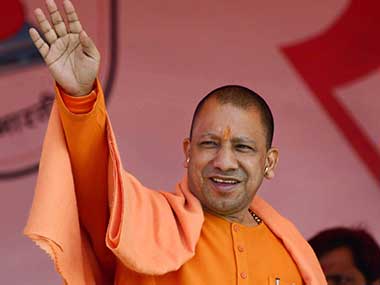 File image of Uttar Pradesh chief minister Yogi Adityanath. PTI[/caption]In the BJP’s stable of chief ministers, the only exception was the saffron-clad Yogi Adityanath, who also presides over the Gorakhnath Math of a powerful Hindu tradition of ascetism, Nath Sampradaya. Ironically, Adityanath is a Rajput by caste.Apparently none of the conventional leaders — neither from the Congress nor from the BJP — could muster enough courage to challenge the antediluvian projection of a community and its women, and rubbish its content; rather than banning the movie. If Padmaavat is to be debated, its content would come across as a puerile fictionalisation of a myth passed as history in a manner that does not conform to standards of modern civilisation. Conventional politics ignored this critical fact and went along with the mob seeking a ban on the movie.Since the BJP has emerged as the ruling party across several states and at the Centre, it owes greater responsibility that any other political party to explain the reason for the constrictive space in conventional politics. Was it always like that? Does right-wing conventional politics offer narrower space than others?Perhaps those aware of the history of the rise of Bharatiya Jana Sangh (BJS), the progenitor of the BJP, would vehemently deny this. Let us recount some facts to bear this out: In the Sangh Parivar fold, Bhairon Singh Shekhawat, former vice-president of India and former Rajasthan chief minister, was arguably the biggest Rajput leader in its history. In 1952, he was one of eight BJS MLAs who won on account of an endorsement from the Kshatriya Mahasabha, an outfit of feudal lords of the state. But the BJS, under the guidance of Deendayal Upadhyaya, chose to favour the concept of abolishing Jagirdari, much against its own political interests.
Shekhawat held the party line against the wishes of feudal Rajput leaders and waged a lone battle for abolition of Jagirdari, even though the ruling Congress was hesitant to effectively carry out these reforms. Though the BJS and Shekhawat stood isolated in Rajasthan and paid the political price when six of its legislators defected, Upadhyaya remained firm on abolishing Jagirdari. Shekhawat’s stature in the party rose thanks to his unwavering and principled stance.Shekhawat faced another acid test in 1987 when a woman named Roop Kanwar was literally egged on to commit ‘sati’ in Deorala village, Sikar district, Rajasthan. The 18-year-old woman was forced to sit on the funeral pyre alongside her husband's body and burnt alive amidst chants of “Sati maiya ki jai”. By that time, Shekhawat had emerged as the tallest leader of the state and was reckoned within the Sangh Parivar as a most promising leader, almost on par with Atal Bihari Vajpayee.The incident triggered a controversy, with a group of Rajput leaders who saw the act in terms of their community’s valour and opposed the crackdown against the villagers, who perpetrated the crime. Once again, Shekhawat stoutly opposed the ‘sati’ tradition, even if it meant inviting the ire of a section of his community. Once again, the respect for him within the party went up several notches after his principled stance.
Unlike in the 60s and 70s, when the BJS had a limited presence and few leaders of national stature, the BJP today is replete with leaders boasting national stature, not to mention several chief ministers. The saffron fold has a plenty of Rajput leaders in its front ranks. For instance, Rajnath Singh, the Union home minister, and the chief ministers of Uttar Pradesh, Rajasthan, Himachal Pradesh and Uttarakhand belong to Rajput caste.None of them, however, spoke up against a lumpen section of leadership known as Karni Sena and succumbed to the mob pressure. An exception was Yogi Adityanath, an unconventional politician: He remained silent on the issue but allowed the movie to be screened in Uttar Pradesh and also effectively tackled the threat of mob violence.The Padmaavat controversy, in short, has exposed BJP’s Rajput leaders as being blissfully ignorant of their own party’s history and woefully inadequate in measuring up to the stature of Shekhawat.
First Published:Jan 30, 2018, 19:30:19 IST
Advertisement
Advertisement

Rahul Gandhi, Kharge lead protest near PM residence; Centre says Parliament discussion was offered
The developments come amid the continuing CJP-led agitation at Jantar Mantar, where protesters have vowed to continue their sit-in despite recent clashes with Delhi Police
2 min read
Parliament's Monsoon Session from July 20: Key bills, numbers game to dominate agenda
The Monsoon Session of Parliament will begin on July 20 and continue till August 13, with the government expected to push several key legislations, including constitutional amendment bills
2 min read
Major blow to Uddhav Thackeray as six Lok Sabha MPs join Shinde camp
In a major political setback for Shiv Sena (UBT) chief Uddhav Thackeray, six of the party's nine Lok Sabha MPs joined the Eknath Shinde-led Shiv Sena in Mumbai on Monday
2 min read
12 years and counting: NDA leaders felicitate PM Modi as he trumps Nehru's tenure record
Leaders of the National Democratic Alliance (NDA) on Wednesday felicitated Prime Minister Narendra Modi on completing 12 years in office and becoming India's longest-serving continuously elected Prime Minister
3 min read
‘Trust, progress and welfare’: PM Modi celebrates 12 years in office, highlights big policy moves
Prime Minister Narendra Modi on Tuesday marked 12 years in office. He described the period as one dedicated to "trust, development and public welfare" while highlighting key achievements of his government
3 min read
Advertisement
Advertisement