


Karunanidhi passes away at 94: Ex-DMK chief, like many others biography forgives, can be called a product of his times
Even a casual observer of the life of M Karunanidhi will acknowledge it to be an illustrious life; indeed, keener observers would call it the life of Indian politics

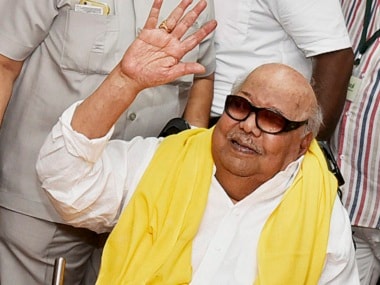
File image of M Karunanidhi. PTI[/caption]First, and most forebearingly, the movement is an anti-caste political tradition, treating it, in history, as an imposition of northern India only precariously sustained by its Brahmin representatives in the south. The movement's founding fathers, so to speak, came from lower caste communities and critiqued their own deprivation as a function of upper caste political and economic supremacy. For much of its pre-Independence history, the movement treated the making of 'India' as a unified political entity as the nationalisation of caste. This came to be treated as an affront against 'national security', despite being a fiercer unmaking of the very nation.Second, the movement took issue with, like caste, the imposition of the Hindi language on southern India which was promptly instated in sure political place by post-colonial India. As historians have written of it, the imposition of Hindi was, for the movement, less a matter of bureaucratic inconvenience for it was a matter of dignity and identity. It is worth restating, in this context, that Karunanidhi catapulted to national fame for his prominent involvement in the Dravidian protest against the renaming of the Kallukuddi railway station to Dalmiya-puram (1953) — a protest that quickly turned violent and as national scripts go, seditious. The movement, thus, countered Hindi by recourse to the vernacular, and Karunanidhi as Kalaignar has so remained an enduring image.Third, the Dravidian movement critiqued not only Brahminical religion — which, by itself, would otherwise have remained a subset of its anti-caste tradition — but religion itself. It privileges reason, rationality, and scientific knowledge, dismissing faith as dogma engineered by the privileged, the propertied, and the powerful for their sustenance. Despite its piquant unpopularity, atheistic rationality is a faith Karunanidhi, buried now in the manner of religious saints, clung to until the twilight of his political career.Although the movement was, from its inception, profoundly political, its transition to electoral politics was more trepidant, executed first through Periyar's Justice Party and then with the Dravidar Kazhagam pioneered by Annadurai. The Dravidar Kazhagam, and Karunanidhi, carried and continue to carry the precepts of the Dravidian movement with peripatetic political and rhetorical confidence, but it was, and has remained, more unabashed in its pursuit of power than Periyar’s avowedly egalitarian undertaking. With his timely ascent to power, especially in heated contestation with MG Ramachandran, Karunanidhi began to consolidate a veritable (and now vociferously dynastic) fiefdom whose Dravidian egalitarianism was never imagined beyond piecemeal, populist measures of social welfare designed by electoral insecurity.
In matters of caste, Karunanidhi’s DMK has performed abysmally — as N Ram phrased it in this piece, "The DMK has never been a pro-Dalit party. When caste clashes take place, they either stay neutral or align with the caste Hindus."To speak of the political establishment of the DMK is to speak of a history of extortive governance, the trudges of corrupt practice, and closer to the contemporary, fiend nepotism. While the DMK’s conspiratorial complicity in what has come to be called the '2G scam' is well known and documented, that Karunanidhi’s illustrious family has consistently and unambiguously reconfigured the economic world of Tamil Nadu to its privileged benefit is deeply felt but obscurely known. As MK Stalin and Kanimozhi prepare to inherit the DMK as a heirloom and the Maran brothers sit atop a televised empire fostered by public dispensation, the DMK’s distance from its Dravida origins could not be starker.Perhaps Karunanidhi, too, like many others biography forgives, can be called a product of his times — for in the 1960s and 1970s, a certain Nehruvian idealism, exemplified, despite its political distance, by the Dravidian movement, tussled with the nefarious ways of electoral life and the spoils of governance. No nation will take pride in that which conquered radical idealism, but Karunanidhi, despite biography, embodied its many incarnations.

Rahul Gandhi, Kharge lead protest near PM residence; Centre says Parliament discussion was offered
Parliament's Monsoon Session from July 20: Key bills, numbers game to dominate agenda
Major blow to Uddhav Thackeray as six Lok Sabha MPs join Shinde camp
12 years and counting: NDA leaders felicitate PM Modi as he trumps Nehru's tenure record
‘Trust, progress and welfare’: PM Modi celebrates 12 years in office, highlights big policy moves