


JNU row: One year on, whether or not pro-Afzal Guru protest was 'doctored', agitation has left many bitter
An evening gathering that culminates into an ugly scene where the very idea of India was challenged and cursed several times was definitely not a pleasant spectacle for a large number of students, teachers and passers-by.

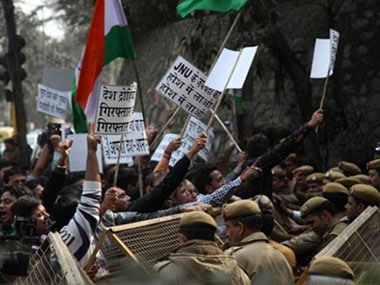
Representational image. News18[/caption]Praxis is how it was articulated in the antiquity which has continued to this day in the form of political parties and sloganeering. Those defending free speech look at it as the backbone of a healthy democracy. Slogans and songs of protest seem to have inspired millions since the Hellenic civilisation, popping up many times in the Medieval era which has been portrayed well in the works of Mikhail Bakhtin. The story of Gargantua and Pantagruel by Francois Rabelais is one of the ways in which dissent used to be aired in the times of carnival, according to Bakhtin. Celebrating dissent has been the hallmark of a progressive society, probably of the one based on the idea of Aufklärung (Enlightenment). However, there are other viewpoints that suggest that in the modern society, protests have become ends and not means. A society based on spectacles has in fact promoted the use of protests in order to manufacture spectacles. It is rightly called a tautology by Guy Debord. He writes in Society of the Spectacle, 1967:"The tautological character of the spectacle stems from the fact that its means and ends are identical. It is the sun that never sets over the empire of modern passivity. It covers the entire surface of the globe, endlessly basking in its own glory.”Therein crops up the counterview. A short analysis of the Free Speech Movement in the USA would tell us that it had more to do with the ideology of the New Left than with anything that qualified as genuine people’s concern. It is a well-established fact that the entire counterculture revolution in the USA was spearheaded by just 10 percent of the population, that too those coming from the upper echelons of the society. A somewhat similar picture has emerged here in the Jawaharlal Nehru University (JNU) that hit the headlines exactly a year ago for reasons, some say were right while others differ.An evening gathering that culminates into an ugly scene where the very idea of India was challenged and cursed several times was definitely not a pleasant spectacle for a large number of students, teachers and passers-by.Such rage against one’s motherland seems to have caused mental trauma for a lot of students that evening. It must also be reminded that it was not the first and the only occasion when such a gathering of anti-India sentinels took place in the JNU. It was a repeat of what had been organised in preceding years, the only difference arising from the fact that earlier it had a low tempo and was restricted within the four walls of a hostel mess. This time it was a brazen attack on Indian sentiments. A year before the incident, Afzal supporters organised a similar programme which was so traumatic for some students that some of them cried on that night before they could find some respite in the bosom of sleep.Thus, can we for a moment care to get beyond the agenda set by the New Left in the 1960s? Can the vanguards of freedom of speech and expression also take the pain to bother about something called freedom of attachment or freedom of affection and reverence towards an object or idea of one’s choice? When those slogans were raised in one of the most insensitive manners, there were others who were pained and aggrieved.What followed the incident was also not satisfactory on many counts. Nobody cared to think about the emotions of those who were aggrieved by such an act. The role of media also was unclear with its clear division on the issue. Some tried to be nationalist while others were rated as anti-nationals. In fact, the debate is something larger than that. It’s about the “tragedy of the commons” (Hardin, 1968). Why should some suffer in order to safeguard the freedom of expression of a handful of aggressive creatures whose rage knows no boundaries? Hence, the debate that centred itself upon whether the act is sedition or not needs to go deep into the emotional impact of it.The government and the law courts are bound by the obvious but not the intellectually-oriented minds. Is sedition the only charge that’s sustainable against somebody who assaults an idea like India so dear to hundreds of million Indians? These are some questions that the judiciary and the government are faced with. How are we to curb any such tendency in future? One need not worry too much given the fact that there are still many who cherish the idea of India quite close to their heart. It is because of these people that India derives strength despite their being unable to clear the filth that surfaced on 9th February last year.The author is central working committee member of Akhil Bharatiya Vidyarthi Parishad (ABVP) and former joint secretary of Jawaharlal Nehru University Students' Union (JNUSU)

Rahul Gandhi, Kharge lead protest near PM residence; Centre says Parliament discussion was offered
Parliament's Monsoon Session from July 20: Key bills, numbers game to dominate agenda
Major blow to Uddhav Thackeray as six Lok Sabha MPs join Shinde camp
12 years and counting: NDA leaders felicitate PM Modi as he trumps Nehru's tenure record
‘Trust, progress and welfare’: PM Modi celebrates 12 years in office, highlights big policy moves