
Advertisement


Sections
Archaeology, epigraphical studies and the existence of Krishna
Krishna is historic and not mere imagination as there is straight evidence to withstand the claim that the land of Baharat and neighbours were very much aware of someone who lived by the name Vāsudeva Krishna with grand heroic deeds

The history of Bharat is indeed overwhelmed with enigma. Right from Kailash Mandir in the precinct of Ellora to more and more. Enigma is what appears to be the best adjective of our past. If I look back at my own journey in life so far and zoom on the phase till reaching teenage, big transformations barged in, in terms of looking at various personalities that included Shri Ram and Shri Krishna too.I can faintly remember, but yes that was the period of post the day my grandfather had passed away and my father had observed all the samskara being the eldest son. He would sing bhajans as praise to Shri Ram and Shri Krishna and I would be the parrot to repeat in broken words at age approaching three. That would be my first interaction with these two personalities whom we are supposed to see as Bhagwan. A bit older I would grow, and the evenings would be spent listening Ramcharit Manas that my grandmother would read and the Sundays would pass watching Ramanand Sagar series.My belief in existence of my Bhagwan would go manifolds high with Shri Ram and Shri Krishna being his avatar and my heroes in true sense until the encounter with history chapters in days to come. Truth had to be chosen path as that indeed was a virtue and the tales of Ramayana and Mahabharat to be seen as mythologies which were all but truth. It was devasting for me to take up the given “truth” that indeed Shri Ram and Shri Krishna were figment of imaginations. I lived almost a decade of my life with this given truth only till when encounter with the hidden (from academic discourses) archaeologies came across my eyes.In this essay, I thereby put across archaeological records which vouch strongly that my books of history at school were lying in the name of giving a truth and Shri Krishna did exist in flesh and bone. The most interesting part is that while the academic history books did teach that every development of best of Hindu practices emerged in Bharat post the claimed birth of Jesus of Nazareth, the truth is light years away from such teachings.Tracing the Vāsudeva Krishna from sources before ChristOne of the earliest literary records that speak about Vāsudeva as one of the five God-Heroes of Vrishnis comes from Aṣṭādhyāyī of Pāṇini, who lived in Gandhara in 7th or 6th century BC (Bod, 2013, p. 14). Vāsudeva appears as deity in Pāṇini's writings in concurrence with Arjuna. He explains Arjuna as Vāsudevaka for being a devotee (bhakta) of Vāsudeva.The dating of the period in which Panini lived may well be years older than the accepted date as of now but going by the academic standards unanimously accepted, it becomes clear that Vāsudeva was certainly a person who lived and was worshiped way before 6th century before BC. On the other hand one of the oldest text (apart from Mahabharat) to speak about Krishna Devakiputra as a student of sage Ghora Angirasa is Chandogya Upanishad (3.17.6) whose dating in academic discourse goes as old as 9th to 7th century BC (Olivelle, 1998).Though there are a few scholars like Gavin Flood who gives a take about Vāsudeva & Krishna as different entities, which again must be seen as far from the truth. While he talks about Vāsudeva & Arjun being mentioned in the works of Panini, he goes on to state that Krishna was a deity of Yadava Clan, who probably became fused with the deity Vāsudeva. He claims that it was by the second century BC that Vāsudeva Krishna was worshiped a distinct deity and finally got identified with Vishnu in Mahabharat (Flood, 1996, pp. 119-20).Mahabharat observes Krishna both as from the clan of Vrishni (Bhagwat Gita, 3.36) and being Vāsudeva (Mahabharata, 5.48.6). In the earlier section, we have come across Panini talking about the characters of Mahabharat and then we have references to bhārata and the compound mahābhārata in Aṣṭādhyāyī (6.2.38). This falsifies the hypothesis that Krishna and Vāsudeva, were two distinct deities to get fused by 2nd century BC.Now, that it is established till above section about that Vāsudeva and Krishna were the same identities, in the section that follow I’ll throw light on archaeological and foreign accounts for the observance of Vāsudeva as a historical personality.Heliodorus pillar was erected around 113 BC in Besnagar by Heliodorus, an ambassador of the Indo-Greek king Antialcidas. There lies an inscription on the pillar that venerates “Vāsudeva,” as the Supreme Deity and goes on to state that it was constructed by “the Bhagavata Heliodorus,” (Salomon, 1998, pp. 265-267). We also find an interesting aspect in the inscription. It is very much in line with the core of Mahabharat 11.7.3. This would take us to believe that the word of Mahabharat had reached Greece long back (Preciado-Solís, 1984, p. 34). Though the pillar was first discovered by Alexander Cunningham in 1877, two more excavations were done with final one getting over in 1960s. The excavations gave us large brick foundations of a huge ancient elliptical Mandir complex with a sanctum, mandapas, & seven additional pillars. According to the “Indian Archaeology 1964-65-A Review” the Mandir was destroyed by the 3rd century BC.[caption id="attachment_11083231" align="alignnone" width="640"]![The outline of an elliptic temple structure that came to be seen after excavation of 1960s]() The outline of an elliptic temple structure that came to be seen after excavation of 1960s[/caption]This built a strong case for the Pillar to be part of a large ancient Vāsudeva mandir. This discovery of large Mandir Complex not only reinforces worship of Krishna way older times, but it also gives setback to those who believe Mandirs became popular only in Gupta Period.Then we have the Hathibada Ghosundi Inscriptions from Rajasthan which were found in three different spots of same vicinity going as old as 2nd Century BC talking of Krishna, Balram & construction of Mandir. The three spots where they were found are as under:
The outline of an elliptic temple structure that came to be seen after excavation of 1960s[/caption]This built a strong case for the Pillar to be part of a large ancient Vāsudeva mandir. This discovery of large Mandir Complex not only reinforces worship of Krishna way older times, but it also gives setback to those who believe Mandirs became popular only in Gupta Period.Then we have the Hathibada Ghosundi Inscriptions from Rajasthan which were found in three different spots of same vicinity going as old as 2nd Century BC talking of Krishna, Balram & construction of Mandir. The three spots where they were found are as under:![T2]() One may refer to following sources for study on same:
One may refer to following sources for study on same:
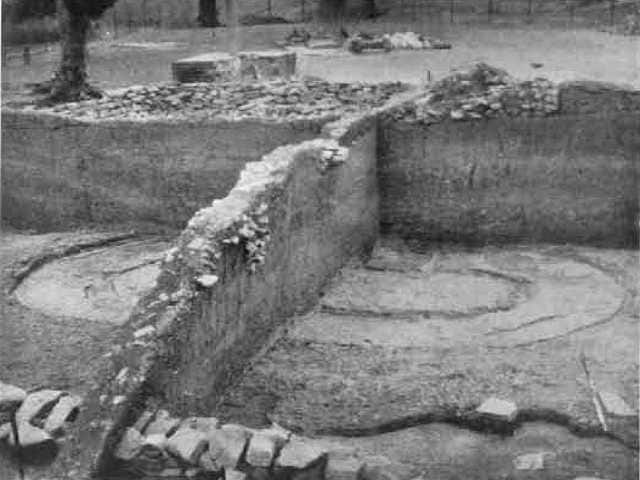 The outline of an elliptic temple structure that came to be seen after excavation of 1960s[/caption]This built a strong case for the Pillar to be part of a large ancient Vāsudeva mandir. This discovery of large Mandir Complex not only reinforces worship of Krishna way older times, but it also gives setback to those who believe Mandirs became popular only in Gupta Period.Then we have the Hathibada Ghosundi Inscriptions from Rajasthan which were found in three different spots of same vicinity going as old as 2nd Century BC talking of Krishna, Balram & construction of Mandir. The three spots where they were found are as under:
- Inside an ancient water well in Ghosundi
- At the boundary wall between Ghosundi & Bassi
- On a stone slab in the inner wall of Hathibada
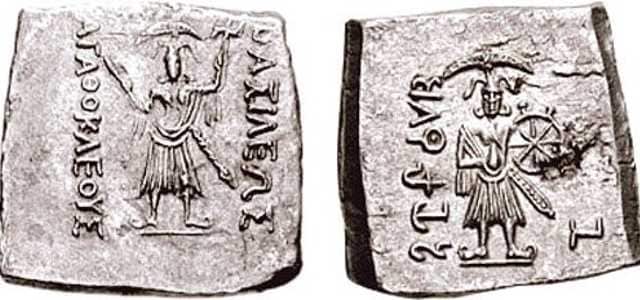 One may refer to following sources for study on same:
- Emergence of Viṣṇu and Śiva Images in India: Numismatic and Sculptural Evidence by Osmund Bopearachchi
- Iconography of Balarāma by NP Joshi, page 22
First Published:Aug 19, 2022, 18:32:14 IST
Advertisement
Advertisement

When Manila and Tokyo draw a line, Beijing draws a red line
What should have been a routine maritime-boundary negotiation between Japan and the Philippines has become a contest over China’s power to veto its neighbours’ strategic choices
6 min read
Bangladesh gets a new envoy to reset its India ties
The selection of a serving foreign secretary underscores the seriousness with which Dhaka now views its relationship with New Delhi
3 min read
Escalation trap to an exit strategy: How can the Iran war end?
This war is no longer about outright victory; it is about finding an exit without appearing to lose
7 min read
India must seize its demographic dividend before it fades
Adequate funding for universal education, leak-proof exams and job creation are vital to leverage India's demographic dividend before it’s too late
4 min read
Bangladesh’s instability has sharpened India’s ‘Chicken Neck’ challenge
India could consider notifying a union territory around the Siliguri Corridor consisting of parts of all bordering districts
8 min read
Advertisement
Advertisement