


Science meet in Goa: Before Newton, Kerala's Madhava gave key mathematical concepts
After suggesting that the Pythagorean theorem had its roots in India, scientists at a national science conference now appear to have stolen Isaac Newton's thunder too.

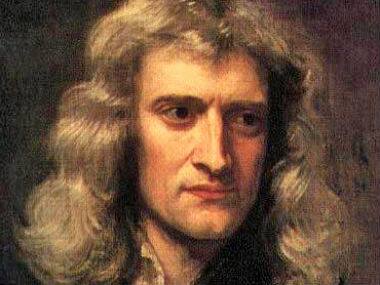
A photo of Isaac Netwon. Image for representational purposes only.[/caption]While Newton was born in the 1600s, Indian astronomer and mathematician Madhava was born in Thrissur, Kerala in the mid 1300s.The Sammelan, which had scientists from across 24 Indian states and was attended by several thousand people over the three days ending Sunday, had four union ministers including Defence Minister Manohar Parrikar as well as Goa Chief Minister Laxmikant Parsekar as chief patrons.Sahasrabuddhe also said ancestors of modern day Indians had used the principles of the Pythagoras theorem to perform yagnas, long before the Greek scientists came up with the Pythagoras theorem. "Many people can relate to many things that Pythagorean theorem, it was already there when our ancestors... they used to have 'yadnya vedikas' for performing yagnas so they used to make use of the Pythagorean theorem," Sahasrabuddhe said.The Sammelan was aimed at creating awareness about ancient Indian sciences and bridging traditional scientific knowledge with modern sciences.Seeking to draw inspiration from the past, the event also discussed several contentious scientific achievements from ancient India, which included an alloy composition from the pre-Mahabharata period which could make aeroplanes disappear."Bharadwaj rishi (sage) has mentioned that if we can have planes which can disappear, that alloy can be used and CSR Prabhu was successful in preparing that particular alloy in modern laboratory. So he is going to come and actually demonstrate that alloy which absorbs 80 percent of the light which falls on the surface," Sahasrabuddhe told IANS recently.He said the ancient alloy could help planes duck radars. Prabhu was one of the key speakers at the event. The conference also saw the exhibition of Akash, Brahmos missile models, the Arjuna battle tank, 3-D radars, bomb disposal robots, Mangalyan and Chandrayan models - all exemplars modern India's scientific and technological achievements.IANS

Here's why you crave sweets after every meal: This one thing can fix it
India's most beloved national parks for wildlife lovers
Even the Beckhams break: The rise of family estrangement
European Council Chief has an OCI card: What is it?
The 90s show Friends, and why we misread modern friendships