
Advertisement


Sections
Satyajit Sarna’s debut poetry collection, The Profane, is a meditation on death, dissent and our time on earth
The Profane is Delhi-based Satyajit Sarna’s first collection of poetry and has “poems of heartbreak and disillusion, of loneliness and mortality, but also of passion for life on earth, in all its mud and glory”.

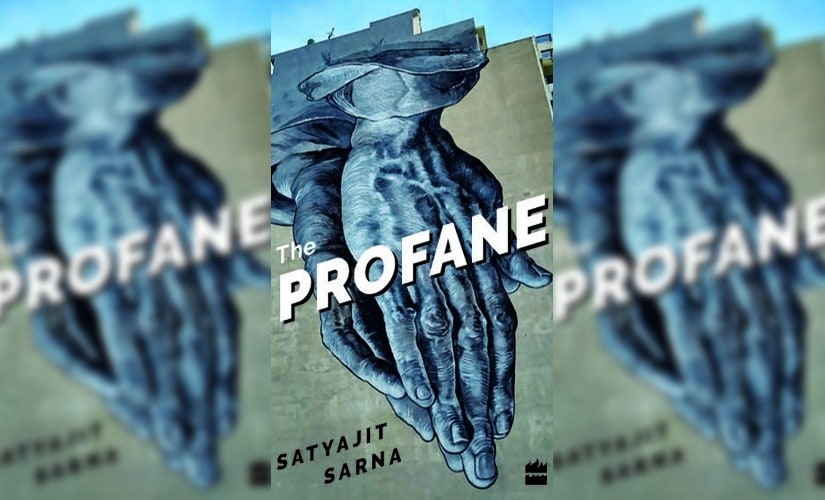 Satyajit Sarna’s The Profane[/caption]In Ozymandias in Doubt, a poem in this new collection, Satyajit writes about the insecurity that creators must grapple with, inspired by Shelley’s Ozymandias.A cold fear grips me.What if the mustachioed manOf 3026 finds your journalsWhen mine are dust and water“Writing poetry”, he says, “feels like it comes from a whole different universe than writing fiction. A short story or novel is written in warm contemplation, and it feels like a nice reliable engine is humming under you. Poetry is written in red hot white-hot heat; your job is to go with it, to hang with the torrent, and not to lie to yourself about what is coming forth. The good poems at any rate.”“The first thing I can recall writing, I think I was about five or six, was a sort of Boys First Adventure Story,” he says. “There was the building of a raft, and the crossing of a river. A horse played some part. This was not the world’s most eventful plot, I feel. I wrote things, little things, through school, sometimes for the joy of it. What I do remember doing, though, is reading, all through school. Reading like my life depended on it, like there was nothing more to the whole world. I read so much crap. So many thrillers, so much very average science fiction and fantasy, all plot driven. I would have read the operating manual for a tractor back then, if I had to. Now that I look back (with guilt), there may not have been a single female writer or female first-person protagonist in the whole lot of it. They just did not exist in my universe. It was a strange blinkered sort of reading. But it was reading, thank god,” he says.Death lingers around a lot of the poems in this collection. “It does. I think about it a lot,” he says, “I can’t say why. But it is one of the big human questions – how we deal with death, and more importantly, how we deal with life in the shadow of death. What do we leave behind? What is it worth, after we are gone? What does it mean to inherit and to transmit?” In No Mas (For Chris Conell, aged fifty-two), he says,Some night when I sayI want to die,I mean it.In Shirts, Satyajit writes,I don’t doubt it – Death lived with her, caressed her hair,held her for some time before they found her lying cold.In The Mourners, he says,Comforting the bereaved is like juggling with daggers.And even in the Renaissance painter Botticelli’s version of the famous Annunciation (in which the archangel Gabriel descends to tell the virgin that she will bear the Christ) Satyajit sees the inevitable.You will raise a soldier, he will die;Your arms will hold his bird-bones, they will rollOff your lap, into the ground, and his soul into the sky.“In Botticelli’s Annunciation, I was thinking about how futile that holy message could have seemed to any one of us, how hollowing. No one wants to be a mother to a martyr. But that is the nature of miracles for those who have faith…” he says.
The political is also personal in The Profane, with poems like National Anthem and I Dreamt of a Lynching. Both poems, reflections of our times, use death in a manner that is markedly different from the others. But the most chilling of poems of this kind is Martyrdom (In 1984, when it happened, it begins), and describes the killing of a man…he went up in a curtain of flame,dancing for them, screaming, until the fire’s tonguehad kissed his lungs, spinning like a dervishAt what point do you feel like a piece is done, I ask and Satyajit says, “I don’t know. It’s a big question – a lot of poets struggle with it. Valery of course famously said that a poem is never finished, only abandoned. There is probably a point where your changes to a thing change it without necessarily improving the thing in itself. And we are all always improving, always learning more about truth and life and the craft. Robert Lowell, for example, did not hesitate to write and rewrite poems, and republish them consequently. There is a certain attraction to chipping away and polishing for ever and ever. On the other, here we are, imperfect, getting bent ever further out of shape as creatures. Yet we have this miraculous, this demiurgic ability, to create things, so to speak, ex nihilo – art and music and poems. So beyond a point, even imperfect, it is okay to release our children into the world, as soon as we are comfortable they can survive. It frees their creator.”[caption id="attachment_6079731" align="alignnone" width="825"]
 Satyajit Sarna. Image courtesy of Satyajit Sarna[/caption]There's a certain sensitivity in a lot of the poetry that is about people, and relationships, in this book. Poetry that is personal involves putting yourself out there. Does that worry this writer? “Oh definitely! Publishing poetry is scary, it feels like taking off one's clothes in public. If it is good, if it can speak to anyone, it necessarily has an element of that nakedness to it. We live in an age of emotional exhibitionism – it would have been mad twenty years ago for anyone to get up in front of a thousand people they know, and tell them an intimate anecdote, or confess that they are feeling blue. Yet, we often do now, across platforms. Our personal is very public. But our very personal, our truly secret, seldom creeps onto our feeds. That’s where the good confessional poetry lives – alone under the one light, in front of strangers. But what’s magical is that you are not the only person to feel this way, not the only person to share those anxieties and fears and furtive joys. That element of empathy makes the personal universal.”Satyajit who’s currently reading “Mary Beard’s SPQR, a very readable history of the rise of Rome, Frantz Fanon’s The Wretched of the Earth, his seminal clarion call for the decolonisation of minds and lands, rereading an old favourite, Umberto Eco’s The Name of the Rose, and Zeina Hashem Beck’s collection of poems, Louder than Hearts,” says he is also working on something that “feels like a very large, nameless, shapeless thing right now. What I can say is that I'm trying to stay true to the prime directive – write the book you would really, really enjoy reading.”
First Published:Feb 16, 2019, 09:31:25 IST
Advertisement
Advertisement

Here's why you crave sweets after every meal: This one thing can fix it
It's common to crave something sweet after meals. However, what's often dismissed as "having a sweet tooth," is mostly nutritional deficiency
1 min read
India's most beloved national parks for wildlife lovers
India holds some of the world’s most wonderful wilderness spaces. Forests and jungles where myth, beauty and survival exist side by side. From mangroves that swallow rivers to grasslands shaped by centuries of migration, the country’s national parks offer more than sightings. They offer moments of stillness, surprise, and reverence.
1 min read
Even the Beckhams break: The rise of family estrangement
People are choosing to cut off contact with their families, prioritising mental health.
4 min read
European Council Chief has an OCI card: What is it?
The OCI Scheme, introduced in 2005, grants foreign nationals of Indian origin a life-long visa for India, but no political rights.
1 min read
The 90s show Friends, and why we misread modern friendships
We’ve all heard about the loneliness epidemic at this point. It isn’t even particularly shocking — it seems like the result on the obvious — people consistently glued to their phones, seeking intimacy and even sex through phone screens, consistent comparison to other peoples’ partners, and what their relationships look like, to how far everyone has come in their jobs — there is much to feel diminished about.
5 min read
Advertisement
Advertisement