
Advertisement


Sections
Nobel Prize for Literature 2018 winner Olga Tokarczuk looks forward to a new form of fiction in a 'differentiated, divided' world
Olga Tokarczuk is the 2018 Nobel literature laureate. Her prize was announced only two months ago because the Swedish Academy postponed naming a winner last year due to internal turmoil connected with a sex abuse scandal.

Nobel Literature Prize winner Olga Tokarczuk says she thinks a new sort of fiction may be needed to counteract the modern era’s tendency to isolate and divide people.[caption id="attachment_7763471" align="alignleft" width="380"]![Olga Tokarczuk at a press conference at the Swedish Academy in Stockholm. The Associated Press/Anders Wiklund]() Olga Tokarczuk at a press conference at the Swedish Academy in Stockholm. The Associated Press/Anders Wiklund[/caption] In her Saturday lecture in Stockholm ahead of receiving the prize on 10 December, the Polish author complained of the “exhausting white noise of oceans of information” in the internet era."The world is dying, and we are failing to notice. We fail to see that the world is becoming a collection of things and incidents, a lifeless expanse in which we move around lost and lonely, tossed here and there by somebody else’s decisions, constrained by an incomprehensible fate, a sense of being the plaything of the major forces of history or chance. Our spirituality is either vanishing or becoming superficial and ritualistic. Or else we are just becoming the followers of simple forces―physical, social, and economic―that move us around as if we were zombies. And in such a world we really are zombies," she said, as quoted in the Nobel Prize official website.— Read Olga Tokarczuk's entire Nobel Lecture here.“It has turned out that we are not capable of bearing this enormity of information, which instead of uniting, generalizing and freeing, has differentiated, divided and enclosed us in individual little bubbles,” she added.Tokarczuk suggested this discourages people from understanding how actions are interconnected, thus contributing to the climate crisis and political tensions.She said she dreams of a new kind of “fourth-person” narrator in fiction who could encompass the views of each character in a novel "as well as having the capacity to step beyond the horizon of each of them, who sees more and has a wider view, and who is able to ignore time."“We can regard this figure of a mysterious, tender narrator as miraculous and significant. This is a point of view, a perspective, from which everything can be seen. Seeing everything means recognizing the ultimate fact that all things that exist are mutually connected into a single whole, even if the connections between them are not yet known to us,” she said.Tokarczuk is the 2018 literature laureate. Her prize was announced only two months ago because the Swedish Academy postponed naming a winner last year due to internal turmoil connected with a sex abuse scandal.The Nobel prizes in physics, chemistry, medicine, economics and literature are being presented on Tuesday in the Swedish capital.Earlier on 7 December, several Nobel laureates in science spoke about climate change at their news conferences in Stockholm.Didier Queloz, an astronomer who shares this year’s Nobel physics prize for discovering a planet outside the Earth’s solar system, said people who shrug off climate change on the grounds that humans will eventually leave for distant planets are wrong.“The stars are so far away I think we should not have any serious hope to escape the Earth,” Queloz said. ”We’re not built to survive on any other planet than this one ... we’d better spend our time and energy trying to fix it.”Watch Olga Tokarczuk's Nobel Lecture here:— With inputs from The Associated Press and © THE NOBEL FOUNDATION 2019
Olga Tokarczuk at a press conference at the Swedish Academy in Stockholm. The Associated Press/Anders Wiklund[/caption] In her Saturday lecture in Stockholm ahead of receiving the prize on 10 December, the Polish author complained of the “exhausting white noise of oceans of information” in the internet era."The world is dying, and we are failing to notice. We fail to see that the world is becoming a collection of things and incidents, a lifeless expanse in which we move around lost and lonely, tossed here and there by somebody else’s decisions, constrained by an incomprehensible fate, a sense of being the plaything of the major forces of history or chance. Our spirituality is either vanishing or becoming superficial and ritualistic. Or else we are just becoming the followers of simple forces―physical, social, and economic―that move us around as if we were zombies. And in such a world we really are zombies," she said, as quoted in the Nobel Prize official website.— Read Olga Tokarczuk's entire Nobel Lecture here.“It has turned out that we are not capable of bearing this enormity of information, which instead of uniting, generalizing and freeing, has differentiated, divided and enclosed us in individual little bubbles,” she added.Tokarczuk suggested this discourages people from understanding how actions are interconnected, thus contributing to the climate crisis and political tensions.She said she dreams of a new kind of “fourth-person” narrator in fiction who could encompass the views of each character in a novel "as well as having the capacity to step beyond the horizon of each of them, who sees more and has a wider view, and who is able to ignore time."“We can regard this figure of a mysterious, tender narrator as miraculous and significant. This is a point of view, a perspective, from which everything can be seen. Seeing everything means recognizing the ultimate fact that all things that exist are mutually connected into a single whole, even if the connections between them are not yet known to us,” she said.Tokarczuk is the 2018 literature laureate. Her prize was announced only two months ago because the Swedish Academy postponed naming a winner last year due to internal turmoil connected with a sex abuse scandal.The Nobel prizes in physics, chemistry, medicine, economics and literature are being presented on Tuesday in the Swedish capital.Earlier on 7 December, several Nobel laureates in science spoke about climate change at their news conferences in Stockholm.Didier Queloz, an astronomer who shares this year’s Nobel physics prize for discovering a planet outside the Earth’s solar system, said people who shrug off climate change on the grounds that humans will eventually leave for distant planets are wrong.“The stars are so far away I think we should not have any serious hope to escape the Earth,” Queloz said. ”We’re not built to survive on any other planet than this one ... we’d better spend our time and energy trying to fix it.”Watch Olga Tokarczuk's Nobel Lecture here:— With inputs from The Associated Press and © THE NOBEL FOUNDATION 2019
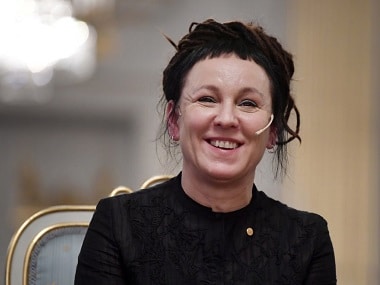 Olga Tokarczuk at a press conference at the Swedish Academy in Stockholm. The Associated Press/Anders Wiklund[/caption] In her Saturday lecture in Stockholm ahead of receiving the prize on 10 December, the Polish author complained of the “exhausting white noise of oceans of information” in the internet era."The world is dying, and we are failing to notice. We fail to see that the world is becoming a collection of things and incidents, a lifeless expanse in which we move around lost and lonely, tossed here and there by somebody else’s decisions, constrained by an incomprehensible fate, a sense of being the plaything of the major forces of history or chance. Our spirituality is either vanishing or becoming superficial and ritualistic. Or else we are just becoming the followers of simple forces―physical, social, and economic―that move us around as if we were zombies. And in such a world we really are zombies," she said, as quoted in the Nobel Prize official website.— Read Olga Tokarczuk's entire Nobel Lecture here.“It has turned out that we are not capable of bearing this enormity of information, which instead of uniting, generalizing and freeing, has differentiated, divided and enclosed us in individual little bubbles,” she added.Tokarczuk suggested this discourages people from understanding how actions are interconnected, thus contributing to the climate crisis and political tensions.She said she dreams of a new kind of “fourth-person” narrator in fiction who could encompass the views of each character in a novel "as well as having the capacity to step beyond the horizon of each of them, who sees more and has a wider view, and who is able to ignore time."“We can regard this figure of a mysterious, tender narrator as miraculous and significant. This is a point of view, a perspective, from which everything can be seen. Seeing everything means recognizing the ultimate fact that all things that exist are mutually connected into a single whole, even if the connections between them are not yet known to us,” she said.Tokarczuk is the 2018 literature laureate. Her prize was announced only two months ago because the Swedish Academy postponed naming a winner last year due to internal turmoil connected with a sex abuse scandal.The Nobel prizes in physics, chemistry, medicine, economics and literature are being presented on Tuesday in the Swedish capital.Earlier on 7 December, several Nobel laureates in science spoke about climate change at their news conferences in Stockholm.Didier Queloz, an astronomer who shares this year’s Nobel physics prize for discovering a planet outside the Earth’s solar system, said people who shrug off climate change on the grounds that humans will eventually leave for distant planets are wrong.“The stars are so far away I think we should not have any serious hope to escape the Earth,” Queloz said. ”We’re not built to survive on any other planet than this one ... we’d better spend our time and energy trying to fix it.”Watch Olga Tokarczuk's Nobel Lecture here:
First Published:Dec 10, 2019, 12:25:56 IST
Advertisement
Advertisement

Here's why you crave sweets after every meal: This one thing can fix it
It's common to crave something sweet after meals. However, what's often dismissed as "having a sweet tooth," is mostly nutritional deficiency
1 min read
India's most beloved national parks for wildlife lovers
India holds some of the world’s most wonderful wilderness spaces. Forests and jungles where myth, beauty and survival exist side by side. From mangroves that swallow rivers to grasslands shaped by centuries of migration, the country’s national parks offer more than sightings. They offer moments of stillness, surprise, and reverence.
1 min read
Even the Beckhams break: The rise of family estrangement
People are choosing to cut off contact with their families, prioritising mental health.
4 min read
European Council Chief has an OCI card: What is it?
The OCI Scheme, introduced in 2005, grants foreign nationals of Indian origin a life-long visa for India, but no political rights.
1 min read
The 90s show Friends, and why we misread modern friendships
We’ve all heard about the loneliness epidemic at this point. It isn’t even particularly shocking — it seems like the result on the obvious — people consistently glued to their phones, seeking intimacy and even sex through phone screens, consistent comparison to other peoples’ partners, and what their relationships look like, to how far everyone has come in their jobs — there is much to feel diminished about.
5 min read
Advertisement
Advertisement