
Advertisement


Sections
Jamini Roy: Google doodle pays tribute to master artist on his 130th birth anniversary
A Google doodle commemorated the 130th birth anniversary of the master artist Jamini Roy

Fluid brush strokes that were an exercise in poetry, colours that were an expression of earthiness and vibrancy, images that were rooted in the folk art forms — such are the hallmarks of a Jamini Roy painting.11 April 2017 marks the 130th birthday of the master, and a Google Doodle commemorated the occasion with a sketch that pays homage to Roy's signature aesthetic.Roy was born in 1887 in then-undivided Bengal, into a family of middle-class landowners. He was sent, at the age of 16, to study at the Government School of Art in Kolkata.His initial forays in art — in the 1920s — were not memorable, some critics note. But all the while, Roy was working on developing his own voice as an artist.He found it in the folk art forms of Bengal. In a profile titled 'Jamini Roy: The Versatile, Experimental Artist', Alok Deshwal writes of these early attempts:"He would paint a little and then something... made him obliterate what he had painted earlier. This went on for a good few days till he suddenly expressed (the) radically different visual ideas germinating in his mind. For the next few years, he did a suite of paintings featuring Santhal women... These paintings were stepping stones to even more dramatic changes in his visual language."[caption id="attachment_3378492" align="alignnone" width="825"]![jamini roy]() Artworks by Jamini Roy. Image courtesy Twitter[/caption]Roy drew inspiration especially from Kalighat pats (the style of painting that developed around the Kalighat temple area in the 19th century), and his paintings depicted ordinary figures from day-to-day/rural life, scenes from the epics and representations of animals.He didn't just turn to his roots for artistic interpretation — even the materials he used represented a return to basics."[Roy] restricted his palette to seven colours: Indian red, yellow ochre, cadmium green, vermillion, grey, blue and white. These were mostly earthy or mineral colours," notes the artist's page on the National Gallery of Modern Art website.Instead of canvas, he used indigenous materials like cloth, wood, and mats coated with lime.All of this led to him being counted among the greatest contemporary masters, and invited comparisons with Henri Matisse.What the acclaim meant to Roy is difficult to say — he was concerned mainly with his art, and spurned recognition. Indranil Banerjie notes in a piece written in 1987 for the India Today magazine that Roy was a prolific artist — he painted over 20,000 works of art in his lifetime; during his prime, he averaged about 10 canvasses a day, and rarely sold any of his paintings for a price higher than Rs 350. He would even buy back works from those he felt wouldn't take care of the art the way it was meant to be.Roy was awarded the Padma Bhushan in 1955, and Indira Gandhi (among the admirers of his work, as was Mahatma Gandhi) declared him a national artist.Roy passed away in 1972, leaving many of his paintings unsigned. His signature over the world of art, however remains indelible.View a virtual gallery of Roy's works here.
Artworks by Jamini Roy. Image courtesy Twitter[/caption]Roy drew inspiration especially from Kalighat pats (the style of painting that developed around the Kalighat temple area in the 19th century), and his paintings depicted ordinary figures from day-to-day/rural life, scenes from the epics and representations of animals.He didn't just turn to his roots for artistic interpretation — even the materials he used represented a return to basics."[Roy] restricted his palette to seven colours: Indian red, yellow ochre, cadmium green, vermillion, grey, blue and white. These were mostly earthy or mineral colours," notes the artist's page on the National Gallery of Modern Art website.Instead of canvas, he used indigenous materials like cloth, wood, and mats coated with lime.All of this led to him being counted among the greatest contemporary masters, and invited comparisons with Henri Matisse.What the acclaim meant to Roy is difficult to say — he was concerned mainly with his art, and spurned recognition. Indranil Banerjie notes in a piece written in 1987 for the India Today magazine that Roy was a prolific artist — he painted over 20,000 works of art in his lifetime; during his prime, he averaged about 10 canvasses a day, and rarely sold any of his paintings for a price higher than Rs 350. He would even buy back works from those he felt wouldn't take care of the art the way it was meant to be.Roy was awarded the Padma Bhushan in 1955, and Indira Gandhi (among the admirers of his work, as was Mahatma Gandhi) declared him a national artist.Roy passed away in 1972, leaving many of his paintings unsigned. His signature over the world of art, however remains indelible.View a virtual gallery of Roy's works here.
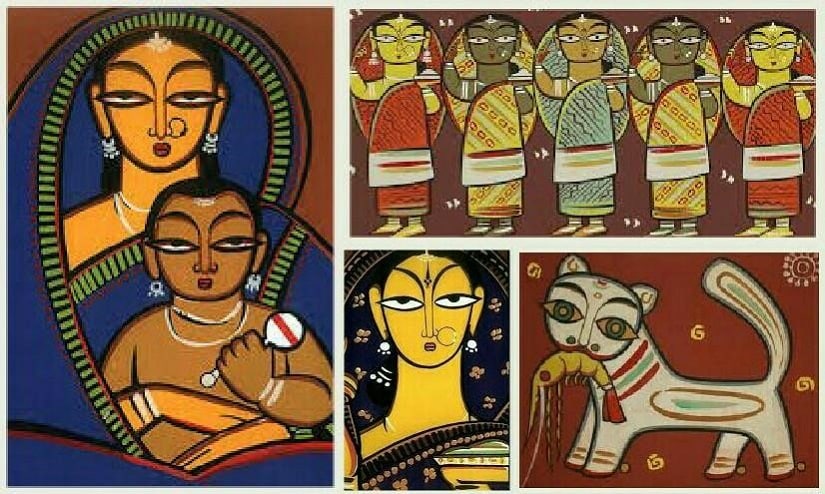 Artworks by Jamini Roy. Image courtesy Twitter[/caption]Roy drew inspiration especially from Kalighat pats (the style of painting that developed around the Kalighat temple area in the 19th century), and his paintings depicted ordinary figures from day-to-day/rural life, scenes from the epics and representations of animals.He didn't just turn to his roots for artistic interpretation — even the materials he used represented a return to basics."[Roy] restricted his palette to seven colours: Indian red, yellow ochre, cadmium green, vermillion, grey, blue and white. These were mostly earthy or mineral colours," notes the artist's page on the National Gallery of Modern Art website.Instead of canvas, he used indigenous materials like cloth, wood, and mats coated with lime.All of this led to him being counted among the greatest contemporary masters, and invited comparisons with Henri Matisse.What the acclaim meant to Roy is difficult to say — he was concerned mainly with his art, and spurned recognition. Indranil Banerjie notes in a piece written in 1987 for the India Today magazine that Roy was a prolific artist — he painted over 20,000 works of art in his lifetime; during his prime, he averaged about 10 canvasses a day, and rarely sold any of his paintings for a price higher than Rs 350. He would even buy back works from those he felt wouldn't take care of the art the way it was meant to be.Roy was awarded the Padma Bhushan in 1955, and Indira Gandhi (among the admirers of his work, as was Mahatma Gandhi) declared him a national artist.Roy passed away in 1972, leaving many of his paintings unsigned. His signature over the world of art, however remains indelible.View a virtual gallery of Roy's works here.
First Published:Apr 11, 2017, 10:49:35 IST
Advertisement
Advertisement

Here's why you crave sweets after every meal: This one thing can fix it
It's common to crave something sweet after meals. However, what's often dismissed as "having a sweet tooth," is mostly nutritional deficiency
1 min read
India's most beloved national parks for wildlife lovers
India holds some of the world’s most wonderful wilderness spaces. Forests and jungles where myth, beauty and survival exist side by side. From mangroves that swallow rivers to grasslands shaped by centuries of migration, the country’s national parks offer more than sightings. They offer moments of stillness, surprise, and reverence.
1 min read
Even the Beckhams break: The rise of family estrangement
People are choosing to cut off contact with their families, prioritising mental health.
4 min read
European Council Chief has an OCI card: What is it?
The OCI Scheme, introduced in 2005, grants foreign nationals of Indian origin a life-long visa for India, but no political rights.
1 min read
The 90s show Friends, and why we misread modern friendships
We’ve all heard about the loneliness epidemic at this point. It isn’t even particularly shocking — it seems like the result on the obvious — people consistently glued to their phones, seeking intimacy and even sex through phone screens, consistent comparison to other peoples’ partners, and what their relationships look like, to how far everyone has come in their jobs — there is much to feel diminished about.
5 min read
Advertisement
Advertisement