


Another one bites the dust: Will Mamata's London visit save Kolkata's disappearing architecture?
Mamata Banerjee wants to buy the house Rabindranath Tagore lived in in London.

Mamata Banerjee wants to buy the house Rabindranath Tagore lived in in London. That’s where he is believed to have written his Gitanjali. “Tagore is our pride,” the West Bengal chief minister told TOI. But while Didi is trying to save India’s heritage in London, her own city’s architectural inheritance is being razed to the ground.In Kolkata however that’s called being “promoted”.“Promoters keep calling and we receive all sorts of temptation,” says Dhritishankar Sen. His ancestral home in South Kolkata was built in 1937. His grandfather Tarak Nath Sen was a legendary professor at Presidency College and the house he says was “a cultural hub of the city”. Houses like his home, with French windows and cast iron railings, once dotted South Kolkata. Now they are being replaced by cookie-cutter multistoried apartment blocks. Sen says there were other houses on his street that were probably aesthetically superior. “But they are not there anymore. We are still resisting.”Writer Amit Chaudhuri has been spearheading a campaign to raise awareness about this very issue. His petition on Avaaz.org has already garnered over 1900 signatures and a letter of support from Amartya Sen. But the deeper issue is a mindset one.[caption id="attachment_2369964" align="alignleft" width="380"] Mamata Banerjee. Agecies.[/caption]Mamata Banerjee is interested in a house in Hampstead because Tagore lived there. Tagore did not live in these houses of South Kolkata. But that does not make them disposable. “ Heritage in this city rarely engages with architecture except in pre-ordained terms,” says Chaudhuri. The birthplaces of famous people. The buildings designed by iconic architects. The seat of imperial power. And the city’s heritage commission is anyway largely toothless and its rules are flouted with impunity. “Heritage is not a good word," says Chaudhuri. "It’s static, it makes you nostalgic but these are new houses, the houses of Calcutta’s modernity.”Instead of putting the dustcover of heritage over them Chaudhuri thinks of these neighbourhoods as places of “urban renewal”. Unfortunately the residents often think of them merely as prime land. The houses are sold for the price of land and before long the character of the entire locality is irredeemably lost. These neighbourhoods are now pockmarked with loss, filled with rubble-strewn vacant lots where a lonely slatted French window propped against a half-demolished wall bears mute witness to what is gone.As she went on her London walk, Mamata said that the pressures on her home state are different from the pressures on London. Nine crores live in Bengal while only six crores live in all of United Kingdom. They need jobs. They need homes. Developers say they are only filling a need for housing. A sprawling bungalow with shady rain trees outside looks lovely but a multi-storeyed building accommodates many more people. People sell their homes because their children have left the city and the buildings are hard to maintain. While the quaint two-storey houses look beautiful in photographs, with their spiral staircases and red oxide floors, the pictures do not capture the reality of roofs that stubbornly leak with every monsoon and the termites burrowing through the walls. And anyway why should the government get in the way of individuals who want to cash in?But it’s not just about individual decision. The chief minister once decreed that those who painted their houses in the designated city colours of Mother Teresa blue and white would get a property tax exemption. But does the Kolkata Municipal Corporation do anything to help a home owner who wants to hold onto one of these distinctive houses?“They don’t care a damn,” says Megha Agarwal. Her uncle had bought a rambling 110-year-old bungalow in South Kolkata with plans to raze it to the ground. Agarwal fell in love with the building and decided to restore it and build a boutique hotel. She knew it would be an architectural challenge and many contractors were not willing to take on the job of even getting a fire license. But what made it really “demotivating” was how indifferent the city leaders were to the project. “We are heavily marketing Calcutta but they are not cooperating,” she says. She had to stop work for 6 months while trying to sort out the title deed for the 110-year-old building without which the city would not give her a trade license. The Corner Courtyard, her boutique hotel is now up and running but she says she is still “jumping through hoops to try and acquire a liquor license.”The Corner Courtyard looks elegant – a ravaged house given a new lease of life with black and white checkered floors, rosewood and Burma teak period furniture and the old-style railings across the balcony. “I’d love to keep doing this,” says Agarwal. “But somewhere a law body has to step in and make life easier.”[caption id="attachment_2369976" align="alignleft" width="380"]
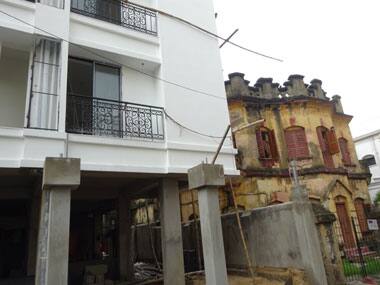 Old Kolkata houses make way for new buildings. Picture courtesy: Sandip Roy[/caption]The bitter truth is the spirit is willing but the law body is weak. The politicians who control them have little incentive to step in. In industry-strapped Bengal, real estate speculation is one business that is still booming. Kolkata is a city of middlemen and politicians accumulate power through the control of syndicates who supply sand, chips, bricks to building projects. New apartment blocks which require all kinds of permits and permissions grease the city’s corruption machinery. There is a whole ecosystem that feeds off the destruction of these houses.Architect Partha Ranjan Das says he has been advocating trying out a Transference of Development Rights (TDR) policy for a while. It’s been used in many cities from New York to Mumbai. TDR has been used to save historic buildings by transferring the development rights to other properties where developers can now build more than was allowed by local land use and zoning policies.The idea is that it will be more profitable all around to sell unused development rights than just sell the house for the value of the land it stands on. The Corporation will get revenue, promoters will get incentives and the homeowner will get money for maintenance from selling the development rights. If five people own a building, and two of them live abroad they can sell off their TDR and that might be enough to save the building says Das. But the Corporation has shown little interest. “Nothing is 100% fool-proof,” says Das. “But are we going to wait for Kolkata to be entirely destroyed before coming up with a masterplan?”And that’s a very real possibility. Other cities like Pune have lost much of their neo-Gothic heritage in a haphazard rush to development. Dhritishankar Sen is hopeful that a campaign like this will at least make people aware of the issue instead of just succumbing to the lure of the promoter. “I want to bring to people’s attention that what we take as a given is not a given in other cities,” says Chaudhuri citing Berlin’s Prenzlauerberg as an example of urban renewal. “This is not only about houses but our disgengagement.” His petition, while addressed to the chief minister and the mayor, has not yet been delivered to Didi’s desk. One of the signatories is Trinamool MP Sugata Bose who is accompanying the CM to London.Mamata’s London visit might make her more receptive to the idea. There are some flickers of hope. As Didi took in the sights of London on a walking tour she was apparently “mesmerized” by London’s architecture.“Where is Sovan (Kolkata mayor Sovan Chatterjee)?” Mamata called out according to TOI. “I hope he is getting some idea of how we need to maintain Kolkata’s architectural heritage.”Alas, unable to keep up with Didi’s brisk pace, Kolkata’s portly mayor had hopped into a taxi and snuck back to his hotel.

Here's why you crave sweets after every meal: This one thing can fix it
India's most beloved national parks for wildlife lovers
Even the Beckhams break: The rise of family estrangement
European Council Chief has an OCI card: What is it?
The 90s show Friends, and why we misread modern friendships