


The Odyssey review: Christopher Nolan delivers spectacle with surprising restraint
The Odyssey review: Christopher Nolan delivers a visually breathtaking adaptation of Homer's epic, anchored by Matt Damon and Anne Hathaway, but it does suffer from a emotionally distant screenplay.

Christopher Nolan has never been interested in making straightforward historical spectacles. Even when he tells stories rooted in history or mythology, he searches for the human dilemma beneath the grandeur. The Odyssey is no different.
This isn't a film about the legendary king who defeated Troy. It's about the man who had to live with what came after. That distinction shapes almost every creative decision Nolan makes.
Instead of turning Homer's epic into three hours of relentless action, he slows it down, allowing audiences to sit with Odysseus' fractured memories, his exhaustion and, above all, his guilt. It is an ambitious choice, and at times, a deeply rewarding one. But it also becomes the film's biggest weakness.
 More from Lifestyle
There is absolutely no questioning why Nolan insisted audiences experience The Odyssey in IMAX. Hoyte van Hoytema's cinematography is breathtaking. Every frame feels almost mythical, recreating a civilisation that has existed for centuries in literature but rarely with this kind of scale on screen. The landscapes appear suspended somewhere between history and dream, making ancient Greece feel both familiar and impossibly distant.
The Cyclops (Bill Irwin) sequence is undoubtedly the film's biggest spectacle. Nolan stages it with remarkable restraint instead of relying purely on CGI excess, and the tension keeps you completely invested.
Circe (played by Samantha Morton)'s island is equally captivating, while the world of Calypso (Charlize Theron) unfolds almost like a dream. It is slower, quieter and deliberately hazy.
The sequence may frustrate some viewers, but it also serves a purpose. By this point, Odysseus himself is struggling to hold on to memory. Those familiar with Homer's text will recognise the significance of the lotus, which dulls memory and weakens one's attachment to the past. The film mirrors that emotional state, even if it slightly disrupts the pacing.
The emotional journey doesn't quite land
The Odyssey asks audiences to understand a warrior haunted by war rather than celebrate his victories. The problem is that for much of its runtime, we are told about Odysseus' suffering instead of truly feeling it.
Yes, we know he brought down Troy. Yes, we understand that countless lives were lost. But Nolan's screenplay doesn't always allow us inside Odysseus' mind enough to fully grasp the burden he carries. His longing for Penelope, Telemachus and Ithaca is evident, but the deeper psychological scars of war remain frustratingly distant for most of the film.
Ironically, the answer arrives only towards the end. The brief glimpses of the Trojan War become the emotional key that unlocks everything Nolan has been building towards. The sequence becomes the emotional centrepiece of the film and perhaps the only moment where we truly understand what has kept Odysseus awake all these years.
That sequence is devastating. It suddenly reframes the sleepless nights, the guilt and the endless wandering, making you wish the screenplay had trusted those emotions much earlier.
The performances
Matt Damon completely commits to Odysseus' physical and emotional journey. His transformation is visible not only through his performance but also through the gradual deterioration of his body. The weight loss, the weary eyes and the quiet resignation all communicate a man who has spent years merely surviving rather than living. He plays Odysseus as someone who did what he had to do, but never truly forgave himself for it.
Anne Hathaway, meanwhile, becomes the emotional anchor of the story. Despite limited screen time, she makes every appearance count. Her Penelope is resilient without becoming performative, carrying the impossible burden of protecting both her kingdom and her son while refusing to surrender hope.
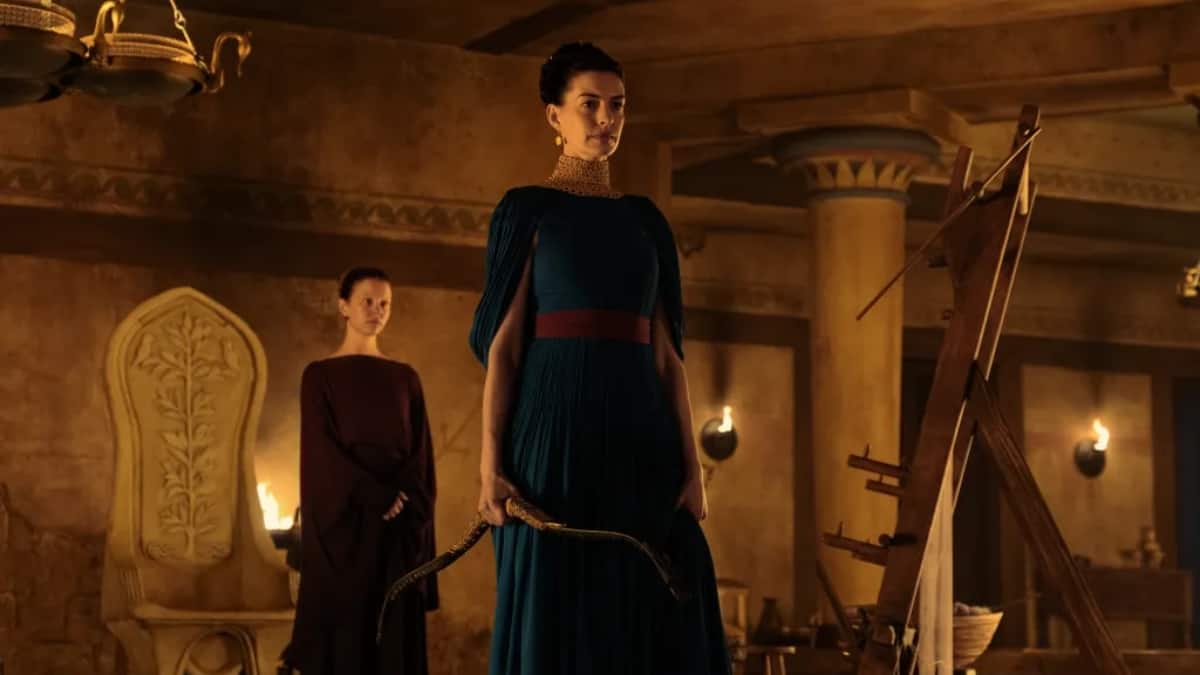
Robert Pattinson also impresses as the calculating Antinous, giving the antagonist enough menace without reducing him to a caricature.
Among the supporting cast, Himesh Patel deserves special mention. Despite early conversations around his casting, he delivers a remarkably grounded Eurylochus, becoming one of Odysseus' most dependable companions.
John Leguizamo also leaves an impression as Eumaeus, whose unwavering loyalty quietly reinforces the film's emotional core.
The same cannot be said for everyone else. Tom Holland's Telemachus rarely gets enough material to develop beyond being the waiting son who is still a boy and yet to prove his worth.
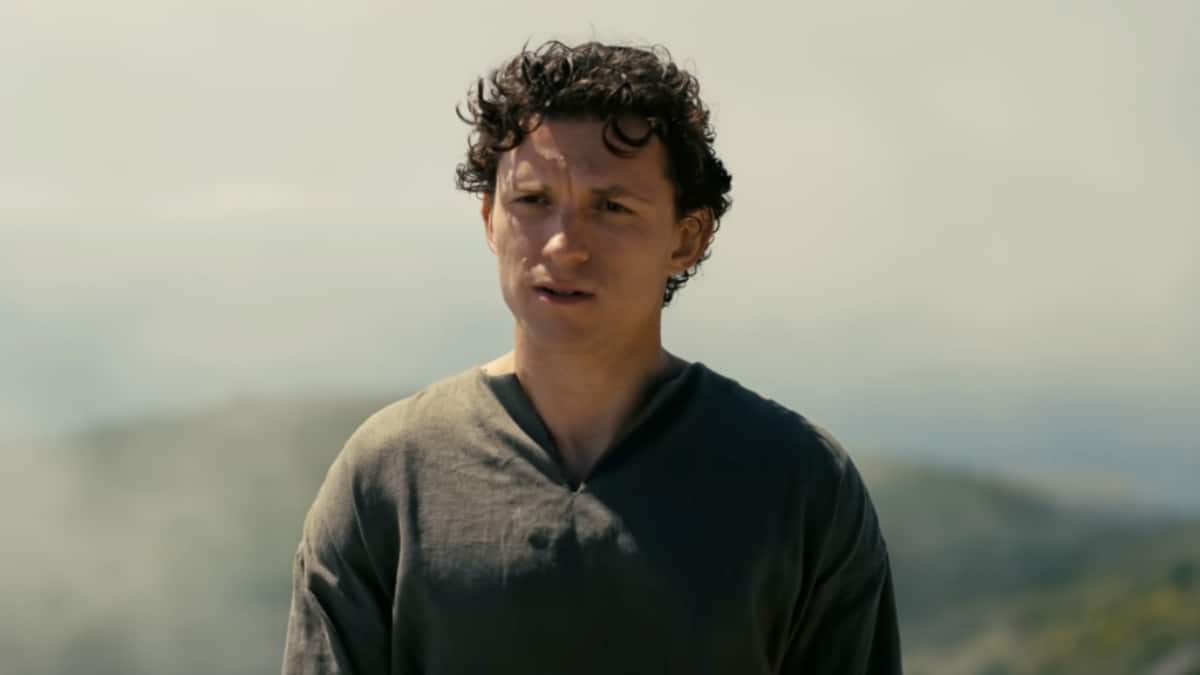
Zendaya's Athena appears only in fleeting moments despite the anticipation surrounding her role, while Lupita Nyong'o's Helen is similarly underused.
And then there's Travis Scott. If words could correctly describe it, he's the 'much-ado-about-nothing' character in the film.
Nolan and the women of The Odyssey
One of Nolan's most thoughtful decisions lies in how he writes the women. The film never pauses to make grand declarations about gender, yet it quietly exposes how power functions in a deeply patriarchal society.
One conversation between Penelope and Telemachus stands out in particular, when she reminds him that people overlook the fact that she sits on the throne simply because she is not a man.
The moment is brief, beautifully written and doesn't linger long enough to look preachy. It trusts the audience to understand its significance.
The modern language- distraction or relatable?
For a film so meticulously crafted, a few creative choices feel oddly modern. The contemporary American accents never fully disappear into the ancient setting. And some dialogue choices are genuinely distracting.
When Telemachus refers to Odysseus as "Dad," it momentarily pulls you out of Homer's world. The occasional expletives have a similar effect. These are small complaints in a three-hour film, but they are noticeable enough to interrupt the immersion Nolan otherwise works so hard to create.
Is The Odyssey Christopher Nolan's best film?
For me, no! But, that doesn't make it any less impressive.
Adapting Homer's epic is an enormous undertaking, and Nolan deserves credit for resisting the temptation to create an action spectacle from beginning to end. Instead, he chooses introspection over constant battle, focusing less on Odysseus' victories than on what those victories cost him. That restraint is what truly elevates it.
The screenplay may not always bridge the emotional distance between the audience and its hero, but the film succeeds in reminding us why The Odyssey continues to matter nearly three millennia later.
More than becoming a fantasy tale involving monsters, gods or impossible voyages and pining for home, it becomes about what war does to those who survive it (the dialogue- "War dehumanises men" echo long after the film is over) and about how civilisation, however broken, bruised and morally compromised, somehow continues to endure.
Rating- 4/5
Chief Sub Editor with a decade of experience in digital media, known for digging into behind-the-scenes trivia during interviews. Equal parts anime lover and pop-culture nerd, she spends her time ferociously hitting the keyboard, daydreaming between deadlines, travelling, chasing street food, and cracking unapologetically bad jokes.

Trade the hustle for the Shire: Inside the "hobbitmaxxing" trend
Spices, health and the Indian plate: Why chilli can be good for you—but moderation is still key
The right way to break up without feeling groggy
How Spider-Man actor Tom Holland has been on a sobriety journey of 4.5 years after being "addicted to alcohol"
Why Chennai is India's filter coffee capital, one tumbler at a time