


India could emerge as a major watchmaking ecosystem within five years: Titan Watches CEO
Kuruvilla Markose, CEO of Titan's watch division, on the growing appeal of mechanical and performance watches in India, why the country can emerge as a major watchmaking ecosystem in the next five years, and more.

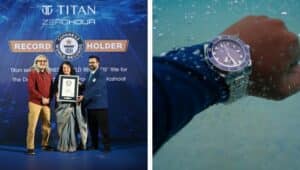
About a month after Titan launched Zero Hour, its performance-sport range, the company has announced a Guinness World Record for what it says is the deepest underwater product photoshoot conducted for a watch campaign. The watch used for the record was the Zero Hour Professional Diver’s Automatic 500M, one of 12 models in the range, with depth capabilities ranging from 100 metres to 500 metres. The record attempt was conducted at a depth of 52.1 metres in open-ocean conditions off Thailand.
Zero Hour marks a concerted attempt by Titan to build a presence in the sports and tool watch segment, which, the company estimates, is worth about Rs 800 crore in India. In this interview with Firstpost, Kuruvilla Markose, CEO of Titan’s watch division, discusses the growing appeal of mechanical and performance watches; and why he believes India can emerge as a major watchmaking ecosystem in the next five years.
 More from Lifestyle
Your men’s watch portfolio grew 44 per cent last fiscal, and Titan Automatics is now the best-selling segment within your premium watch portfolio. What’s driving this growth?
As incomes rise, people are looking for products that have engineering ability. We have been steadily building our mechanical portfolio and we continue to offer what Titan has always stood for — value. Value can exist at a Rs 10,000 price point or at a Rs 2 lakh price point. Watches above Rs 25,000 are growing for us at close to 30 per cent, compared to around 11 per cent for watches below Rs 25,000. One of the biggest growth drivers within the men's cluster is the sports category. Globally, premium brands have evolved into what we call land, air and sea watches: chronographs, pilot watches and diver's watches. That finer segmentation is now finding its way into India.
You often speak about consumers becoming more interested in engineering rather than just design. Is that what gives you confidence that categories like diver's watches can become meaningful in India?
Until now, the Indian market was looking for products that were good on design. Consumers were focused on what we call the Y capability or the appearance of the watch. As we move above the Rs 25,000 price point, consumers become interested in the X capability or what's inside the watch. They start asking about movements, power reserves, accuracy, ISO certification, PADI accreditation, helium release valves and lume quality. Those things begin to matter.
India's performance sports watch segment is estimated at around Rs 800 crore today. How large can this category become over the next five years?
I think it can grow at something like 30 per cent a year. The category is transitioning from design-oriented products to more professional and prosumer products. As those products become a larger part of the mix, the value of the category will grow significantly. When you add land and air categories alongside divers, there is a lot of opportunity.
How much of a watch like the Zero Hour 500M is actually made in India?
Some capabilities, like certain dial components and lume quality at that level, are not available in India, neither in the indigenous ecosystem nor in-house with us. For those specialised capabilities, we went outside. But I'd say comfortably 70 to 75 per cent of the value addition has happened in India. So it is very much an Indian watch, not unlike some brands that have recently claimed to be Indian but are predominantly Chinese. This is genuinely Indian. And it's getting better every year. India is emerging as the third power in watchmaking after Switzerland and the Far East — Japan and China combined, with Japan higher on capability but China evolving rapidly. Today, roughly half of the Indian watch market, about Rs 13,000 crore, comprises watches priced above Rs 25,000. India is about to cross the point where luxury watches, in value terms, will be larger than the mass and masstige segments.
There are already vendors in India supplying components to Swiss OEMs, and Titan itself supplies some components to Swiss OEMs. As the number of automatics we produce increases, questions arise: should we be making our own assortments, our own escapements? These are questions occupying the minds of our teams and vendor partners. We will work together to create an Indian watchmaking ecosystem that emerges as the third power after Switzerland and the Far East.
Micro-brands in India often say that apart from hands and dials, most components are not made in India. Is that a fair assessment? And how long will it take to build that ecosystem?
Largely, yes. Hands and dials. To some extent, good-quality leather straps are available. But today you would not get good-quality solid stainless-steel bracelets. Cases, you can get reasonably good ones, but not very complicated cases; for those we either make in-house or source from outside. Again, with regard to decorations, Switzerland remains the best place for sophisticated finishing. What we've developed internally is a framework we call L0, L1, L2 and L3. L0 signifies the best in the world: the best movements, chronometer-level accuracy, high power reserves and extraordinary finishing. That capability today does not exist in India.
L1 is aspirational luxury. L2 is accessible luxury. L3 is premium accessible. What's available in India today is predominantly L2, L3 or lower. What we are aspiring to do is create L0 and L1 capability in India. It's not easy, there is a learning curve. But we're looking for smart ways to shorten it. I don't think we'll need 10 years to get there. I would say three years is achievable. If I'm being conservative, five. But that is certainly the attempt, and it will require building the ecosystem, which is why I deliberately speak of the Swiss ecosystem, the Far East ecosystem and the Indian ecosystem.
Does the high-end watch business help bring new customers into Titan's broader ecosystem?
The watches business acquires about 16 to 17 million customers every year. Across the Titan portfolio, jewellery acquires about 3 million customers a year, watches 16 to 17 million, fragrances and fashion accessories another 3 million, and eye care about 2 million. All of these customers come into our pool and migrate across categories. That cross-selling ability is what makes us genuinely distinctive. To clarify, a person buying a high-end watch is likely already a Tanishq customer. What the luxury focus in watches is doing is bringing back a set of consumers who may have migrated to buying Rolex, Omega, Vacheron Constantin or Rado. Today, Titan has a portfolio that is worthy of their attention.
One question that keeps coming up on Reddit and Instagram: when are you finally moving to 38mm case sizes?
It's coming. We are conscious of the shift towards smaller sizes, and some of our new launches reflect that. Personally, my wrist is on the smaller side and I love 38 to 39mm. That change is happening as we go along.
Murali K Menon is a writer based in Mumbai.

Trade the hustle for the Shire: Inside the "hobbitmaxxing" trend
Spices, health and the Indian plate: Why chilli can be good for you—but moderation is still key
The right way to break up without feeling groggy
How Spider-Man actor Tom Holland has been on a sobriety journey of 4.5 years after being "addicted to alcohol"
Why Chennai is India's filter coffee capital, one tumbler at a time