


Was Nathuram Godse a patriot? Before creating a love or hate campaign, first understand Mahatma Gandhi's assassin
Nathuram Godse, the assassin of Mohandas Gandhi did not get a chance to write an autobiography. But he spoke for himself at the court of law

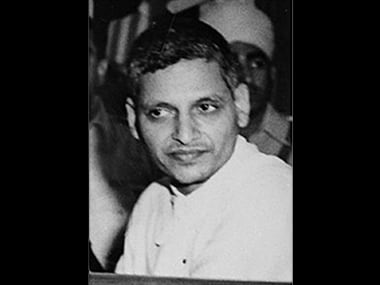
File image of Nathuram Godse, News18[/caption]Second, Godse was not a mass murderer. He murdered one man, and surrendered then and there. He further requested the court not to show any mercy at him while reading out his statement. However, as per Godse, Gandhi was a mass murderer. He accused Gandhi of being pro-Muslim and anti-Hindu in his political activities and positions. Nathuram considered Gandhi to be solely responsible for the riots in India during 1946, and until his death in 1948. According to Godse, if Gandhi was not at the helm of Indian politics during the freedom struggle and thereafter, Partition, the resultant bloodbath could have been avoided.Gandhi claimed that his final fasting days were for Hindu-Muslim unity. But Godse invoked a different context altogether. After Partition, Pakistan was due to get an amount of Rs 55 crore from the imperial treasury as part of the deal. But Sardar Vallabhbhai Patel held it up from his end until the Kashmir issue was solved. Godse accused Gandhi of blackmailing the Indian government using his fasts, and interfering in State affairs. Godse alleged that it was not only undemocratic, but dictatorial in the sense that Gandhi's own understanding had to prevail no matter what. This action made India weak at bargaining on Kashmir. He finally decided to eliminate Gandhi by assassination when he sat for his final satyagraha.Third, Godse considered Gandhi to be a hypocrite at statecraft and his method of satyagraha a total failure in practical terms. Gandhi should be acknowledged for his deep study of Indian philosophy and relating it to the 20th Century social context and also leading a very innovative movement. Ahimsa is an ancient idea propagated by Buddhism for ages. But Gandhi was a barrister at British law. He loved it. He was not a saint trying to be a politician, but a politician trying to be a saint. His method of non-violent yet unconstitutional resistance was the result of deep study and integration of both Indian philosophy as well as British law. The British Raj in India was proud of its hegemonic rule of law, which was a first for India in almost 3,000 years of its history. To fight against such a rule, neither armed resistance nor constitutional dialogue worked. Gandhi chose the middle path and shook the entire establishment. But this was only possible when both parties respected the rule of law.In 1947, Pakistan sent invaders into Kashmir to forcefully integrate it with Pakistan. Godse had one question regarding this. Since Gandhi believed so deeply in satyagraha, why did he agree with Jawaharlal Nehru and Patel when it came to sending the army to Kashmir? Why did he not send a group of satyagrahis to fast before the invaders and change their behaviour? This point questions the ideology of satyagraha altogether. From a position of power, satyagraha does not possibly work, it seems.Fourth, lets address the current issue: Patriotism. A dictionary definition suggests it is "the feeling of loving your country more than any others and being proud of it". There is no doubt that right-wing nationalists like Godse were proud of India; we can question and discuss the love. Nationalism can be of two sorts, cultural nationalism and people's nationalism — the first one is characteristic of right-wing ideology and the second is the trait of the Left. Vladimir Lenin was a patriot too since he loved and cared about the Soviet Union before other countries.Godse claimed to have done public service as a member of the Rashtriya Swyamsevak Sangh (RSS). But he also had problems with Gandhi holding prayer meetings in the Bhangi colony and reading phrases of the Quran in his prayer meetings. As a person, Godse was problematic, but still the question remains: If violence delegitimises one's patriotism, then why do we have an India Gate and a National War Memorial at all? All soldiers are professional killers. Godse considered Gandhi an enemy of the State, so he killed him. One can question his politics as well as his problematic social positions, but cannot question his patriotism on the basis of a political murder. Also, Gandhi advocated non-violence. But that does not make the use of violence obsolete. India has fought six wars with its neighbouring countries and commands one of the largest armies in the world.Finally, let us understand the Mahatma — the father of the nation. We have made a god out of a man in Gandhi. Historian Bipan Chandra in his popular book India's struggle for freedom refers to all top leaders of freedom struggle by name... Nehru, Patel etc. But, when it comes to Gandhi, he refers to him as Gandhiji. Gandhi was made a Mahatma slowly and gradually after his death. There were many in opposition among his contemporaries and tallest among them were Subhas Chandra Bose and Dr BR Ambedkar.
In conclusion, it ought to be pointed out that Godse is as much a patriot as Afzal Guru or Bhagat Singh. And if that statement equates to sedition, so be it. It needs to be resisted in court like Gandhi himself would have done.The back cover of Why I assassinated Gandhi quotes Justice Khosla, "The audience was visibly and audibly moved. There was a deep silence when he (Godse) ceased speaking." This silence has been strategically maintained by academics till date. Godse has been named a terrorist, a murderer, an anti-national, and what not. One must read about Godse before creating a love or hate campaign in his name.The author writes at urbangaonwala.com and tweets @UrbanGaonwala

J&K cop on Amarnath Yatra duty shot dead in Anantnag terror attack; TRF claims responsibility
Jaishankar meets Canada's Anita Anand, discusses bilateral cooperation and shared interests
Delhi, Bengaluru, Hyderabad... Neet paper leak protest spreads nationwide even as govt reaches out to CJP, Opposition
Why is India seeing 95% cloud cover despite a Super El Niño?
Jaishankar, Rubio review trade, defence, AI cooperation at Manila meeting