
Advertisement


Sections
The ugly questions that hang over Mumbai cop’s 26/11 honour
The Union Government’s is giving Maharashtra police officer Vishwas Nangre Patil the President’s Police Medal for Gallantry—sparking off a growing controversy.

[caption id="attachment_1000171" align="alignleft" width="380"]![Mumbai police officials outside the Hotel Taj Palace during the November 2008 attacks. Reuters]() Mumbai police officials outside the Hotel Taj Palace during the November 2008 attacks. Reuters[/caption]Five years after 26/11, Maharashtra Police officer Vishwas Nangre-Patil is scheduled to receive one of India’s highest honours for gallantry: the President Police Medal for Gallantry. The Ministry of Home Affairs committee which appraises awardees, heard at a meeting in New Delhi on Tuesday that Nangre-Patil, leading ill-equipped and ill-prepared men, shot a terrorist in battle inside the Taj Mahal Hotel. It was an act of exceptional courage, even by the standards of those days.If it happened, that is.Firstpost investigation of Nangre-Patil’s actions at the Taj has revealed several murky questions hang over exactly what happened—questions that raise the disturbing prospect that lobbying and political networking might be at work in the medals process.The case for giving Nangre-Patil India’s highest police honour centres around events at the Taj on the morning of 27 November, 2008.Sunil Kudiyadi, the Taj’s security manager, accompanied Nangre-Patil and a group of men from the police’s reserve into the area between the hotel’s south and north wing. The terrorists, the government account says, located themselves along the hotel’s famed “royal staircase”, allowing them to fire and throw grenades at police.Maharashtra’s High-Level Enquiry Committee on 26/11 recorded that Nangre-Patil “showed remarkable grit and courage in trying to engage the terrorists from a lower level position on the staircase”.“According to Taj hotel security manager Shri Kudiyadi”, it adds, “it seemed that one terrorist was injured in the firing by Shri Nangre-Patil. (Read: Maharashtra’s High-Level Enquiry Committee Report on 26/11)Evidence to support Kudiyadi’s account, though, is thin on the ground. There isn't, for one, a single reference to any terrorist being shot during the period Patil was inside the Taj in hours of intercepted conversations between the 26/11 controllers in Karachi and the terrorists in Mumbai.The only explicit conversation related to any injury is to a terrorist accidentally shot in the leg while others were trying to kill a stray dog. The incident, however, didn't take place anywhere near Nangre-Patil’s locations on 26/11, so can’t be connected.However, there is an intercepted conversation where one of 26/11 controllers warned the hit-team of injuries caused by ricocheting bullets.“You’re inside rooms; the rooms are small; these are Kalashnikov bullets,” the controller says. “There’s a system; the system is that don’t fire inside the rooms, because the bullet will come back and hit you (ricochet). That’s how Ali got hit, that how Shoaib got hit; that’s how Umair got hit. This is not good. Make them (the victims) stand near the doors and then shoot them. They’re right in front of you, so make them get up and go stand there (where you can shoot them safely)."(LISTEN: 26/11 controller briefs terrorists in the Taj. Please note that this audio file has been digitally edited for clarity:)This video, of a Taj hotel resident being killed by the terrorists shows just what a ricochet looks like: at about 00.32’, there’s a burst of light, visible if you slow down the footage, showering potentially-lethal shrapnel in all directions.(VIDEO: Man shot dead by terrorists in Hotel Taj Palace during 26/11. Please note the contents of this video are graphic, and may disturb some readers)This much is clear: Nangre-Patil, like many Mumbai police officers, did the best he could in a bad situation. He was among the first police officers to reach the Taj, along with Rajyavardhan Singh, then on deputation to the Intelligence Bureau, and Hemant Nagrale.The three made their way to the Taj’s control room, guided by a member of the hotel’s staff, where they were able to watch the attack unfolding through the hotel’s closed-circuit cameras.Later, the Intelligence Bureau—which was monitoring conversations between the terrorists and their handlers in real time—warned that the Lashkar-e-Taiba assault team was moving towards the control room.From interviews with Intelligence Bureau personnel and Maharashtra Police officers also involved in the 26/11 operation, Firstpost has learned that Nangre-Patil and his team left the control room—leaving behind his men, one of whom was subsequently killed in a grenade attack, while several were injured. The constable’s body was recovered only three days later, after National Security Guard personnel cleared the area.“It wasn’t unreasonably wrong for Nangre-Patil to leave the room”, says a senior New Delhi-based intelligence officer linked to the operation, “but the fact is he left men behind to face the attack.”Nangre-Patil, speaking to Firstpost, said it wouldn't be appropriate for him to discuss the issue, saying instead that people could make up their own minds on the issue by reading the government’s enquiry report.These questions have been well known known: papers were moved to give Patil a Police Medal for Gallantry—one notch below that now being considered—in January, 2009. It was rejected because of concerns over the quality of evidence.Singh, notably, declined to receive one in 2009, saying merely being present at the scene of a crisis was a police officer’s duty, not exceptional valour. In 2010, 68 police officers won medals for acts of bravery on 26/11—seven of them posthumously.Four separate officials in the Ministry of Home Affairs declined to comment on why Nangre-Patil’s case is now being considered anew, but one claimed the decision to move the papers was made by Union Minister for Home, Sushilkumar Shinde. Nangre-Patil’s father-in-law, Madhukar Mule, is a prominent Nationalist Congress Party politician.It’s time for Shinde to come up with a straight answer; too many people, in and out of uniform, died on 26/11 for this to be something the United Progressive Alliance ought to play politics with.
Mumbai police officials outside the Hotel Taj Palace during the November 2008 attacks. Reuters[/caption]Five years after 26/11, Maharashtra Police officer Vishwas Nangre-Patil is scheduled to receive one of India’s highest honours for gallantry: the President Police Medal for Gallantry. The Ministry of Home Affairs committee which appraises awardees, heard at a meeting in New Delhi on Tuesday that Nangre-Patil, leading ill-equipped and ill-prepared men, shot a terrorist in battle inside the Taj Mahal Hotel. It was an act of exceptional courage, even by the standards of those days.If it happened, that is.Firstpost investigation of Nangre-Patil’s actions at the Taj has revealed several murky questions hang over exactly what happened—questions that raise the disturbing prospect that lobbying and political networking might be at work in the medals process.The case for giving Nangre-Patil India’s highest police honour centres around events at the Taj on the morning of 27 November, 2008.Sunil Kudiyadi, the Taj’s security manager, accompanied Nangre-Patil and a group of men from the police’s reserve into the area between the hotel’s south and north wing. The terrorists, the government account says, located themselves along the hotel’s famed “royal staircase”, allowing them to fire and throw grenades at police.Maharashtra’s High-Level Enquiry Committee on 26/11 recorded that Nangre-Patil “showed remarkable grit and courage in trying to engage the terrorists from a lower level position on the staircase”.“According to Taj hotel security manager Shri Kudiyadi”, it adds, “it seemed that one terrorist was injured in the firing by Shri Nangre-Patil. (Read: Maharashtra’s High-Level Enquiry Committee Report on 26/11)Evidence to support Kudiyadi’s account, though, is thin on the ground. There isn't, for one, a single reference to any terrorist being shot during the period Patil was inside the Taj in hours of intercepted conversations between the 26/11 controllers in Karachi and the terrorists in Mumbai.The only explicit conversation related to any injury is to a terrorist accidentally shot in the leg while others were trying to kill a stray dog. The incident, however, didn't take place anywhere near Nangre-Patil’s locations on 26/11, so can’t be connected.However, there is an intercepted conversation where one of 26/11 controllers warned the hit-team of injuries caused by ricocheting bullets.“You’re inside rooms; the rooms are small; these are Kalashnikov bullets,” the controller says. “There’s a system; the system is that don’t fire inside the rooms, because the bullet will come back and hit you (ricochet). That’s how Ali got hit, that how Shoaib got hit; that’s how Umair got hit. This is not good. Make them (the victims) stand near the doors and then shoot them. They’re right in front of you, so make them get up and go stand there (where you can shoot them safely)."(LISTEN: 26/11 controller briefs terrorists in the Taj. Please note that this audio file has been digitally edited for clarity:)This video, of a Taj hotel resident being killed by the terrorists shows just what a ricochet looks like: at about 00.32’, there’s a burst of light, visible if you slow down the footage, showering potentially-lethal shrapnel in all directions.(VIDEO: Man shot dead by terrorists in Hotel Taj Palace during 26/11. Please note the contents of this video are graphic, and may disturb some readers)This much is clear: Nangre-Patil, like many Mumbai police officers, did the best he could in a bad situation. He was among the first police officers to reach the Taj, along with Rajyavardhan Singh, then on deputation to the Intelligence Bureau, and Hemant Nagrale.The three made their way to the Taj’s control room, guided by a member of the hotel’s staff, where they were able to watch the attack unfolding through the hotel’s closed-circuit cameras.Later, the Intelligence Bureau—which was monitoring conversations between the terrorists and their handlers in real time—warned that the Lashkar-e-Taiba assault team was moving towards the control room.From interviews with Intelligence Bureau personnel and Maharashtra Police officers also involved in the 26/11 operation, Firstpost has learned that Nangre-Patil and his team left the control room—leaving behind his men, one of whom was subsequently killed in a grenade attack, while several were injured. The constable’s body was recovered only three days later, after National Security Guard personnel cleared the area.“It wasn’t unreasonably wrong for Nangre-Patil to leave the room”, says a senior New Delhi-based intelligence officer linked to the operation, “but the fact is he left men behind to face the attack.”Nangre-Patil, speaking to Firstpost, said it wouldn't be appropriate for him to discuss the issue, saying instead that people could make up their own minds on the issue by reading the government’s enquiry report.These questions have been well known known: papers were moved to give Patil a Police Medal for Gallantry—one notch below that now being considered—in January, 2009. It was rejected because of concerns over the quality of evidence.Singh, notably, declined to receive one in 2009, saying merely being present at the scene of a crisis was a police officer’s duty, not exceptional valour. In 2010, 68 police officers won medals for acts of bravery on 26/11—seven of them posthumously.Four separate officials in the Ministry of Home Affairs declined to comment on why Nangre-Patil’s case is now being considered anew, but one claimed the decision to move the papers was made by Union Minister for Home, Sushilkumar Shinde. Nangre-Patil’s father-in-law, Madhukar Mule, is a prominent Nationalist Congress Party politician.It’s time for Shinde to come up with a straight answer; too many people, in and out of uniform, died on 26/11 for this to be something the United Progressive Alliance ought to play politics with.
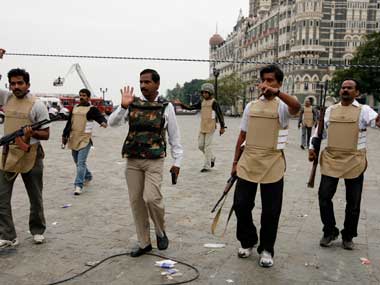 Mumbai police officials outside the Hotel Taj Palace during the November 2008 attacks. Reuters[/caption]Five years after 26/11, Maharashtra Police officer Vishwas Nangre-Patil is scheduled to receive one of India’s highest honours for gallantry: the President Police Medal for Gallantry. The Ministry of Home Affairs committee which appraises awardees, heard at a meeting in New Delhi on Tuesday that Nangre-Patil, leading ill-equipped and ill-prepared men, shot a terrorist in battle inside the Taj Mahal Hotel. It was an act of exceptional courage, even by the standards of those days.If it happened, that is.Firstpost investigation of Nangre-Patil’s actions at the Taj has revealed several murky questions hang over exactly what happened—questions that raise the disturbing prospect that lobbying and political networking might be at work in the medals process.The case for giving Nangre-Patil India’s highest police honour centres around events at the Taj on the morning of 27 November, 2008.Sunil Kudiyadi, the Taj’s security manager, accompanied Nangre-Patil and a group of men from the police’s reserve into the area between the hotel’s south and north wing. The terrorists, the government account says, located themselves along the hotel’s famed “royal staircase”, allowing them to fire and throw grenades at police.Maharashtra’s High-Level Enquiry Committee on 26/11 recorded that Nangre-Patil “showed remarkable grit and courage in trying to engage the terrorists from a lower level position on the staircase”.“According to Taj hotel security manager Shri Kudiyadi”, it adds, “it seemed that one terrorist was injured in the firing by Shri Nangre-Patil. (Read: Maharashtra’s High-Level Enquiry Committee Report on 26/11)Evidence to support Kudiyadi’s account, though, is thin on the ground. There isn't, for one, a single reference to any terrorist being shot during the period Patil was inside the Taj in hours of intercepted conversations between the 26/11 controllers in Karachi and the terrorists in Mumbai.The only explicit conversation related to any injury is to a terrorist accidentally shot in the leg while others were trying to kill a stray dog. The incident, however, didn't take place anywhere near Nangre-Patil’s locations on 26/11, so can’t be connected.However, there is an intercepted conversation where one of 26/11 controllers warned the hit-team of injuries caused by ricocheting bullets.“You’re inside rooms; the rooms are small; these are Kalashnikov bullets,” the controller says. “There’s a system; the system is that don’t fire inside the rooms, because the bullet will come back and hit you (ricochet). That’s how Ali got hit, that how Shoaib got hit; that’s how Umair got hit. This is not good. Make them (the victims) stand near the doors and then shoot them. They’re right in front of you, so make them get up and go stand there (where you can shoot them safely)."(LISTEN: 26/11 controller briefs terrorists in the Taj. Please note that this audio file has been digitally edited for clarity:)This video, of a Taj hotel resident being killed by the terrorists shows just what a ricochet looks like: at about 00.32’, there’s a burst of light, visible if you slow down the footage, showering potentially-lethal shrapnel in all directions.(VIDEO: Man shot dead by terrorists in Hotel Taj Palace during 26/11. Please note the contents of this video are graphic, and may disturb some readers)
First Published:Jul 31, 2013, 16:07:27 IST
Advertisement
Advertisement

Air India to cut Delhi-Toronto flight time by 3 hours, resume non-stop services from August 1
Air India will resume non-stop Delhi-Toronto flights from August 1, cutting travel time by nearly three hours and deploying its new Boeing 787-9 Dreamliner on the route
2 min read
J&K cop on Amarnath Yatra duty shot dead in Anantnag terror attack; TRF claims responsibility
The Resistance Front (TRF), a shadow outfit of Lashkar-e-Taiba, claimed responsibility for the attack through a social media post
2 min read
Jaishankar meets Canada's Anita Anand, discusses bilateral cooperation and shared interests
External Affairs Minister S Jaishankar on Wednesday held talks on bilateral ties with his Canadian counterpart Anita Anand, focusing on cooperation and common goals.
1 min read
Delhi, Bengaluru, Hyderabad... Neet paper leak protest spreads nationwide even as govt reaches out to CJP, Opposition
Protests over the alleged NEET paper leak intensified across multiple cities, while the Centre signalled talks with the Opposition and the Cockroach Janta Party. The Delhi High Court also stepped in, seeking preservation of CCTV footage related to police action.
3 min read
Why is India seeing 95% cloud cover despite a Super El Niño?
India is witnessing nearly 95 per cent cloud cover despite a Super El Niño, a climate event usually linked to weaker monsoons. Regional weather systems, cyclonic circulations, the monsoon trough and moisture from two seas are temporarily overpowering one of the world's strongest climate phenomena
5 min read
Advertisement
Advertisement