


Targeted killings of apple traders and non-local labourers show Kashmir battle has reached a decisive phase
The attack on apple traders and migrant labourers show that battle for normalisation of Kashmir — the logic that drove the Narendra Modi government's decision to revoke Article 370 — has now reached a decisive phase. The Modi government must find a way to stop these killings, or else the painstaking efforts to normalise and the gamble of doing away with Article 370 may be rendered fruitless.

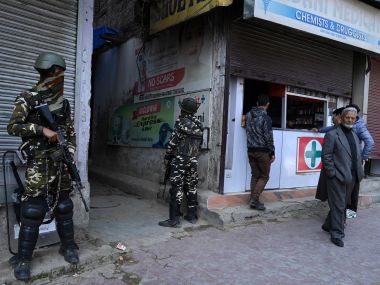
Security measures have increased in Srinagar a day after two non-Kashmiris were shot dead by suspected militants. Getty Images[/caption]These attacks are also self-fulfilling. If Kashmir's apple trade is hit despite a good harvest, if orchard owners run into debt and livelihood of all those associated with this trade are affected, the resultant anger will most likely be directed towards India because it is more difficult to vent frustration at gun-wielding terrorists. This strategy is incumbent on Pakistan spreading fear and panic, and the killings show that terrorists are succeeding."We are dependent on transporters from other states for exports. But now, everyone is more afraid than ever" Mohammad Ashraf Wani, president of Fruit Mandi in Shopian was quoted, as saying in a News18 report. "With no one to come and get them, our apples will rot." According to this Firstpost report, Shopian apple market has about 215 locally-owned trucks, however, this time of the year around 8,000 trucks and there is a severe transportation shortage due to migrant labourers and truckers running away in fear for their lives.There is, however, still a lack of understanding of the subversive role played by Pakistan in keeping Kashmir restive. The violence and bloodshed on the streets in Shopian or Pulwama (where the latest civilian killings took place) are not the doing of ordinary Kashmiris who want to get on with their lives.These are orchestrated and executed by terror handlers and operatives from Pakistan — which lies bankrupt, diplomatically isolated and without a means to force India's hand — as a last-ditch attempt to keep the headlines fixated on Kashmir to meet its larger political objective.To understand how this fits into Pakistan's obsession with India, we may take note of a viral video clip shared on Twitter by a noted Indian journalist. The clip, part of a promo for Azadi-E-Kashmir Convention on 12 October, reveals the level of depravity that Pakistan has sunk to, blinded by a mad rage at India's move to revoke Kashmir's semi-autonomous status. The video propaganda shows Pakistani school-going kids fantasising about colonising India.Brainwashing innocent children, making them a part of war propaganda and mainstreaming jihad speak of unadulterated hatred towards India that drive Pakistan's military leadership and govern each of its actions. This hatred is not merely ideological and existential, it is in equal parts driven by an economic logic.If Pakistan's all-powerful military has gained total control of the nation's social, political and economic resources, as military analyst Ayesha Siddiqa writes in her book Military Inc.: Inside Pakistan's Military Economy, then it uses this anti-India hatred to justify its outsized role, painting India as 'Hindustan' (the land of the Hindus) — Islamic Pakistan's malevolent 'other' against whom it must fight a never-ending jihad. It is, therefore, in Pakistan military's interest, that runs the quasi-democracy through a puppet civilian leadership, that anti-India rhetoric must be kept and mainstreamed.Pakistan defines its existence in relation to India, seeks ideological and economic parity with India and yet has taken a string of policy decisions that has fatally crippled its economic rise and stunted its socio-political development. Yet it must appear to be "equal" with India and must be seen waging a 1000-year battle for ghazwa-e-Hind, and hence it has little option but to use terrorism as an inexpensive yet legitimate tool of statecraft to force a parity with India.To this ideological agenda has been added a revanchist motive that makes Pakistan covet the territory of Muslim-dominated Kashmir as an unfinished business of partition. It is evident that India's decision to better integrate Kashmir with mainland by reading down the temporary Constitutional provision has pushed Pakistan to the verge of collective insanity.This context is imperative to understand why India was forced to clamp communication blockade or deploy troops in Kashmir. If Pakistan ceases and desists from conducting its asymmetric war against India, then India will have less reason to lock down Kashmir.As strategic analyst Brahma Chellaney writes in Project Syndicate, "it is a difficult time for local people: telecommunications and Internet service have been disrupted, a virtual curfew has been imposed in some areas, and thousands of troops have descended on the region. But these measures are a response to the presence of large numbers of Pakistan-backed terrorists. If Pakistan halts its destabilizing activities, India will have no need to exert such forceful control over J&K."The attack on apple traders and migrant labourers show that the battle for normalisation of Kashmir — the logic that drove the Narendra Modi government's decision to revoke Article 370 — has now reached a decisive phase. The Modi government must find a way to stop these killings, or else the painstaking efforts to normalise and the gamble of doing away with Article 370 may be rendered fruitless.

J&K cop on Amarnath Yatra duty shot dead in Anantnag terror attack; TRF claims responsibility
Jaishankar meets Canada's Anita Anand, discusses bilateral cooperation and shared interests
Delhi, Bengaluru, Hyderabad... Neet paper leak protest spreads nationwide even as govt reaches out to CJP, Opposition
Why is India seeing 95% cloud cover despite a Super El Niño?
Jaishankar, Rubio review trade, defence, AI cooperation at Manila meeting