


Supreme Court to examine MHA's controversial 'snooping order': 4 PILs filed against Centre's 20 December order
The Supreme Court on Monday issued a notice to the Ministry of Home Affairs (MHA) regarding the government's order allowing several central investigative agencies to intercept email and phone correspondence for "national security" purposes.

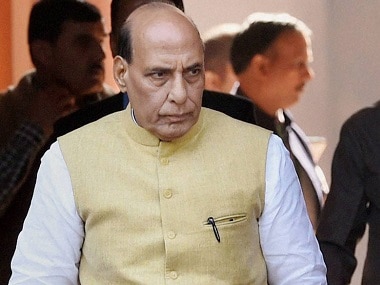
File image of Union minister Rajnath Singh. News18[/caption]India Today reported that MHA officials have clarified the 'snooping' order was to empower anti-terror operations and investigations, adding that the government's objective is to be able to intercept data from terror networks in correspondence done over platforms like Whatsapp and email.What was Centre's 20 December order?According to the government's 20 December notification, ten central investigating agencies were authorised under the Information Technology (IT) Act for computer interception and analysis.The ten agencies that were notified are the Intelligence Bureau, Narcotics Control Bureau, Enforcement Directorate, the Central Board of Direct Taxes (for Income Tax Department), Directorate of Revenue Intelligence, Central Bureau of Investigation, National Investigation Agency, the Research and Analysis Wing, Directorate of Signal Intelligence (in service areas of Jammu and Kashmir, North East and Assam) and Delhi Police commissioner.The Centre had justified the order saying that it is based on the UPA-era IT Act and the IT Rules 2009 that allow for surveillance by a competent authority and said all cases of surveillance will be placed before a review committee headed by the cabinet secretary.MHA order aimed "to find political opponents, thinkers and speakers, in a bid to control the entire country under dictatorship.."On 3 January, a petition filed by advocate Manohar Lal Sharma, was declined for urgent listing by the bench headed by Gogoi. The bench had said, "We will see. As and when required we will list the matter."The petition filed by advocate Sharma in December sought to quash the government's notification. In his petition, he termed the notification as "illegal, unconstitutional and ultra vires to the law".He had also sought to prohibit the agencies from initiating any criminal proceedings, enquiry or investigation against anybody under the provisions of the IT Act based on the notification.The plea had claimed that the notification was issued "to find political opponents, thinkers and speakers, in a bid to control the entire country under dictatorship and to win the coming general election under an undisclosed emergency as well as slavery which cannot be permitted within the Constitution of India".It had alleged that the MHA's "blanket surveillance order must be tested against the fundamental right to privacy". The petition also warned against "a serious danger and injury" to the freedom, life and liberty of the citizens of India. Further, it was contended that the order must be tested on the touchstone of the Right to Privacy, which was recognized by the Supreme Court as a fundamental right.With inputs from agencies

Air India to cut Delhi-Toronto flight time by 3 hours, resume non-stop services from August 1
J&K cop on Amarnath Yatra duty shot dead in Anantnag terror attack; TRF claims responsibility
Jaishankar meets Canada's Anita Anand, discusses bilateral cooperation and shared interests
Delhi, Bengaluru, Hyderabad... Neet paper leak protest spreads nationwide even as govt reaches out to CJP, Opposition
Why is India seeing 95% cloud cover despite a Super El Niño?