


Stubble burning costing India $152.9 billion in health expenses over five years: Study
Respiratory illness is one of the leading causes of death in India, with a huge economic burden.

As rice farmers in North India begin burning their fields in late September and October each year, the particulate pollution in Delhi's air spikes 20 times above safe levels prescribed by the World Health Organisation. A new report claims that over five years, crop burning could cost India an estimated value of $152.9 billion in healthcare expenditure.Respiratory illnesses and infections are among the leading causes of death in the world and as well as in India.September and October every year also happens to be the time when acute respiratory infections peak in North India. The risk of getting a respiratory infection goes up by thrice as much as any other time of the year, the study has found.[caption id="attachment_6205801" align="alignnone" width="1280"]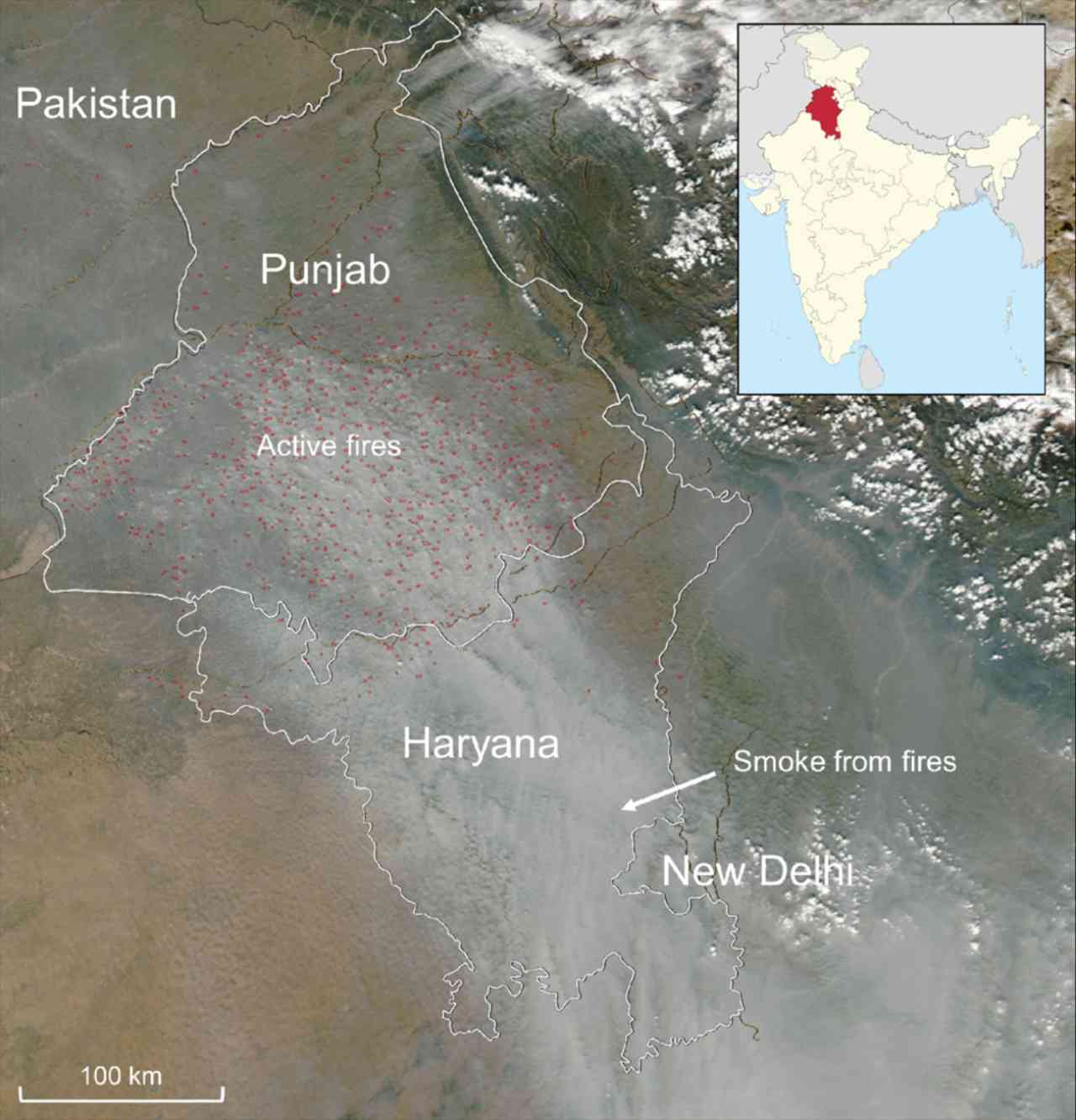 Satellite images across Punjab, Haryana and Delhi during 2012 stubble burning season. Image courtesy: NASA[/caption]The link between crop burning and the surge in respiratory illnesses that follows boils down to a single, scientific reason. Burning crops release fine particles, that are carried by the wind across long distances, and picked up by air quality indices as particulate matter or "PM 2.5".PM 2.5 is the most important air quality measurement as far as public health is concerned since the particles are tiny enough to get trapped deep inside the lungs, increasing the risk of lung cancer by 36 percent.The report published in the International Journal of Epidemiology used health data from India’s fourth District Level House Survey (DLHS-4) and data on reported fires using moderate-resolution satellite data over a five-month period in Haryana, Punjab and Delhi.The data from these states was compared to southern states, where crop burning and use of firecrackers is fairly uncommon. In fact, the study found remarkably fewer cases of acute respiratory infections and fires in the south than in northern states.[caption id="attachment_6205821" align="alignnone" width="1280"]
 A farmer burns paddy waste stubble in a field on the outskirts of Ahmedabad in November 2017. Reuters[/caption]Over a 15-day period, authors found that 5.4 percent of individuals that were surveyed in Haryana complained of respiratory symptoms indicating an infection. Reports from the southern states, however, were only from 0.1 percent of those surveyed."Solutions to eliminate crop burning exist, but require further investments," according to the study's authors. In their view, investing in the elimination of stubble burning and giving farmers other options to dispose off crop residue is "likely to improve population-level respiratory health and yield major economic returns."The authors also recommend in the study that investing in methods to cut crop burning will bring the best returns on investment among public-health interventions, among the government's possible plans of action.

J&K cop on Amarnath Yatra duty shot dead in Anantnag terror attack; TRF claims responsibility
Jaishankar meets Canada's Anita Anand, discusses bilateral cooperation and shared interests
Delhi, Bengaluru, Hyderabad... Neet paper leak protest spreads nationwide even as govt reaches out to CJP, Opposition
Why is India seeing 95% cloud cover despite a Super El Niño?
Jaishankar, Rubio review trade, defence, AI cooperation at Manila meeting