
Advertisement


Sections
'Step towards self-destruction': Far-right comes out against Supreme Court's Section 377 verdict
During the hearing of the case, Hindu, Muslim and Christian groups were among litigants who supported Section 377 of the IPC.

The Supreme Court's verdict on Thursday decriminalising homosexuality has been met with mixed reactions from conservative elements of society. While some expressed support in relatively half-hearted terms, others strongly disagreed.Hindu, Muslim and Christian groups—including Sanatan Dharam Pratinidhi Sabha, a member of the Vishwa Hindu Parishad, the All India Muslim Personal Law Board, Raza Academy, Utkal Christian Council and the Apostolic Churches Alliance— were among litigants in the apex court who opposed the decriminalisation of homosexuality.BJP MP Subramanian Swamy, took a swipe at those contending that Section 377 violated fundamental rights:In an interview to News18, Swamy further said, "The decision of a two-judge bench has been overturned by a five-judge bench. If this freedom leads to excesses, including paedophilia, gay bars, increase in HIV cases, etc, we can have a seven-judge bench to overturn this. There is no finality to the Supreme Court's judgment today."Swamy's comments on the issue on Thursday, while more extreme than many others, are something of a climb-down from his earlier remarks, including terming homosexuality as a "danger to national security."[caption id="attachment_5130991" align="alignleft" width="380"]![File image of BJP MP Subramanian Swamy. PTI]() File image of BJP MP Subramanian Swamy. PTI[/caption]The newspaper Milli Gazette—a publication which describes itself as "Indian Muslims' leading English newspaper since January 2000"—described the apex court verdict as a "a step towards self-destruction."The RSS seemed to support the verdict, but with a caveat. In a statement issued Thursday, the RSS said, "Like the Supreme Court verdict, we also don't consider this (homosexuality) a crime. Same-sex marriages and relations are not in consonance with nature, and so we do not support such relations. Traditionally, Indian society has not supported such relations. Ordinarily, people learn from experience, and so this issue needs to handled at a social and psychological level."This statement is similar to what Dattatreya Hosabale, the organisation's joint general secretary, said in 2016: "Homosexuality is not a crime, but (is a) socially immoral act in our society. No need to punish, but to be treated as a psychological case." However, he further added, "Gay marriage is institutionalisation of homosexuality. It should be prohibited."On the other hand, spiritual guru Sri Sri Ravi Shankar was more effusive, "Letting go of obsolete laws, keeping up with a scientific temper and honouring people’s choices has strengthened our democracy." However, he courted controversy in November, when he said at an event at Delhi's Jawaharlal Nehru University (JNU) that same-sex relations are a 'tendency' and are not 'permanent.'In response to a question by a student speaking about ill-treatment by his loved ones due to his sexual orientation, he had said, "This is your tendency now. Just acknowledge it and accept it, and know that this tendency is not a permanent thing. It may change."Gay sex among consenting adults is not a criminal offence, the Supreme Court unanimously ruled Thursday, holding that part of a 158-year-old colonial law that criminalised it violated the constitutional right to equality and dignity.The top court decriminalised part of the Section 377 of the Indian Penal Code that criminalises consensual gay sex, saying it was irrational, indefensible and manifestly arbitrary. A five-judge constitution bench headed by Chief Justice Dipak Misra unanimously held that the Lesbian, Gay, Bisexual, Transgender and Queer (LGBTQ) community possess the same constitutional rights as other citizens of the country.It termed sexual orientation as a "biological phenomenon" and "natural" and held that any discrimination on this ground was violative of the fundamental rights.With inputs from PTI
File image of BJP MP Subramanian Swamy. PTI[/caption]The newspaper Milli Gazette—a publication which describes itself as "Indian Muslims' leading English newspaper since January 2000"—described the apex court verdict as a "a step towards self-destruction."The RSS seemed to support the verdict, but with a caveat. In a statement issued Thursday, the RSS said, "Like the Supreme Court verdict, we also don't consider this (homosexuality) a crime. Same-sex marriages and relations are not in consonance with nature, and so we do not support such relations. Traditionally, Indian society has not supported such relations. Ordinarily, people learn from experience, and so this issue needs to handled at a social and psychological level."This statement is similar to what Dattatreya Hosabale, the organisation's joint general secretary, said in 2016: "Homosexuality is not a crime, but (is a) socially immoral act in our society. No need to punish, but to be treated as a psychological case." However, he further added, "Gay marriage is institutionalisation of homosexuality. It should be prohibited."On the other hand, spiritual guru Sri Sri Ravi Shankar was more effusive, "Letting go of obsolete laws, keeping up with a scientific temper and honouring people’s choices has strengthened our democracy." However, he courted controversy in November, when he said at an event at Delhi's Jawaharlal Nehru University (JNU) that same-sex relations are a 'tendency' and are not 'permanent.'In response to a question by a student speaking about ill-treatment by his loved ones due to his sexual orientation, he had said, "This is your tendency now. Just acknowledge it and accept it, and know that this tendency is not a permanent thing. It may change."Gay sex among consenting adults is not a criminal offence, the Supreme Court unanimously ruled Thursday, holding that part of a 158-year-old colonial law that criminalised it violated the constitutional right to equality and dignity.The top court decriminalised part of the Section 377 of the Indian Penal Code that criminalises consensual gay sex, saying it was irrational, indefensible and manifestly arbitrary. A five-judge constitution bench headed by Chief Justice Dipak Misra unanimously held that the Lesbian, Gay, Bisexual, Transgender and Queer (LGBTQ) community possess the same constitutional rights as other citizens of the country.It termed sexual orientation as a "biological phenomenon" and "natural" and held that any discrimination on this ground was violative of the fundamental rights.With inputs from PTI
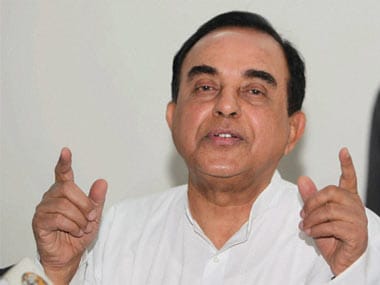 File image of BJP MP Subramanian Swamy. PTI[/caption]The newspaper Milli Gazette—a publication which describes itself as "Indian Muslims' leading English newspaper since January 2000"—described the apex court verdict as a "a step towards self-destruction."The RSS seemed to support the verdict, but with a caveat. In a statement issued Thursday, the RSS said, "Like the Supreme Court verdict, we also don't consider this (homosexuality) a crime. Same-sex marriages and relations are not in consonance with nature, and so we do not support such relations. Traditionally, Indian society has not supported such relations. Ordinarily, people learn from experience, and so this issue needs to handled at a social and psychological level."This statement is similar to what Dattatreya Hosabale, the organisation's joint general secretary, said in 2016: "Homosexuality is not a crime, but (is a) socially immoral act in our society. No need to punish, but to be treated as a psychological case." However, he further added, "Gay marriage is institutionalisation of homosexuality. It should be prohibited."On the other hand, spiritual guru Sri Sri Ravi Shankar was more effusive, "Letting go of obsolete laws, keeping up with a scientific temper and honouring people’s choices has strengthened our democracy." However, he courted controversy in November, when he said at an event at Delhi's Jawaharlal Nehru University (JNU) that same-sex relations are a 'tendency' and are not 'permanent.'In response to a question by a student speaking about ill-treatment by his loved ones due to his sexual orientation, he had said, "This is your tendency now. Just acknowledge it and accept it, and know that this tendency is not a permanent thing. It may change."Gay sex among consenting adults is not a criminal offence, the Supreme Court unanimously ruled Thursday, holding that part of a 158-year-old colonial law that criminalised it violated the constitutional right to equality and dignity.The top court decriminalised part of the Section 377 of the Indian Penal Code that criminalises consensual gay sex, saying it was irrational, indefensible and manifestly arbitrary. A five-judge constitution bench headed by Chief Justice Dipak Misra unanimously held that the Lesbian, Gay, Bisexual, Transgender and Queer (LGBTQ) community possess the same constitutional rights as other citizens of the country.It termed sexual orientation as a "biological phenomenon" and "natural" and held that any discrimination on this ground was violative of the fundamental rights.With inputs from PTI
First Published:Sep 06, 2018, 19:40:43 IST
Advertisement
Advertisement

China has dominated Myanmar’s rare earth mines — now India eyes deal to harness country’s critical minerals
India is deepening rare earth cooperation with Myanmar as New Delhi seeks alternative sources of critical minerals dominated by China, including dysprosium and terbium used in EVs, defence systems and clean energy technologies
6 min read
CJP protest in Delhi: New videos of stone pelting, violence emerge as police, agitators trade charges
Fresh videos of violence that broke out during the Cockroach Janta Party's (CJP) protest in Delhi have surfaced, with the police releasing footage showing alleged stone pelting, vandalism and attacks on security personnel
3 min read
'From make in India to launch from India': Skyroot COO on why Vikram-1 could change India’s space sector
Skyroot Aerospace’s successful Vikram-1 mission marks a major milestone for India’s private space sector, as the country seeks to shift from “Make in India” to “Launch from India” and compete in the global commercial satellite launch market
8 min read
Choke terror funding, keep international shipping lanes safe: Jaishankar at Asean Regional Forum
Jaishankar's remarks came against the backdrop of recent terror attacks targeting India and growing threats to commercial shipping amid conflicts in West Asia and Europe
2 min read
PM Modi announces fast-track courts for paper leak cases; CJP responds ‘Dharmendra Pradhan must go’
Amid protests demanding accountability for the leak of medical entrance test Neet and other irregularities in the education system, Prime Minister Narendra Modi has announced that the government has decided to set up fast-track courts to ensure swift and stringent punishment for those involved in paper leaks.
3 min read
Advertisement
Advertisement