


SC sets aside Jammu and Kashmir High Court order, rules state has no vestige outside the Constitution
Jammu and Kashmir has "no vestige" of sovereignty outside the Indian Constitution and its own, while the citizens of the state are "first and foremost" citizens of India, the Supreme Court has held.

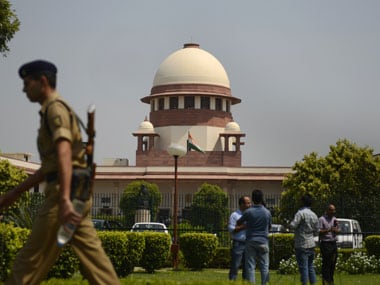
Supreme Court Of India. AFP[/caption]The bench set aside the verdict of Jammu and Kashmir High Court that had held that any law made by Parliament, which affects the laws made by state legislature, cannot be extended to Jammu and Kashmir."The High Court judgment begins from the wrong end and therefore reaches the wrong conclusion. It states that in terms of Section 5 of the Constitution of Jammu & Kashmir, the State has absolute sovereign power to legislate in respect of laws touching the rights of its permanent residents qua their immovable properties," the apex court said.It further said, "We may also add that permanent residents of Jammu & Kashmir are citizens of India, and there is no dual citizenship as is contemplated by some other federal Constitutions in other parts of the world".The apex court judgement came on the appeal by State Bank of India (SBI) against the high court verdict which had held that the The Securitisation and Reconstruction of Financial Assets and Enforcement of Security Interest Act, 2002 (SARFAESI) Act would collide with the Transfer of Property Act of Jammu & Kashmir, 1920.SARFAESI is an enactment which entitles banks to enforce their security interest outside the court process to take possession of secured assets of the borrower and sell them outside the court process.The apex court, in its 61-page verdict, also said it was "disturbing to note that various parts of High Court judgment speak of the absolute sovereign power of Jammu & Kashmir.""It is necessary to reiterate that Section 3 of the Constitution of Jammu & Kashmir, which was framed by a Constituent Assembly elected on the basis of universal adult franchise, makes a ringing declaration that the State of Jammu & Kashmir is and shall be an integral part of the Union of India. And this provision is beyond the pale of amendment," it said.The apex court, while setting aside the high court order, held that provisions of the SARFAESI Act can be applied to Jammu and Kashmir."We therefore set aside the judgment of the High Court. As a result, notices issued by banks in terms of Section 13 (Enforcement of security interest) and other coercive methods taken under the said Section are valid and can be proceeded with further," the bench said. The High Court had held the Act was inapplicable for banks like the SBI which are Indian banks.

China has dominated Myanmar’s rare earth mines — now India eyes deal to harness country’s critical minerals
CJP protest in Delhi: New videos of stone pelting, violence emerge as police, agitators trade charges
'From make in India to launch from India': Skyroot COO on why Vikram-1 could change India’s space sector
Choke terror funding, keep international shipping lanes safe: Jaishankar at Asean Regional Forum
PM Modi announces fast-track courts for paper leak cases; CJP responds ‘Dharmendra Pradhan must go’