


RFID tags to anti-drones: How security at the Amarnath Yatra has been heightened
The Centre is taking all necessary steps to protect pilgrims, who will undertake the 43-day Amarnath Yatra, starting from 30 June. This year’s pilgrimage assumes double significance as it is being held for the first time since the abrogation of Section 370 in Jammu and Kashmir

There’s been a hustle at the home ministry as Amit Shah has been conducting back-to-back marathon meetings for the preparation for the Amarnath Yatra, an annual pilgrimage which is all set to start on 30 June after a gap of two years.
The annual pilgrimage — which was put on hold for the past two years owing to the COVID-19 pandemic — will be historic, as six to eight lakh pilgrims are expected to visit the shrine in the Himalayas this year.
Moreover, the pilgrimage assumes double significance, as it’s the first being held after Section 370 was abrogated in 2019.
With preparations in full swing — registrations for the yatra began on 11 April — we take a closer look at the history of the yatra, its significance and the measures being taken to ensure safety of the devotees.
 More from India
History of Amarnath Yatra
The annual Amarnath Yatra to the cave shrine of Lord Shiva high up in the Himalayas is among the country’s most revered pilgrimages.
Hundreds of thousands of pilgrims make the trek up to the shrine each year. However, there is no official record of when the Yatra formally began.
According to lore, a Muslim shepherd by the name Buta Malik discovered the cave in 1850. It is said that he was in the mountains with his animals when a Sufi saint gave him a bag of coal. When he returned home and checked the contents of the bag, he found it to be full of gold. Malik ran to thank the saint, but could not find him and instead found the cave and the famous ice lingam.
However, this view isn't accepted by all; there are a number of ancient texts, historical chronicles and research works which throw ample light on the history/origin of the Amarnath pilgrimage.
Initially, the pilgrimage was organised by the Purohit Sabha Mattan, Anantnag, and Dashnami Akhara, Srinagar for 15 days.
It was in 2000 that then Chief Minister Farooq Abdullah intervened, demanding for better arrangements for the yatra. This led to the formation of the Shri Amarnathji Shrine Board with the Governor at the head. In 2005, the Board decided to spread the pilgrimage out over nearly two months.
The Amarnath Yatra was a low-key affair in the early years. However, since the 1990s it has seen a rise in the number of participants and saw the highest number in 2011 of 6.3 lakh devotees.
Threats to the yatra
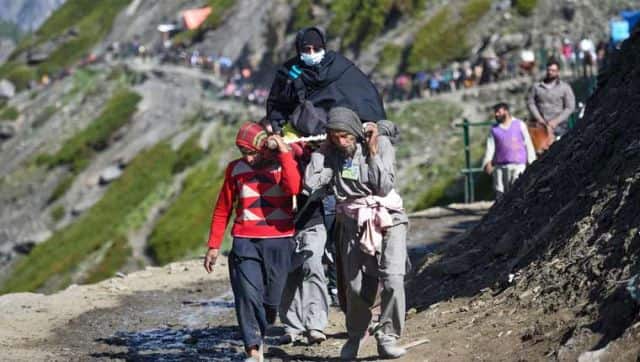
The annual pilgrimage is no child’s play, as devotees have to trek dangerous terrain to reach the cave in the mountains.
But, the terrain and the difficult weather is not the only worry for devotees and authorities, alike. In the past, the yatra has been a target of terror attacks.
Also read: On the Amarnath Yatra, pilgrims counter danger with faith
Back in 2000, the Yatra saw its first-ever attack in which 25 people, including 17 pilgrims died. The next year, 2001, two hand grenades were hurled at pilgrims at Sheshnag, on the road to the cave shrine, killing 12 pilgrims and wounding 13.
In 2017, the Amarnath Yatra saw its worst attack when terrorists attacked pilgrims in their bus, killing seven people.
Later, the government told Lok Sabha that 53 devotees had been killed and another 167 had been injured in 36 terror attacks on the Amarnath Yatra since 1990.
Protecting pilgrims this year
With a record number of pilgrims expected, security agencies are making elaborate and foolproof security arrangements for a smooth yatra.
Sources were quoted by Deccan Herald as saying that the government will deploy over 40,000 central paramilitary and police personnel to secure the 43-day yatra.
Fearing the use of drones by terrorists, the security agencies, according to an India Today report, will deploy anti-drones along the routes in yatra.
It has also been stated that all yatris will be provided with Radio Frequency Identification (RFID) tags, which will help track them.
“This will be the first time RFID tags are provided to pilgrims, earlier vehicles carrying them were tracked through the tags. It was then provided by the Central Reserve Police Force (CRPF),” a senior government official was quoted as saying by The Hindu.
Besides the RFID tags, each pilgrim would also be insured for Rs five lakh, said the government. Moreover, instructions have been given that mobile towers be increased for better communication.
The Jammu and Kashmir Police told Rising Kashmir that CCTVs and drones will monitor the pilgrimage throughout the twin routes and all routes will be sanitised before the commencement of Yatra each day and there will be no compromise on security arrangement.
An official said: “No pilgrim vehicle will be allowed to mingle with civilian vehicles. There will be proper timing for pilgrim vehicles on all routes.”
The security arrangements have been heightened after the Valley is already on edge after a Kashmiri Pandit, Rahul Bhat, was shot dead by terrorists in tehsil office in Chadoora town in Budgam district on 22 May.
With inputs from agencies
Read all the Latest News, Trending News, Cricket News, Bollywood News,
India News and Entertainment News here. Follow us on Facebook, Twitter and Instagram.

J&K cop on Amarnath Yatra duty shot dead in Anantnag terror attack; TRF claims responsibility
Jaishankar meets Canada's Anita Anand, discusses bilateral cooperation and shared interests
Delhi, Bengaluru, Hyderabad... Neet paper leak protest spreads nationwide even as govt reaches out to CJP, Opposition
Why is India seeing 95% cloud cover despite a Super El Niño?
Jaishankar, Rubio review trade, defence, AI cooperation at Manila meeting