


Ravi Shankar Prasad's digital nationalism sends out mixed messages, may inhibit glorious technology revolution
Prasad's latest statement that internet giants should reinvest their profits in India to create jobs, is bound to be seen in a suspicious light for more reasons than one

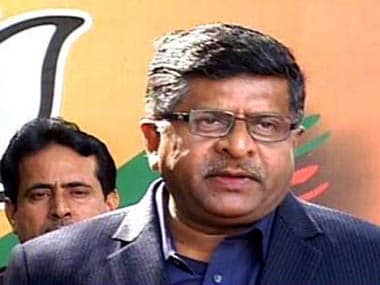
File image of Ravi Shankar Prasad. News18[/caption]In such a context, a call to create jobs through reinvestment smacks of a philosophy that may be in tune with the increasingly protectionist tendencies everywhere from the US to Eastern Europe and China, but there is reason to believe that unless carefully measured and articulated, this may stop the Fourth Industrial Revolution in its tracks even as the Third Industrial Revolution powered by digital technologies only just takes off in India.The fourth revolution, as the World Economic Forum says, is "characterised by a fusion of technologies that is blurring the lines between the physical, digital, and biological spheres". What exactly does Prasad want? Unless he articulates his thoughts clearly, we have to point out that internet giants already have spun hundreds of thousands of jobs in India.Google in four Indian cities and Amazon in five are counted among the top tech places to work in India. Their engineers are shaping new technologies and business processes in which "Serviced from India" or "Designed in India" is already a much bigger success than the intention of a "Make in India" manufacturing programme. Facebook has a facility in Hyderabad that may not be as big as the other two giants, but between the three of them, they have "ecosystem" partners including advertising agencies, search engine experts, content creators, e-commerce players and sundry service providers that together account for a huge workforce.Faced with new challenges of content moderation as well as regulation, Facebook is hiring away and India is definitely a key zone to recruit more. India's thriving start-up scene, which is ranked third in the world, saw its Startup India programme count 8,000 firms as of last March. Prasad says it is "only fair and just" that giants invest their profits back into its largest markets. If we take a nuanced view, it would seem the minister is looking at some kind of a fiscal policing of the consumer side of the Internet giants — such as e-commerce operations that benefit from local customers.In the backdrop of an attempt to regulate e-commerce in India, does that mean some kind of a carrot-and-stick method to help local companies? The definition of a local company is itself as "complicated" as some Facebook relationship statuses. Global venture capital funds are nurturing homegrown entrepreneurs in India and creating "unicorns" (billion-dollar valuation startups). Further, news is just out that legendary investor Warren Buffett is planning to pick up a stake in One97, the parent of Paytm.The NDA government's proposed e-commerce policy draft wants regulations on everything from discounts and competition to foreign direct investment where online marketplaces sell their own manufactured goods. Amazon and Walmart-controlled Flipkart understandably want the whole draft junked.Two years ago, India introduced a six percent equalisation levy popularly known as "Google Tax" to milk a portion of the advertising revenue gains internet giants get from their ecosystem. Now there is speculation that this may be extended even to non-digital multinationals. In such a context, the minister has a lot of talking to do to explain his case on internet investments into India.
"While cyberspace is truly global, it must be linked with local ideas, local culture and local views," the minister has said. What is he getting at?Global capital loves India's potent mix of engineers, entrepreneurs and service providers in a billion-plus-people market formng the world's fastest growing economy. Does Prasad want to introduce a quasi-Nehruvian policy of inward-looking regulations that undo the philosophy of globalisation pursued since 1991? For the avowedly anti-Nehruvian BJP, that would be a counter-intuitive thought. As a major gainer from technological globalisation and free capital flows over the past three decades, India must know the limits of digital nationalism.The author is a senior journalist. He tweets @madversity

Air India to cut Delhi-Toronto flight time by 3 hours, resume non-stop services from August 1
J&K cop on Amarnath Yatra duty shot dead in Anantnag terror attack; TRF claims responsibility
Jaishankar meets Canada's Anita Anand, discusses bilateral cooperation and shared interests
Delhi, Bengaluru, Hyderabad... Neet paper leak protest spreads nationwide even as govt reaches out to CJP, Opposition
Why is India seeing 95% cloud cover despite a Super El Niño?