
Advertisement


Sections
One in ten samples from major Indian rivers contaminated with heavy metals, as per a nationwide survey of surface water by CWC
The CWC cited population growth, rise in agricultural and industrial activities were are largely responsible for the heavy metal pollution.

It seems that most, if not all, of India's rivers have a heavy metal contamination problem. In a nationwide survey of river water quality by the Central Water Commission (CWC), two-thirds of the samples from water quality stations across India's major rivers showed one or more heavy metal contaminants, at levels that exceed the safe limits set by the Bureau of Indian Standards.In many parts of the country, residents use water directly from the source (rivers) for use in their homes, and for consumption. Rapid urbanisation and industrialisation in recent years has threatened the availability of good quality and quantity of water. The report also highlights that India, being a developing nation, doesn't always have facilities available (or even possible) for drinking water treatment before supply.[caption id="attachment_7797181" align="alignnone" width="1024"]![A man gathers water as he bathes in a section of the Yamuna River polluted by industrial waste-foam in the outskirts of New Delhi; May 2013. Image: Getty]() A man gathers water as he bathes in a section of the Yamuna River polluted by industrial waste-foam in the outskirts of New Delhi; May 2013. Image: Getty[/caption]While some amount of metals in drinking water is normal and even required, if the level goes beyond the set limits it can lead to a range of diseases. This makes the heavy metal contamination of rivers an urgent and immediate public health concern, since the contaminants in question (heavy metals) are associated with a host of serious, chronic illnesses.Long-term exposure can lead to "progressing physical, muscular, and neurological degenerative processes that mimic Alzheimer’s disease, Parkinson’s disease, muscular dystrophy and multiple sclerosis," as per a report in The Hindu. [caption id="attachment_7796611" align="alignnone" width="1024"]
A man gathers water as he bathes in a section of the Yamuna River polluted by industrial waste-foam in the outskirts of New Delhi; May 2013. Image: Getty[/caption]While some amount of metals in drinking water is normal and even required, if the level goes beyond the set limits it can lead to a range of diseases. This makes the heavy metal contamination of rivers an urgent and immediate public health concern, since the contaminants in question (heavy metals) are associated with a host of serious, chronic illnesses.Long-term exposure can lead to "progressing physical, muscular, and neurological degenerative processes that mimic Alzheimer’s disease, Parkinson’s disease, muscular dystrophy and multiple sclerosis," as per a report in The Hindu. [caption id="attachment_7796611" align="alignnone" width="1024"]![CWC's water quality monitoring stations across India. Image: Status of Trace & Toxic Metals in Indian Rivers 2019 Report]() CWC's water quality monitoring stations across India. Image: Status of Trace & Toxic Metals in Indian Rivers 2019 report[/caption]The CWC collected 442 surface water samples in all, from various water quality monitoring stations in India. Out of the 2959 samples taken from 447 water quality monitoring stations (see map above), 287 samples were positive for excessive levels of heavy metals (10 percent of all the samples), per the survey's findings detailed in CWC's Status of Trace & Toxic Metals in Indian Rivers 2019 report. Moreover, 101 stations (3.4 percent) tested positive for contamination by two different metals, and six (0.2 percent) that were positive for three different metal contaminants.The samples were analyzed for selected eight trace and toxic metals at National River Water Quality Laboratory, Central Water Commission, New Delhi. The most common heavy metal found in rivers was iron, which was above limits that are considered "safe" in 156 samples (5.3 percent). Other heavy metals that were also found above acceptable levels in were lead, nickel, chromium, cadmium and copper were the other metals. Arsenic and zinc are the two toxic metals whose concentrations were found within the safe limits throughout the study."Over the last few decades, the concentration of these heavy metals in river water and sediments has increased rapidly," the report reads, followed by the suggestion that these levels need to be monitored more closely and frequently. "Population growth and rise in agricultural and industrial activities" were cited as responsible for the unsafe level of unsafe heavy metal levels in major Indian rivers.The 2019 report is the third edition in an exercise conducted by the Central Water Commission (CWC) over May 2014 to April 2018.
CWC's water quality monitoring stations across India. Image: Status of Trace & Toxic Metals in Indian Rivers 2019 report[/caption]The CWC collected 442 surface water samples in all, from various water quality monitoring stations in India. Out of the 2959 samples taken from 447 water quality monitoring stations (see map above), 287 samples were positive for excessive levels of heavy metals (10 percent of all the samples), per the survey's findings detailed in CWC's Status of Trace & Toxic Metals in Indian Rivers 2019 report. Moreover, 101 stations (3.4 percent) tested positive for contamination by two different metals, and six (0.2 percent) that were positive for three different metal contaminants.The samples were analyzed for selected eight trace and toxic metals at National River Water Quality Laboratory, Central Water Commission, New Delhi. The most common heavy metal found in rivers was iron, which was above limits that are considered "safe" in 156 samples (5.3 percent). Other heavy metals that were also found above acceptable levels in were lead, nickel, chromium, cadmium and copper were the other metals. Arsenic and zinc are the two toxic metals whose concentrations were found within the safe limits throughout the study."Over the last few decades, the concentration of these heavy metals in river water and sediments has increased rapidly," the report reads, followed by the suggestion that these levels need to be monitored more closely and frequently. "Population growth and rise in agricultural and industrial activities" were cited as responsible for the unsafe level of unsafe heavy metal levels in major Indian rivers.The 2019 report is the third edition in an exercise conducted by the Central Water Commission (CWC) over May 2014 to April 2018.
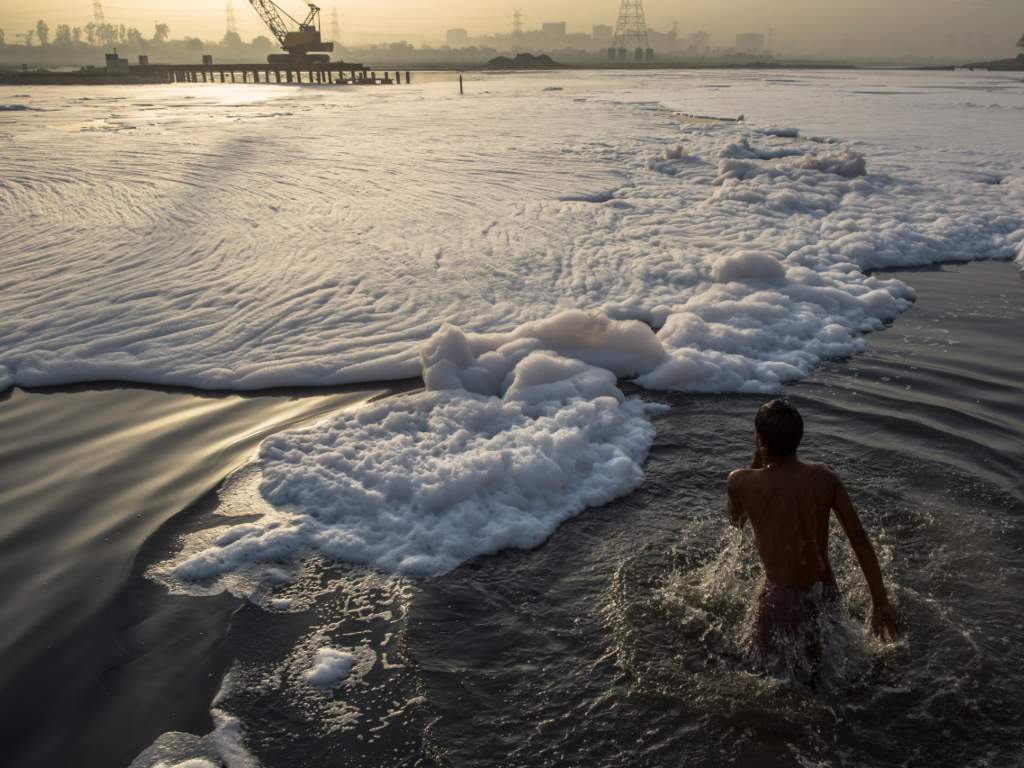 A man gathers water as he bathes in a section of the Yamuna River polluted by industrial waste-foam in the outskirts of New Delhi; May 2013. Image: Getty[/caption]While some amount of metals in drinking water is normal and even required, if the level goes beyond the set limits it can lead to a range of diseases. This makes the heavy metal contamination of rivers an urgent and immediate public health concern, since the contaminants in question (heavy metals) are associated with a host of serious, chronic illnesses.Long-term exposure can lead to "progressing physical, muscular, and neurological degenerative processes that mimic Alzheimer’s disease, Parkinson’s disease, muscular dystrophy and multiple sclerosis," as per a report in The Hindu. [caption id="attachment_7796611" align="alignnone" width="1024"]
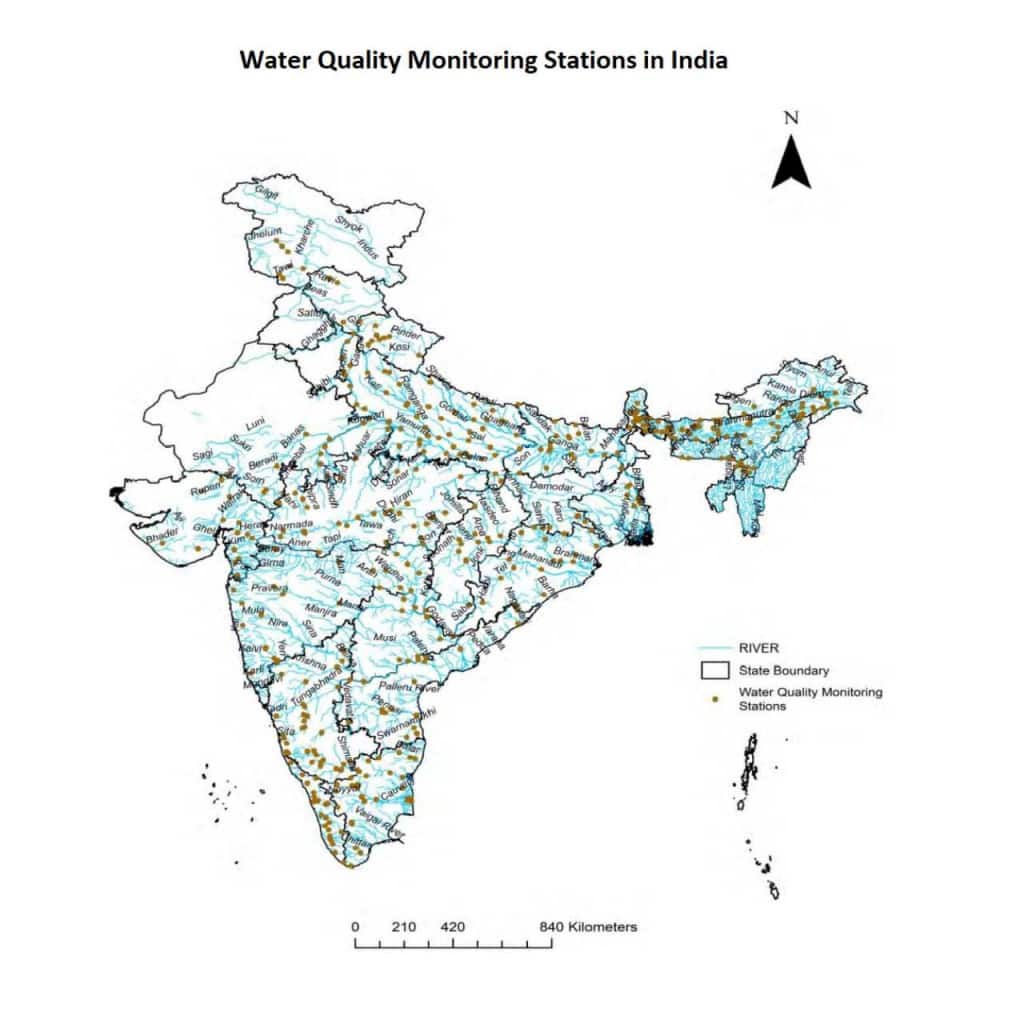 CWC's water quality monitoring stations across India. Image: Status of Trace & Toxic Metals in Indian Rivers 2019 report[/caption]The CWC collected 442 surface water samples in all, from various water quality monitoring stations in India. Out of the 2959 samples taken from 447 water quality monitoring stations (see map above), 287 samples were positive for excessive levels of heavy metals (10 percent of all the samples), per the survey's findings detailed in CWC's Status of Trace & Toxic Metals in Indian Rivers 2019 report. Moreover, 101 stations (3.4 percent) tested positive for contamination by two different metals, and six (0.2 percent) that were positive for three different metal contaminants.The samples were analyzed for selected eight trace and toxic metals at National River Water Quality Laboratory, Central Water Commission, New Delhi. The most common heavy metal found in rivers was iron, which was above limits that are considered "safe" in 156 samples (5.3 percent). Other heavy metals that were also found above acceptable levels in were lead, nickel, chromium, cadmium and copper were the other metals. Arsenic and zinc are the two toxic metals whose concentrations were found within the safe limits throughout the study.
First Published:Dec 18, 2019, 11:52:54 IST
Advertisement
Advertisement

Air India to cut Delhi-Toronto flight time by 3 hours, resume non-stop services from August 1
Air India will resume non-stop Delhi-Toronto flights from August 1, cutting travel time by nearly three hours and deploying its new Boeing 787-9 Dreamliner on the route
2 min read
J&K cop on Amarnath Yatra duty shot dead in Anantnag terror attack; TRF claims responsibility
The Resistance Front (TRF), a shadow outfit of Lashkar-e-Taiba, claimed responsibility for the attack through a social media post
2 min read
Jaishankar meets Canada's Anita Anand, discusses bilateral cooperation and shared interests
External Affairs Minister S Jaishankar on Wednesday held talks on bilateral ties with his Canadian counterpart Anita Anand, focusing on cooperation and common goals.
1 min read
Delhi, Bengaluru, Hyderabad... Neet paper leak protest spreads nationwide even as govt reaches out to CJP, Opposition
Protests over the alleged NEET paper leak intensified across multiple cities, while the Centre signalled talks with the Opposition and the Cockroach Janta Party. The Delhi High Court also stepped in, seeking preservation of CCTV footage related to police action.
3 min read
Why is India seeing 95% cloud cover despite a Super El Niño?
India is witnessing nearly 95 per cent cloud cover despite a Super El Niño, a climate event usually linked to weaker monsoons. Regional weather systems, cyclonic circulations, the monsoon trough and moisture from two seas are temporarily overpowering one of the world's strongest climate phenomena
5 min read
Advertisement
Advertisement