
Advertisement


Sections
Madhya Pradesh's Bhavantar Bhugtan Yojana leaves cultivators fuming, farmers allege traders usurp benefits
The Bhavantar Bhugtan Yojana, which was introduced in the wake of simmering discontent among farmers in Madhya Pradesh, has only left them fuming.

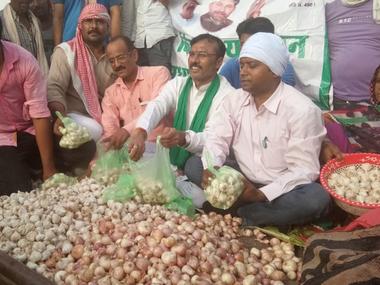 Anil Yadav (in green scarf), Madhya Pradesh general secretary of the Bhartiya Kisan Union during a protest. Image: 101Reporters[/caption]Tussle between farmers and tradersMandi officials at Karond said 8,000-10,000 quintals of vegetables arrive here every day, throwing light on the huge earning difference between traders and farmers of nearby areas. Farmers said their profits are negligible even when there is a rise in vegetable prices since the gain is mostly usurped by traders in connivance with government officials.Kushwah grows soybean as the primary crop and cultivates vegetables at other times of the year. But selling his primary crop has been a distressing exercise. Four months after widespread agrarian protests, the Shivraj Singh Chouhan government in the state had launched the Bhavantar Bhugtan Yojana (BBY) in October – a scheme of paying farmers the difference between the minimum support price (MSP) and the average wholesale price to mitigate losses. However, benefits of the scheme for soybean closed in December and since then, the rates in mandis have crossed the MSP of Rs 3,050.“I had sold soybean in October for Rs 2,650 per quintal and had also availed the benefit of the price difference between its MSP and wholesale rate through BBY. But soon after the scheme closed, the price rose to Rs 3,300 per quintal. This shows that traders deliberately keep prices depressed while purchases under BBY are made so that the benefits do not go to farmers,” said Kushwah.Farmers pay around Rs 4,000 per quintal when the crop is purchased by them in seed form. This further adds to their burden.The situation is similar for most farmers in the state who try to sell their crops and avail benefits of government schemes. “Initially, we thought BBY was a good scheme because the government would take care if our crops are sold below the MSP. But we make numerous rounds of mandis to keep track of our payment that hardly comes on time,” said Bheem Singh, another farmer.State general secretary of the Bhartiya Kisan Union (BKU), Anil Yadav, said, “Garlic was brought under the BBY. At first, it was sold at Rs 8,000 per quintal and then dropped to as low as Rs 200 per quintal in subsequent months. The cartel of traders had brought down the rate below its MSP. One of the local farmers had invested Rs 27,000 in buying garlic seeds and another Rs 8,000 for fertiliser and labour costs. But he got only Rs 6,000 from the mandi sale, suffering a loss of Rs 29,000.”Till around January, garlic was being sold at Rs 60-80 per kilogram. In Mandsaur, the prices later fell to as low as Rs 1 per kg. “Many farmers threw their produce as it was not a viable option to even carry it to the mandi. A similar trend was observed in the case of tomatoes and onion. Why do rates of agricultural produce fall when farmers are about to sell them but rise again later?” asked Yadav.The scheme, which was introduced in the wake of simmering discontent among farmers, has only left them fuming. “It proved beneficial only to traders, who systemically controlled and lowered rates during the Bhavantar period and later increased them to make huge gains,” said another farmer, who did not wish to be named.Traders under lensAjay Dubey, an RTI activist and member of Transparency International, an international NGO fighting corruption, said, “We had obtained a list of 400 suspicious Bhavantar transactions across the state that were compiled by the mandi board officials.”
Dubey said he has placed an application with the income tax department to probe the matter and see why some traders were found buying huge quantities of produce only from select farmers. “It could be only the tip of an iceberg,” he said.Explaining more about the modus operandi of traders, BKU general secretary Yadav said, “Traders buy produce at dirt cheap rates from local farmers and ask them to avail of the benefits of BBY from the government authorities. Or, they themselves would buy the produce from mandis of other states where the rates are low and make false entries on names of farmers to avail of Bhavantar benefits.”Yadav also gave the example of a sting operation that was carried out by a media house last year, exposing the nexus between mandi officials and traders.In a recent raid at the godown of a trader, identified as Dayaram Sahu, in Lateri area of Vidisha district, officials had seized unaccounted and unverified stocks of chana and masoor dal in large quantities. The stocks found at his godown were more than what he had bought from the mandi.[caption id="attachment_4504425" align="aligncenter" width="825"]
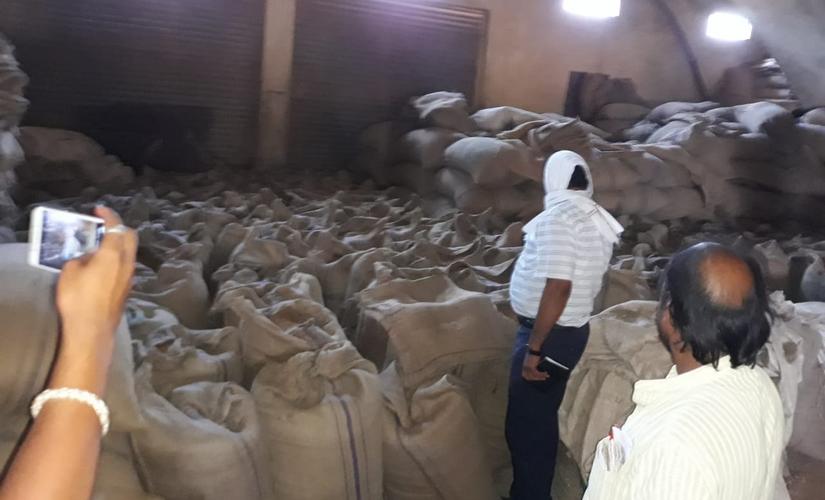 Officials during a raid in a godown in Vidisha, Madhya Pradesh. Image: 101Reporters[/caption]A food official who was part of the raid said, “Sahu was found guilty of selling 320 quintals and 210 quintals of chana dal at lower rates. The produce was procured illegally from some other place at cheaper prices, which is against government rules.”In another instance, licences of 30 traders were cancelled in Shajapur area recently after they were found involved in a BBY scam.In an announcement made by chief minister Chouhan in March, it was decided that gram, lentils and mustard would be removed from the BBY scheme. The motive, according to government officials, was to encourage farmers to sell these crops at MSP in order to get the “right prices”.(Shahroz Afridi is a Bhopal-based freelance writer and a member of 101Reporters.com, a pan-India network of grassroots reporters.)
First Published:Jun 10, 2018, 15:52:59 IST
Advertisement
Advertisement

J&K cop on Amarnath Yatra duty shot dead in Anantnag terror attack; TRF claims responsibility
The Resistance Front (TRF), a shadow outfit of Lashkar-e-Taiba, claimed responsibility for the attack through a social media post
2 min read
Jaishankar meets Canada's Anita Anand, discusses bilateral cooperation and shared interests
External Affairs Minister S Jaishankar on Wednesday held talks on bilateral ties with his Canadian counterpart Anita Anand, focusing on cooperation and common goals.
1 min read
Delhi, Bengaluru, Hyderabad... Neet paper leak protest spreads nationwide even as govt reaches out to CJP, Opposition
Protests over the alleged NEET paper leak intensified across multiple cities, while the Centre signalled talks with the Opposition and the Cockroach Janta Party. The Delhi High Court also stepped in, seeking preservation of CCTV footage related to police action.
3 min read
Why is India seeing 95% cloud cover despite a Super El Niño?
India is witnessing nearly 95 per cent cloud cover despite a Super El Niño, a climate event usually linked to weaker monsoons. Regional weather systems, cyclonic circulations, the monsoon trough and moisture from two seas are temporarily overpowering one of the world's strongest climate phenomena
5 min read
Jaishankar, Rubio review trade, defence, AI cooperation at Manila meeting
Jaishankar and US Secretary of State Marco Rubio reviewed key pillars of the India-US Comprehensive Global Strategic Partnership, including trade, defence, energy, critical minerals and artificial intelligence, while also exchanging views on regional and global developments.
1 min read
Advertisement
Advertisement