


Legality of Pakistan surgical strikes: India has arsenal of lawful defences at its disposal, conjecture is unnecessary
While it is indisputable that, principally, bombings well within the territory of Pakistan bear greater legal repercussions than the erstwhile surgical operations in Pakistan-occupied-Kashmir, authors argue that India has a whole arsenal of legal defences at its disposal and the conjectures are therefore inappropriate

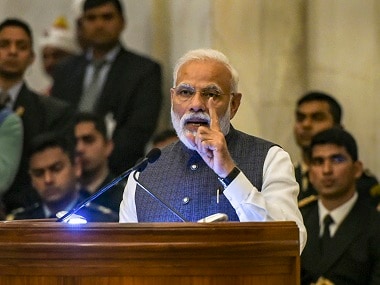
File image of Prime Minister Narendra Modi. PTI[/caption]Furthermore, India's stance is strengthened by Resolutions 1368 and 1373 of the United Nations which recognize acts of international terrorism as an actionable threat to international peace and security.Pre-emptive Self-Defence: Protection in International LawIt has been a contentious issue before jurists whether the right to self-defence under Article 51 includes a pre-emptive action. However, what is worth considering is the fact that right to self-defence emanates not only from Article 51 of the Charter, but also from the principles of customary international law. In fact, it is considered to be an inherent right under Customary International Law, meaning that it is as important as the idea of the state itself and it will exist even without the UN Charter and its Article 51.The Caroline Test, which emerged as a principle of customary international law after the Caroline affair holds unambiguously that the states are authorised to a pre-emptive right of self-defence conditioned on the fact that it must be instant, proportional and necessary. Since the Indian Government has maintained that the strikes have been carried out on the basis of credible intelligence it received about potential attacks by Jaish-e-Mohammad in the nearby future, the customary international law standards are fairly met.There have been valid preemptive strikes in response to terror attacks in the past too. The US claimed to be acting in accordance with Article 51, when on 20th August, 1998 it launched cruise missile attacks inside Afghanistan and Sudan, in response to terrorist bombings on its embassies in Kenya and Tanzania.It may also be noted that this was also a strike against a non-state actor and not against the state inside which the perpetrators were dwelling.It is important here to mention the technicalities referred to in the statement by Foreign Secretary, wherein he has specifically mentioned that the strikes are preemptive in direct anticipation of another future suicide bombing. Therefore, the direct cause of India's air strikes, is an anticipated suicide bombing in future and not anything in the past. This has given a sound legal backing to India's actions under International Law.Road Ahead for PakistanBasing its intendment to retaliate, Pakistan is now faced with the choice of either attacking India's military base(s) or its civilian settlements. Whereas the former would qualify as an act of war under International Law, the latter constitutes a graver wrongdoing against International Humanitarian Law. The recourse, if any, is therefore to raise the issue before UN which is unlikely to yield desirable results given the solidarity with which UNSC stands with India post the Pulawama terror attack as manifested in the UNSC statement. To conclude, maybe the only remedy for a state crippled with forces of fanaticism is to sit-back and introspect.Raghav Pandey is an Assistant Professor of Law at Maharashtra National Law University, Mumbai and teaches Public International Law and Anuj Bansal is a first-year student of Post Graduate Programme at IIM Ahmedabad.

Air India to cut Delhi-Toronto flight time by 3 hours, resume non-stop services from August 1
J&K cop on Amarnath Yatra duty shot dead in Anantnag terror attack; TRF claims responsibility
Jaishankar meets Canada's Anita Anand, discusses bilateral cooperation and shared interests
Delhi, Bengaluru, Hyderabad... Neet paper leak protest spreads nationwide even as govt reaches out to CJP, Opposition
Why is India seeing 95% cloud cover despite a Super El Niño?