


Is rising local militancy in south Kashmir a distraction tactic to hide real action in North?
According to the local grapevine, throngs of foreign militants are lurking in north Kashmir; a large number are said to be concentrated in the Sonawari-Safapora belt.

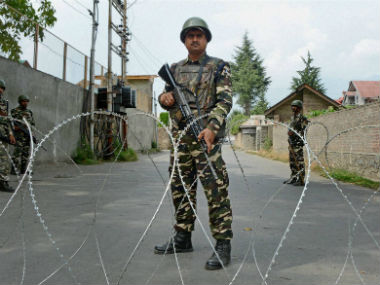
Representational image. PTI[/caption]Most of these suspected terrorists are said to be foreign militants, a great majority of whom could have infiltrated over the past three years through routes across the Shamsabari range that runs in an arc across the Kupwara district. On most days (and nights) at the peak of summer last year, the army engaged several different militant groups and foiled infiltration attempts through various routes. This sort of intensity of infiltration has been unknown since the 1990s.Similarly, the forests around Ajas and other parts of the Bandipora region are likely to be home to many more foreign militants. There are reports that infiltrations have taken place from the Dras area, and into the Valley through Tulail and Gurez. This route was used in 1990-91 too. On one occasion back then, the army killed more than a hundred intruders in one massive operation.At the heart of all these areas in the north is Sopore, which has been the epicentre of insurgency for decades. So crammed with miltants was the area around Sopore that it was almost out of India's control from around 1990 to 1992. Militants roamed freely and even army convoys took detours to avoid the town.At this point, those in charge of security would be well advised to urgently secure bridges and other supply lines to the three divisions stationed in the north — and rapidly construct alternate routes along the Pir Panjal on the western edge of the Valley.Diversionary anticsIt is possible that the concentration of attacks and encounters — mainly by local militants — in south Kashmir is designed to give the foreign militants in the north a chance to take roots and prepare for action. To that extent, the action in south Kashmir may even turn out to be a side-show before the main action begins. Besides, local militants have always been considered less daunting than foreign ones.The infiltrators are likely to be far more lethally trained than the local boys, who are generally trained locally. The arms that these foreigners bring with them too are likely to be more sophisticated. Most of the local boys have armed themselves with rifles they have snatched from police or paramilitary personnel. Weapon snatching appears to have been something of a ritual of initiation to join the new militancy which emerged from about the beginning of this decade.Increased violence aheadEven amid so much bloodshed, there is much talk in the Valley of a further increase in violence after Eid-ul Fitr. The festival is due after another week and violence could take a quantum leap a few days after the celebrations.Last year too, there was similar talk during the month of Ramzaan about heightened unrest after Eid and indeed, extraordinary unrest followed the killing of militant commander Burhan Wani just two days after the festival.There are indications that last year’s unrest might turn out to be something of a practice run for much greater violence this year. Violence during the second half of this year might resemble a horrific war — on the ground within the Valley, quite apart from heightened exchanges on the Line of Control and the International Border.
David Devadas is an expert on politics and geopolitics. Formerly a Senior Fellow at the Nehru Memorial Museum and Library, Visiting Professor at Jamia Millia Islamia, and Political Editor of Business Standard, he is currently Distinguished Fellow at the Institute for Social Sciences. He has written books on Kashmir, on youth, and on history. He has been a radio compere, guest faculty at JNU's Academic Staff College, St Stephen's College and Hindu College. He has worked for the Indian Express, The Hindustan Times, India Today, The Economic Times and Gulf News. His most impactful article, on a murder cover-up, prevented a Congress President from becoming prime minister. One led to the closure of an airline, and another created a furore and consequent clean-up in Delhi's health department. Several have correctly predicted election results in key states, and a series of reports from Srinagar made the government aware of how unsettled the situation there was in 1990. He is an alumnus of St Xavier's School, St Stephen's College, and the Indian Institute of Mass Communication. He has lived for extended periods in Geneva and Berlin, and has traveled to almost 50 countries. He enjoys various kinds of music, theatre, design, architecture and art.

China has dominated Myanmar’s rare earth mines — now India eyes deal to harness country’s critical minerals
CJP protest in Delhi: New videos of stone pelting, violence emerge as police, agitators trade charges
'From make in India to launch from India': Skyroot COO on why Vikram-1 could change India’s space sector
Choke terror funding, keep international shipping lanes safe: Jaishankar at Asean Regional Forum
PM Modi announces fast-track courts for paper leak cases; CJP responds ‘Dharmendra Pradhan must go’