
Advertisement


Sections
How many immigrants will benefit from Citizenship Act? 25,447 Hindus, 5,807 Sikhs, 55 Christians, two Buddhists and two Parsis, says Intelligence Bureau
Those who will immediately benefit from the Citizenship Amendment Act are a total of "31,313 persons belonging to minority communities, including "25,447 Hindu, 5,807 Sikhs, 55 Christians, 2 Buddhists and 2 Parsis who have been given Long Term Visa on the basis of their claim of religious persecution in their respective countries and want Indian Citizenship".

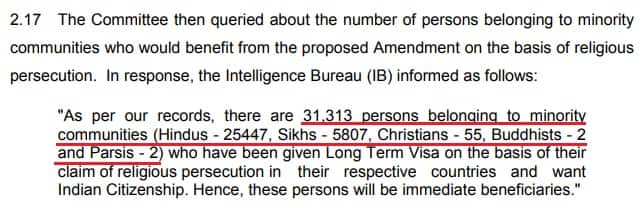 The joint parliamentary committee, tasked with the job of looking into the amended citizenship bill in 2016 when the Narendra Modi government made its first attempt to get it passed by Parliament, asked what will the fate of others from minority communities "who have come to India from the three countries under reference due to religious persecution but have not declared so at the time of their arrival in India".The Intelligence Bureau said:
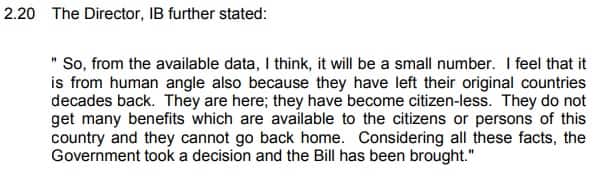
"For other to apply for Indian Citizenship under this category, they will have to prove that they came to India due to religious persecution. If they had not declared so at that time of their arrival in India, it would be difficult for them to make such a claim now. Any future claim will be enquired into, including through R&AW before a decision is taken. 'The committee, in the 2016 report, asked if only 31,313 people will benefit from the bill and the IB confirmed:"Yes, because they have claimed; they have applied. There will be many others who might have come and they might have already taken citizenship by various means. They might have obtained passport, ration card. All other documents they might have obtained and they might have already registered themselves in the voters list. So, for all practical purposes, they are already citizens of this country. Tribunals are already there to identify if any of them has obtained it by fraudulent means. That is a different issue altogether. The Bill is for those who have applied and who have claimed that they have been persecuted in their respective country."The bureau, in their submission, clearly state that initially "it will be a small number."
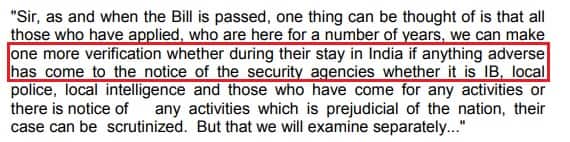
 The committee had also inquired whether all those who had applied would be granted citizenship once the Bill was passed or further verification will be carried out. The IB in its submissions, stated:
 The submissions by the Intelligence Bureau are important, especially in light of comments made by Union Home Minister Amit Shah in Rajya Sabha earlier this week, when the Upper House passed the Citizenship Amendment Bill. Quoting Shah, the Newslaundry reported that the home minister admitted that the numbers might likely rise.In his address to the Rajya Sabha on Wednesday, Shah said, "I request all of you to accept this Bill which has been brought in by the Narendra Modi government so that crores of people see a new day". In fact, throughout his address, Shah repeatedly said that "lakhs and crores of people" will benefit from the new law.16 Joint Committee on Bill to Amend the Citizenship Act 1955 by Devparna Acharya on Scribd
Responding to questions in Rajya Sabha on Wednesday, Shah said, "When we make this law and tell immigrants that you will get citizenship from the day you came and we will protect you, then when the citizenship numbers come, I will be in this House and Ghulam Nabi sahab will be here, and the numbers will be in lakhs and crores. That is what I want to tell the House..." The question then becomes why there is such a huge difference in the number cited by the MHA and the figures quoted by the Intelligence Bureau three years ago.During the debate on the Citizenship Amendment Bill in the Rajya Sabha, senior Congress leader and former Union Minister P Chidambaram posed six key questions to the government on the legality of the then proposed law. He termed the Bill as one which provides for citizenship by "arbitrary executive fiat". In short, but strongly-worded remarks, Chidambaram dared the government to put forward the opinion of the law department, or invite the Attorney-General to speak on the points mentioned by him. He also alleged that the government is "ramming through" the Bill despite knowing it is unconstitutional, only to advance its Hindutva agenda.The six questions posed by Chidambaram were:
- "Why is the government grouping together three countries — Afghanistan, Pakistan and Bangladesh — and leaving out others?"
- "Why has it identified only six religious groups — Hindus, Sikhs, Buddhists, Jains, Parsis, and Christians — and left out others like Ahmadiyyas, Rohingyas and Hazaras?"
- "There are three Abrahamic religions — Judaism, Christianity and Islam. Why has Christianity been included, and the other two been left out?"
- "Why have Sri Lankan Hindus and Bhutanese Christians been left out? This is beyond common sense and logic."
- "Why does the Bill address only religious persecution? Are people not persecuted for political reasons?"
- "Does the Bill violate the three fundamental elements of Article 14? There must be equality before law, any classification of people must not be unreasonable, and even if a classification is reasonable, it must not be arbitrary."
First Published:Dec 15, 2019, 15:32:45 IST
Advertisement
Advertisement

J&K cop on Amarnath Yatra duty shot dead in Anantnag terror attack; TRF claims responsibility
The Resistance Front (TRF), a shadow outfit of Lashkar-e-Taiba, claimed responsibility for the attack through a social media post
2 min read
Jaishankar meets Canada's Anita Anand, discusses bilateral cooperation and shared interests
External Affairs Minister S Jaishankar on Wednesday held talks on bilateral ties with his Canadian counterpart Anita Anand, focusing on cooperation and common goals.
1 min read
Delhi, Bengaluru, Hyderabad... Neet paper leak protest spreads nationwide even as govt reaches out to CJP, Opposition
Protests over the alleged NEET paper leak intensified across multiple cities, while the Centre signalled talks with the Opposition and the Cockroach Janta Party. The Delhi High Court also stepped in, seeking preservation of CCTV footage related to police action.
3 min read
Why is India seeing 95% cloud cover despite a Super El Niño?
India is witnessing nearly 95 per cent cloud cover despite a Super El Niño, a climate event usually linked to weaker monsoons. Regional weather systems, cyclonic circulations, the monsoon trough and moisture from two seas are temporarily overpowering one of the world's strongest climate phenomena
5 min read
Jaishankar, Rubio review trade, defence, AI cooperation at Manila meeting
Jaishankar and US Secretary of State Marco Rubio reviewed key pillars of the India-US Comprehensive Global Strategic Partnership, including trade, defence, energy, critical minerals and artificial intelligence, while also exchanging views on regional and global developments.
1 min read
Advertisement
Advertisement