
Advertisement


Sections
Gujarat Elections 2017: Welcome to Rajsamadhiyala village, where voting is compulsory and political campaigning is prohibited
Firstpost visits a Gujarat village where voting is enforced by fines and the voting percentage is above 90.

About twenty kilometres away from Rajkot is a unique village where voting is compulsory. If one doesn't vote, then they must pay a fine. This rule regarding compulsory voting has been made by the villagers and it imposes a fine of Rs 51 on those who fail to vote. As the election season comes closer, this village — adjacent to Rajkot-Bhavnagar Highway — has become a point of discussion in the area. The name of the village is Rajsamadhiyala.Rajsamadhiyala falls under Rajkol Rural Vidhan Sabha area. The village started mandatory voting in 1983 when Hardev Singh Jadeja became it's sarpanch. Today, 34 years later, voting in Rajsamadhiyala village is still mandatory.Jadeja said, 'Initially, some fines were issued but that is a thing of the past Now people have become aware. For the past ten to fifteen years, there has not been any penalties for anyone. If anyone has to stay away from voting due to important work or in case of an emergency, then they take permission from the village's Lok Adalat before going.'The effect of the rule is seen from the fact that in the last four elections, the percentage of voting in the village has been between 90 to 95 percent. On being asked why the number never reached a hundred, current sarpanch Ashok Bhai Vaghera said, 'The voter list also contains names of those who have died. Apart from this, after marriage, girls go to another village but their names remain in the voter's list.' This means that 100 percent voting is not achieved due to the voter list not being updated. Even then, 90 percent or more voting is an impressive feat in itself.[caption id="attachment_4222195" align="alignnone" width="825"]![The road approaching Rajsamadiyala village. Firstpost/Amitesh Singh]() The road approaching Rajsamadiyala village. Firstpost/Amitesh Singh[/caption]Strict rules in the villageIn addition to compulsory voting, there are many more laws in this village which are very strict. People who do not follow them face a fine imposed by the village Lok Adalat.
The road approaching Rajsamadiyala village. Firstpost/Amitesh Singh[/caption]Strict rules in the villageIn addition to compulsory voting, there are many more laws in this village which are very strict. People who do not follow them face a fine imposed by the village Lok Adalat.![The two boards listing the rules and facilities in Rajsamadiyala village. Firstpost/Amitesh Singh]() The two boards listing the rules and facilities in Rajsamadiyala village. Firstpost/Amitesh Singh[/caption]The biggest fine in the village so far was taken for consumption of liquor. A 2007 wedding ceremony cost Baba Bhai Kanpariya dearly when he served liquor to his guests. The Lok Adalat imposed a fine of Rs. 10,000 on Baba Bhai, which he had to pay.When Firstpost went to meet Baba Bhai, his house was locked as he had gone to Rajkot for treatment. However, the neighbours told Firstpost the entire story. Baba Bhai's neighbor, Dinesh Bhai Kanpariya, said that the liquor was served to the guest at night in the farm, but during checking the next day, an empty bottle was found.Another neighbour, Jagdish Kakaria, also acknowledged the fine and said, "The wedding happened at eight and the guests were served alcohol at ten in the farm. The next day, an empty bottle was found during an inspection by Lok Adalat members. After this the Lok Adalat imposed a fine of Rs 10,000 which Baba Bhai paid.
The two boards listing the rules and facilities in Rajsamadiyala village. Firstpost/Amitesh Singh[/caption]The biggest fine in the village so far was taken for consumption of liquor. A 2007 wedding ceremony cost Baba Bhai Kanpariya dearly when he served liquor to his guests. The Lok Adalat imposed a fine of Rs. 10,000 on Baba Bhai, which he had to pay.When Firstpost went to meet Baba Bhai, his house was locked as he had gone to Rajkot for treatment. However, the neighbours told Firstpost the entire story. Baba Bhai's neighbor, Dinesh Bhai Kanpariya, said that the liquor was served to the guest at night in the farm, but during checking the next day, an empty bottle was found.Another neighbour, Jagdish Kakaria, also acknowledged the fine and said, "The wedding happened at eight and the guests were served alcohol at ten in the farm. The next day, an empty bottle was found during an inspection by Lok Adalat members. After this the Lok Adalat imposed a fine of Rs 10,000 which Baba Bhai paid.
 The road approaching Rajsamadiyala village. Firstpost/Amitesh Singh[/caption]Strict rules in the villageIn addition to compulsory voting, there are many more laws in this village which are very strict. People who do not follow them face a fine imposed by the village Lok Adalat.
As one enters the village, two boards written in Gujarati list out the rules applicable and facilities available in the village. According to the rules of Rajsamadhiyala Lok Adalat, a fine of Rs 51 is imposed on throwing garbage, consuming or selling gutka in the village.Bigger mistakes attract bigger penalties. For instance, the penalty for the consumption of liquor and selling it is imposed according to the situation. Arrangements have been made to settle all disputes in the village's Lok Adalat. However, if a person goes for further litigation instead of accepting the Lok Adalat's verdict, then they will also have to pay a fine of Rs 501.There are strict rules in the village even with regards the environment. For instance, there is a fine of Rs 551 for cutting tree branches without permission, whereas use of plastic or throwing out plastic waste attracts a fine of Rs 51.However, the village shop is allowed to use plastic for selling chips, kurkure and similar items for children's consumption, since there is no other option.Gopal Giri Gosaini, who runs the general store in the village, had to pay a fine of Rs 51 a month ago. The shopkeeper has to write the name of the buyer on the packet of chips, using a sketch pen. By doing this, the person throwing the packet after eating chips can be identified. However, Gopal Giri sold a packet of chips without writing the name of the buyer.After the chips packet was spotted on the road, the Lok Adalat fined Gopal Giri. While talking to Firstpost, the shopkeeper admits that he made a mistake. However, he still agrees with the rule.[caption id="attachment_4222201" align="alignnone" width="825"]
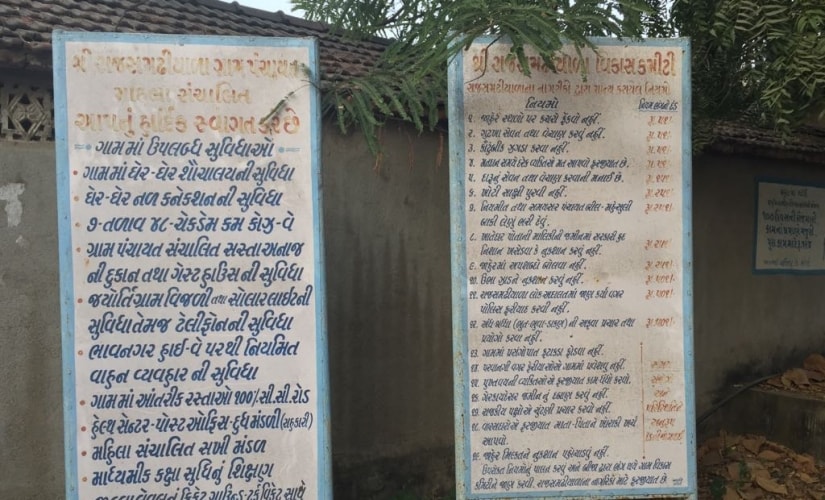 The two boards listing the rules and facilities in Rajsamadiyala village. Firstpost/Amitesh Singh[/caption]The biggest fine in the village so far was taken for consumption of liquor. A 2007 wedding ceremony cost Baba Bhai Kanpariya dearly when he served liquor to his guests. The Lok Adalat imposed a fine of Rs. 10,000 on Baba Bhai, which he had to pay.When Firstpost went to meet Baba Bhai, his house was locked as he had gone to Rajkot for treatment. However, the neighbours told Firstpost the entire story. Baba Bhai's neighbor, Dinesh Bhai Kanpariya, said that the liquor was served to the guest at night in the farm, but during checking the next day, an empty bottle was found.Another neighbour, Jagdish Kakaria, also acknowledged the fine and said, "The wedding happened at eight and the guests were served alcohol at ten in the farm. The next day, an empty bottle was found during an inspection by Lok Adalat members. After this the Lok Adalat imposed a fine of Rs 10,000 which Baba Bhai paid.
Jadeja says, 'We follow the Gita instead of Gandhi. If someone drinks alcohol, then one must not do Satyagraha with him, but punish him.'If there is strictness, there are facilities tooWhile there is strictness in the village, it has also developed well. When Prime Minister Narendra Modi speaks of Adarsh Gram Yojna, then it is a village in his own home state of Gujarat which is narrating the story of development.Development in the village is clearly visible as the annual fee being taken from the people and government schemes are being utilised properly. Along with the entire village road being PCC, the village has toilets, electricity and water in every household, street lights running on solar power, CCTV cameras, separate water tanker for the village as well as a health centre. Now, even free Wi-Fi has been made available.Grains are sold in the shops being run by the village panchayat at low rates. Rajsamadhiyala has a school, a temple, unity among the people and disputes are rare. However, it is the cricket stadium in the village which forces the visitors who come here to think. After talking to the people in the village, when Firstpost visited the village's cricket stadium, it seemed like we had reached a ground in Rajkot city. During the evening, the cricket ground was bathed in milky light and was quite a sight. Mahbub, who came to play from Rajkot, said, "Even state-level players come here to play. The ground is very good."No talk of elections in Patidar-dominated villageRajsamadhiyala has a population of over 1,700 out of which over 1,000 are voters. More than 65 percent of houses in the village belong to Patidars. Lok Adalat president Hardev Singh Jadeja says that all castes have been given representation in the Lok Adalat, so that the law can be strictly enforced.This Lok Adalat is the governing body of the village. Apart from keeping an eye on the work done by the panchayat, it also works for the proper implementation of the panchayat's plans.However, even as the state is gripped by election fever, there is no talk of elections in the village. Neither is anyone ready to speak on elections nor is any party's flag or poster visible. This is because according to the rules of the village, representatives of political parties have also been prohibited from coming to ask for votes.
First Published:Nov 22, 2017, 11:08:33 IST
Advertisement
Advertisement

J&K cop on Amarnath Yatra duty shot dead in Anantnag terror attack; TRF claims responsibility
The Resistance Front (TRF), a shadow outfit of Lashkar-e-Taiba, claimed responsibility for the attack through a social media post
2 min read
Jaishankar meets Canada's Anita Anand, discusses bilateral cooperation and shared interests
External Affairs Minister S Jaishankar on Wednesday held talks on bilateral ties with his Canadian counterpart Anita Anand, focusing on cooperation and common goals.
1 min read
Delhi, Bengaluru, Hyderabad... Neet paper leak protest spreads nationwide even as govt reaches out to CJP, Opposition
Protests over the alleged NEET paper leak intensified across multiple cities, while the Centre signalled talks with the Opposition and the Cockroach Janta Party. The Delhi High Court also stepped in, seeking preservation of CCTV footage related to police action.
3 min read
Why is India seeing 95% cloud cover despite a Super El Niño?
India is witnessing nearly 95 per cent cloud cover despite a Super El Niño, a climate event usually linked to weaker monsoons. Regional weather systems, cyclonic circulations, the monsoon trough and moisture from two seas are temporarily overpowering one of the world's strongest climate phenomena
5 min read
Jaishankar, Rubio review trade, defence, AI cooperation at Manila meeting
Jaishankar and US Secretary of State Marco Rubio reviewed key pillars of the India-US Comprehensive Global Strategic Partnership, including trade, defence, energy, critical minerals and artificial intelligence, while also exchanging views on regional and global developments.
1 min read
Advertisement
Advertisement