
Advertisement


Sections
Floods in Assam, Bihar echo in Parliament: Five Indians died per day in rain-related accidents over past 3 years
As many as 6,585 people lost their lives due to rain-related natural calamities — such as cyclone, floods and landslides — in India over three years ending July 18, 2019, a government reply to the Lok Sabha said on 23 July, 2019. This amounts to nearly 2,000 deaths every year, on average.

Mumbai: As many as 6,585 people lost their lives due to rain-related natural calamities — such as cyclone, floods and landslides — in India over three years ending July 18, 2019, a government reply to the Lok Sabha said on 23 July, 2019. This amounts to nearly 2,000 deaths every year, on average.More than 170 people died in floods in the states of Bihar and Assam, which affected more than 10 million people, India Today reported on July 24, 2019.The Kaziranga National Park in Assam’s Golaghat district has reported the death of 204 animals including 15 rhinoceroses since July 13, 2019.The states of Assam and Bihar are prone to floods every year due to heavy rains and the overflowing of rivers.The Kaziranga National Park in Assam's Golaghat district has reported the death of 204 animals including 15 rhinoceroses since July 13, 2019. Satellite images released by the National Aeronautics and Space Administration (NASA), the US space agency, shows how “the Brahmaputra river rose out of its banks in many locations across India and Bangladesh”, flooding huge swaths of farmland.[caption id="attachment_7073011" align="alignnone" width="730"]![Source: Lok Sabha]() Source: Lok Sabha[/caption]The 2018 deluge in the southern state of Kerala--one of the worst in 94 years--claimed 477 lives or 23 percent of all (2,045) deaths in rain-related natural calamities reported in 2018-19. Bihar reported the most — 970 or 15 percent deaths — followed by Kerala (756), West Bengal (663), Maharashtra (522) and Himachal Pradesh (458) over three years. These five states account for 51% of all deaths. More than 200,000 livestock deaths have been reported and over 3.9 million houses/huts damaged due to rain-related natural calamities over these three years, government data show. Rain-related calamities killed 496 people between April 1, 2019, and July, 18, 2019, or about five deaths per day, on average, with Maharashtra reporting the most (137), followed by Bihar (78).Heavy rains, floods have killed more than 100,000 over 64 yearsAs many as 107,487 people died due to heavy rains and floods across India over 64 years between 1953 and 2017, according to Central Water Commission data presented to the Rajya Sabha on 19 March, 2018, IndiaSpend reported on July 17, 2018. “The main reasons of floods have been assessed as high intensity rainfall in short duration, poor or inadequate drainage capacity, unplanned reservoir regulation and failure of flood control structures,” according to the reply. More than 40 million hectares (12%) of India’s land is prone to floods, official data show. India witnessed 431 major natural disasters over three decades between 1980 and 2010, leading to loss of human lives, property and resources. “About 48 percent of the flood prone area has been provided with reasonable protection against flood of a low to moderate magnitude due to technological and economic constraints. It is not possible to provide protection against all magnitude of flood,” the Central Water Commission states. India could see a six-fold increase in the number of people exposed to the risk of severe floods by 2040--to 25 million people, up from 3.7 million facing this risk between 1971 and 2004, IndiaSpend reported in February 2018, based on a study published in Science Advances, a peer-reviewed journal.Not just India, most of South Asia prone to floodsAbout seven million people in India, Nepal, Bangladesh and Pakistan (as much as the population of Hong Kong) have been displaced or had their lives disrupted by flooding in mid-July 2019, NASA reported on 18 July, 2019.[caption id="attachment_7073271" align="alignnone" width="825"]
Source: Lok Sabha[/caption]The 2018 deluge in the southern state of Kerala--one of the worst in 94 years--claimed 477 lives or 23 percent of all (2,045) deaths in rain-related natural calamities reported in 2018-19. Bihar reported the most — 970 or 15 percent deaths — followed by Kerala (756), West Bengal (663), Maharashtra (522) and Himachal Pradesh (458) over three years. These five states account for 51% of all deaths. More than 200,000 livestock deaths have been reported and over 3.9 million houses/huts damaged due to rain-related natural calamities over these three years, government data show. Rain-related calamities killed 496 people between April 1, 2019, and July, 18, 2019, or about five deaths per day, on average, with Maharashtra reporting the most (137), followed by Bihar (78).Heavy rains, floods have killed more than 100,000 over 64 yearsAs many as 107,487 people died due to heavy rains and floods across India over 64 years between 1953 and 2017, according to Central Water Commission data presented to the Rajya Sabha on 19 March, 2018, IndiaSpend reported on July 17, 2018. “The main reasons of floods have been assessed as high intensity rainfall in short duration, poor or inadequate drainage capacity, unplanned reservoir regulation and failure of flood control structures,” according to the reply. More than 40 million hectares (12%) of India’s land is prone to floods, official data show. India witnessed 431 major natural disasters over three decades between 1980 and 2010, leading to loss of human lives, property and resources. “About 48 percent of the flood prone area has been provided with reasonable protection against flood of a low to moderate magnitude due to technological and economic constraints. It is not possible to provide protection against all magnitude of flood,” the Central Water Commission states. India could see a six-fold increase in the number of people exposed to the risk of severe floods by 2040--to 25 million people, up from 3.7 million facing this risk between 1971 and 2004, IndiaSpend reported in February 2018, based on a study published in Science Advances, a peer-reviewed journal.Not just India, most of South Asia prone to floodsAbout seven million people in India, Nepal, Bangladesh and Pakistan (as much as the population of Hong Kong) have been displaced or had their lives disrupted by flooding in mid-July 2019, NASA reported on 18 July, 2019.[caption id="attachment_7073271" align="alignnone" width="825"]![Source: NASA Earth Observatory]() Source: NASA Earth Observatory[/caption]The two images above, captured on 28 June (before) and 14 July, 2019 (after), depict India’s eastern region showing water (navy and dark blue) out of river banks and on the floodplains. Clouds can be seen in white or cyan and vegetation-covered land in green. Like NASA, The International Charter Space and Major Disasters depicts the before and after images of flood-affected areas in the state of Assam.The Charter is a group of space agencies and space system operators — including the Indian Space Research Organisation — across the world that provides satellite images for disaster monitoring. “Global climate change is likely to increase frequency and severity of flooding in South Asia threatening agricultural production and increase uncertainty for small-scale farmers whose livelihoods serve the rural economy in these regions necessitating an integrated approach to overall risk reduction,” a December 2018 article titled Flood risk assessment in South Asia to prioritise flood index insurance applications in Bihar, India said.
Source: NASA Earth Observatory[/caption]The two images above, captured on 28 June (before) and 14 July, 2019 (after), depict India’s eastern region showing water (navy and dark blue) out of river banks and on the floodplains. Clouds can be seen in white or cyan and vegetation-covered land in green. Like NASA, The International Charter Space and Major Disasters depicts the before and after images of flood-affected areas in the state of Assam.The Charter is a group of space agencies and space system operators — including the Indian Space Research Organisation — across the world that provides satellite images for disaster monitoring. “Global climate change is likely to increase frequency and severity of flooding in South Asia threatening agricultural production and increase uncertainty for small-scale farmers whose livelihoods serve the rural economy in these regions necessitating an integrated approach to overall risk reduction,” a December 2018 article titled Flood risk assessment in South Asia to prioritise flood index insurance applications in Bihar, India said.![Indiaspend-logo]() Cities in South Asia such as "Dhaka, Karachi, Kolkata and Mumbai—urban areas that are home to more than 50 million people—face a substantial risk of flood-related damage over the next century", a 2018 World Bank report titled South Asia’s Hotspots—The Impact of Temperature and Precipitation Changes on Living Standards, stated.Mumbai experienced heavy rainfall in the first week of July 2019, with some parts receiving the second-highest rainfall in July in 45 years that brought the financial capital to a halt, claiming nearly 16 lives, IndiaSpend reported on 2 July, 2019. While linking a particular event to climate change requires extensive analysis, it is clear that the increasing rate of intense rainfall events over Mumbai and the Western Ghats is due to rising temperatures, Roxy Mathew Koll, climate scientist at the Indian Institute of Tropical Meteorology, Pune, had told IndiaSpend.Heavy rainfall events (more than 100 mm) in urban India have increased over the past 100 years; there has been an overall increasing trend of events exceeding 100, 150 and 200 mm since the 1900s, and an increasing variability in recent decades, IndiaSpend reported on 29 August, 2017.Indiaspend.org is a data-driven, public-interest journalism non-profit/FactChecker.in is fact-checking initiative, scrutinising for veracity and context statements made by individuals and organisations in public life.
Cities in South Asia such as "Dhaka, Karachi, Kolkata and Mumbai—urban areas that are home to more than 50 million people—face a substantial risk of flood-related damage over the next century", a 2018 World Bank report titled South Asia’s Hotspots—The Impact of Temperature and Precipitation Changes on Living Standards, stated.Mumbai experienced heavy rainfall in the first week of July 2019, with some parts receiving the second-highest rainfall in July in 45 years that brought the financial capital to a halt, claiming nearly 16 lives, IndiaSpend reported on 2 July, 2019. While linking a particular event to climate change requires extensive analysis, it is clear that the increasing rate of intense rainfall events over Mumbai and the Western Ghats is due to rising temperatures, Roxy Mathew Koll, climate scientist at the Indian Institute of Tropical Meteorology, Pune, had told IndiaSpend.Heavy rainfall events (more than 100 mm) in urban India have increased over the past 100 years; there has been an overall increasing trend of events exceeding 100, 150 and 200 mm since the 1900s, and an increasing variability in recent decades, IndiaSpend reported on 29 August, 2017.Indiaspend.org is a data-driven, public-interest journalism non-profit/FactChecker.in is fact-checking initiative, scrutinising for veracity and context statements made by individuals and organisations in public life.
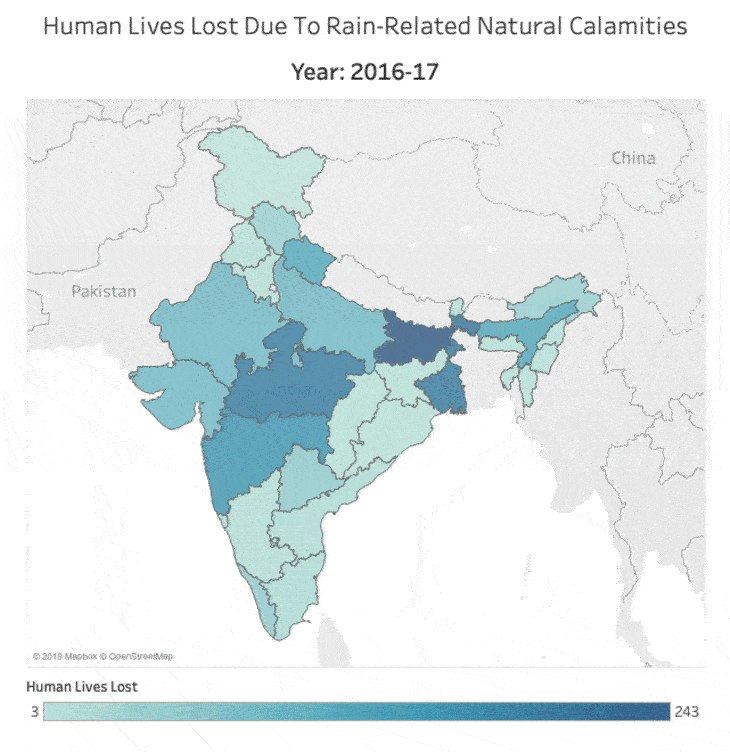 Source: Lok Sabha[/caption]The 2018 deluge in the southern state of Kerala--one of the worst in 94 years--claimed 477 lives or 23 percent of all (2,045) deaths in rain-related natural calamities reported in 2018-19. Bihar reported the most — 970 or 15 percent deaths — followed by Kerala (756), West Bengal (663), Maharashtra (522) and Himachal Pradesh (458) over three years. These five states account for 51% of all deaths. More than 200,000 livestock deaths have been reported and over 3.9 million houses/huts damaged due to rain-related natural calamities over these three years, government data show. Rain-related calamities killed 496 people between April 1, 2019, and July, 18, 2019, or about five deaths per day, on average, with Maharashtra reporting the most (137), followed by Bihar (78).Heavy rains, floods have killed more than 100,000 over 64 yearsAs many as 107,487 people died due to heavy rains and floods across India over 64 years between 1953 and 2017, according to Central Water Commission data presented to the Rajya Sabha on 19 March, 2018, IndiaSpend reported on July 17, 2018. “The main reasons of floods have been assessed as high intensity rainfall in short duration, poor or inadequate drainage capacity, unplanned reservoir regulation and failure of flood control structures,” according to the reply. More than 40 million hectares (12%) of India’s land is prone to floods, official data show. India witnessed 431 major natural disasters over three decades between 1980 and 2010, leading to loss of human lives, property and resources. “About 48 percent of the flood prone area has been provided with reasonable protection against flood of a low to moderate magnitude due to technological and economic constraints. It is not possible to provide protection against all magnitude of flood,” the Central Water Commission states. India could see a six-fold increase in the number of people exposed to the risk of severe floods by 2040--to 25 million people, up from 3.7 million facing this risk between 1971 and 2004, IndiaSpend reported in February 2018, based on a study published in Science Advances, a peer-reviewed journal.Not just India, most of South Asia prone to floodsAbout seven million people in India, Nepal, Bangladesh and Pakistan (as much as the population of Hong Kong) have been displaced or had their lives disrupted by flooding in mid-July 2019, NASA reported on 18 July, 2019.[caption id="attachment_7073271" align="alignnone" width="825"]
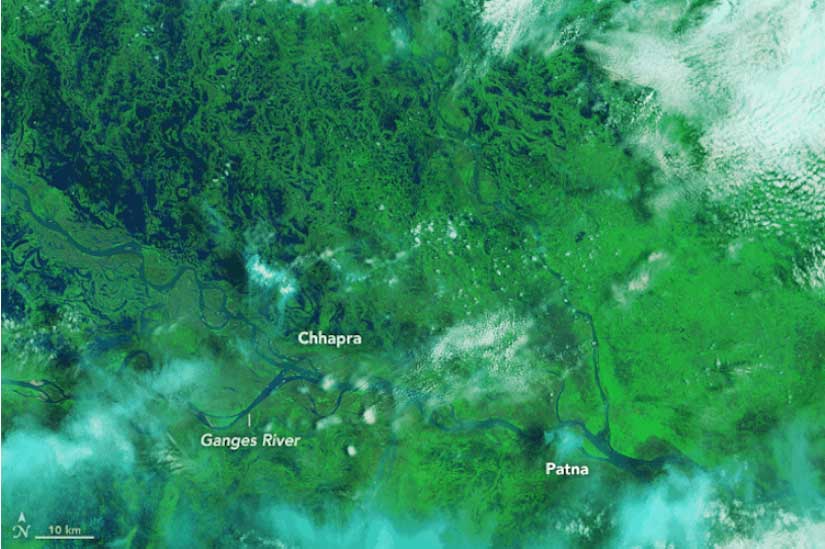 Source: NASA Earth Observatory[/caption]The two images above, captured on 28 June (before) and 14 July, 2019 (after), depict India’s eastern region showing water (navy and dark blue) out of river banks and on the floodplains. Clouds can be seen in white or cyan and vegetation-covered land in green. Like NASA, The International Charter Space and Major Disasters depicts the before and after images of flood-affected areas in the state of Assam.The Charter is a group of space agencies and space system operators — including the Indian Space Research Organisation — across the world that provides satellite images for disaster monitoring. “Global climate change is likely to increase frequency and severity of flooding in South Asia threatening agricultural production and increase uncertainty for small-scale farmers whose livelihoods serve the rural economy in these regions necessitating an integrated approach to overall risk reduction,” a December 2018 article titled Flood risk assessment in South Asia to prioritise flood index insurance applications in Bihar, India said.
 Cities in South Asia such as "Dhaka, Karachi, Kolkata and Mumbai—urban areas that are home to more than 50 million people—face a substantial risk of flood-related damage over the next century", a 2018 World Bank report titled South Asia’s Hotspots—The Impact of Temperature and Precipitation Changes on Living Standards, stated.Mumbai experienced heavy rainfall in the first week of July 2019, with some parts receiving the second-highest rainfall in July in 45 years that brought the financial capital to a halt, claiming nearly 16 lives, IndiaSpend reported on 2 July, 2019. While linking a particular event to climate change requires extensive analysis, it is clear that the increasing rate of intense rainfall events over Mumbai and the Western Ghats is due to rising temperatures, Roxy Mathew Koll, climate scientist at the Indian Institute of Tropical Meteorology, Pune, had told IndiaSpend.Heavy rainfall events (more than 100 mm) in urban India have increased over the past 100 years; there has been an overall increasing trend of events exceeding 100, 150 and 200 mm since the 1900s, and an increasing variability in recent decades, IndiaSpend reported on 29 August, 2017.Indiaspend.org is a data-driven, public-interest journalism non-profit/FactChecker.in is fact-checking initiative, scrutinising for veracity and context statements made by individuals and organisations in public life.
First Published:Jul 29, 2019, 14:37:53 IST
Advertisement
Advertisement

J&K cop on Amarnath Yatra duty shot dead in Anantnag terror attack; TRF claims responsibility
The Resistance Front (TRF), a shadow outfit of Lashkar-e-Taiba, claimed responsibility for the attack through a social media post
2 min read
Jaishankar meets Canada's Anita Anand, discusses bilateral cooperation and shared interests
External Affairs Minister S Jaishankar on Wednesday held talks on bilateral ties with his Canadian counterpart Anita Anand, focusing on cooperation and common goals.
1 min read
Delhi, Bengaluru, Hyderabad... Neet paper leak protest spreads nationwide even as govt reaches out to CJP, Opposition
Protests over the alleged NEET paper leak intensified across multiple cities, while the Centre signalled talks with the Opposition and the Cockroach Janta Party. The Delhi High Court also stepped in, seeking preservation of CCTV footage related to police action.
3 min read
Why is India seeing 95% cloud cover despite a Super El Niño?
India is witnessing nearly 95 per cent cloud cover despite a Super El Niño, a climate event usually linked to weaker monsoons. Regional weather systems, cyclonic circulations, the monsoon trough and moisture from two seas are temporarily overpowering one of the world's strongest climate phenomena
5 min read
Jaishankar, Rubio review trade, defence, AI cooperation at Manila meeting
Jaishankar and US Secretary of State Marco Rubio reviewed key pillars of the India-US Comprehensive Global Strategic Partnership, including trade, defence, energy, critical minerals and artificial intelligence, while also exchanging views on regional and global developments.
1 min read
Advertisement
Advertisement