
Advertisement


Sections
Endangered Species: India's tribal regions, lacking in basic healthcare facilities, reel under menace of malnutrition
The second part of the docuseries Endangered Species, titled First Citizens, travels across the states of Chhattisgarh, Maharashtra and Jharkhand, which have some of the largest tribal populations in the country. They lack basic healthcare facilities and support systems for good hygiene and health education

Malnutrition is a looming threat over the lives of millions of Indian children in rural and tribal areas. Failure to tackle this menace has resulted in extremely vulnerable communities and has had a huge impact on local development and economy. Endangered Species includes an extensive photostory by the acclaimed photographer and Padma Shri awardee Sudharak Olwe and writer Priya Pathiyan, and a two-part documentary series by filmmaker Nirman Chowdhury that documents the issue in some of the worst-affected states in India and features people and families fighting this battle.*** Watch part one of this series.They are India’s first citizens — the rightful heirs to this land. India’s indigenous tribes, or Adivasis as they are commonly known, have a history that spans over thousands of years. With over 500 different tribes spread across various parts of the country, this community is diverse. But as with all indigenous populations across the globe, they too have faced different forms of discrimination over the years. Their forests and lands have been stolen, their way of life has been completely decimated.Today, these tribes struggle to survive, losing their identity in many ways in an attempt to assimilate with a “modern” world.The second part of Photography Promotion Trust's docuseries Endangered Species — titled First Citizens — delves into the cause of malnutrition in India’s tribal regions. It travels in the states of Chhattisgarh, Maharashtra and Jharkhand, which have some of the largest tribal populations in the country but lack basic healthcare facilities and support systems for good hygiene and health education.[caption id="attachment_8165711" align="alignnone" width="825"]![Still from Endangered Species: First Citizens. Screengrab via YouTube]() Still from Endangered Species: First Citizens. YouTube screenshot[/caption]Endangered Species: First Citizens takes the viewers to Chhattisgarh: to villages across the tribal areas in Dongergaon, close to Rajnandgaon and the more far-flung Naxal neighbourhoods of Manpur and Kanker. The film then travels to areas in Maharashtra such as Ghadchiroli, Thane and Palghar to see how the people of the Warli tribe are battling malnutrition. It also taps into the everyday lives of the Ho tribals in Jharkhand’s Chakradharpur to closely observe and understand how their customs impact their children’s lives.Because they live in remote regions of the country, these tribes have been far removed from the political discourse of the nation. The film looks at the status of health and education in these areas, and the emergence of Left-wing radicalism.Superstition plagues the tribal regions, which has led to health complications in women and newborn babies. Even with the advent of modern medicine, the Adivasis have almost no proper access to hospitals, health care facilities and are often treated like third-class citizens. As a result of this mistreatment, discrimination and several other reasons, they have turned back to dubious “faith healers” who have complicated an already complex health situation.In a country that is currently debating the idea of citizenship, the film poses this question: “When will the lives of our first citizens be counted?”Watch the second part here:
Still from Endangered Species: First Citizens. YouTube screenshot[/caption]Endangered Species: First Citizens takes the viewers to Chhattisgarh: to villages across the tribal areas in Dongergaon, close to Rajnandgaon and the more far-flung Naxal neighbourhoods of Manpur and Kanker. The film then travels to areas in Maharashtra such as Ghadchiroli, Thane and Palghar to see how the people of the Warli tribe are battling malnutrition. It also taps into the everyday lives of the Ho tribals in Jharkhand’s Chakradharpur to closely observe and understand how their customs impact their children’s lives.Because they live in remote regions of the country, these tribes have been far removed from the political discourse of the nation. The film looks at the status of health and education in these areas, and the emergence of Left-wing radicalism.Superstition plagues the tribal regions, which has led to health complications in women and newborn babies. Even with the advent of modern medicine, the Adivasis have almost no proper access to hospitals, health care facilities and are often treated like third-class citizens. As a result of this mistreatment, discrimination and several other reasons, they have turned back to dubious “faith healers” who have complicated an already complex health situation.In a country that is currently debating the idea of citizenship, the film poses this question: “When will the lives of our first citizens be counted?”Watch the second part here:
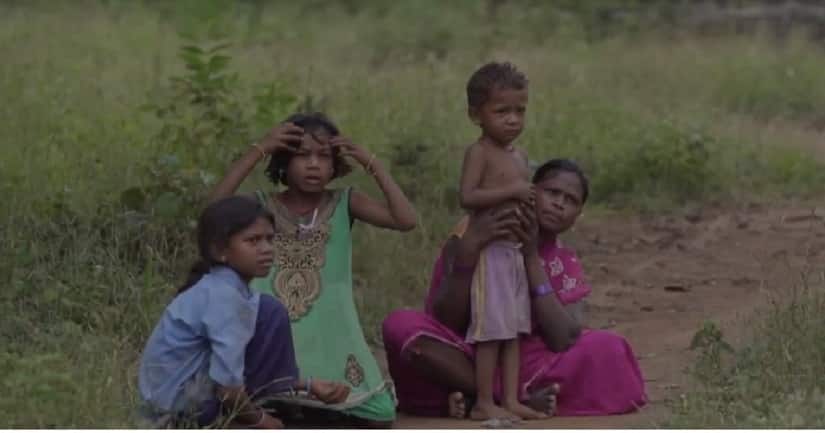 Still from Endangered Species: First Citizens. YouTube screenshot[/caption]Endangered Species: First Citizens takes the viewers to Chhattisgarh: to villages across the tribal areas in Dongergaon, close to Rajnandgaon and the more far-flung Naxal neighbourhoods of Manpur and Kanker. The film then travels to areas in Maharashtra such as Ghadchiroli, Thane and Palghar to see how the people of the Warli tribe are battling malnutrition. It also taps into the everyday lives of the Ho tribals in Jharkhand’s Chakradharpur to closely observe and understand how their customs impact their children’s lives.Because they live in remote regions of the country, these tribes have been far removed from the political discourse of the nation. The film looks at the status of health and education in these areas, and the emergence of Left-wing radicalism.Superstition plagues the tribal regions, which has led to health complications in women and newborn babies. Even with the advent of modern medicine, the Adivasis have almost no proper access to hospitals, health care facilities and are often treated like third-class citizens. As a result of this mistreatment, discrimination and several other reasons, they have turned back to dubious “faith healers” who have complicated an already complex health situation.In a country that is currently debating the idea of citizenship, the film poses this question: “When will the lives of our first citizens be counted?”Watch the second part here:
First Published:Mar 19, 2020, 14:37:51 IST
Advertisement
Advertisement

J&K cop on Amarnath Yatra duty shot dead in Anantnag terror attack; TRF claims responsibility
The Resistance Front (TRF), a shadow outfit of Lashkar-e-Taiba, claimed responsibility for the attack through a social media post
2 min read
Jaishankar meets Canada's Anita Anand, discusses bilateral cooperation and shared interests
External Affairs Minister S Jaishankar on Wednesday held talks on bilateral ties with his Canadian counterpart Anita Anand, focusing on cooperation and common goals.
1 min read
Delhi, Bengaluru, Hyderabad... Neet paper leak protest spreads nationwide even as govt reaches out to CJP, Opposition
Protests over the alleged NEET paper leak intensified across multiple cities, while the Centre signalled talks with the Opposition and the Cockroach Janta Party. The Delhi High Court also stepped in, seeking preservation of CCTV footage related to police action.
3 min read
Why is India seeing 95% cloud cover despite a Super El Niño?
India is witnessing nearly 95 per cent cloud cover despite a Super El Niño, a climate event usually linked to weaker monsoons. Regional weather systems, cyclonic circulations, the monsoon trough and moisture from two seas are temporarily overpowering one of the world's strongest climate phenomena
5 min read
Jaishankar, Rubio review trade, defence, AI cooperation at Manila meeting
Jaishankar and US Secretary of State Marco Rubio reviewed key pillars of the India-US Comprehensive Global Strategic Partnership, including trade, defence, energy, critical minerals and artificial intelligence, while also exchanging views on regional and global developments.
1 min read
Advertisement
Advertisement