
Advertisement


Sections
Despite Rio Olympics 2016 success, Indian women are routinely denied opportunities
Women saved the day for India at Rio, but data reveals that Indian women are routinely denied opportunities at education, work and even being born

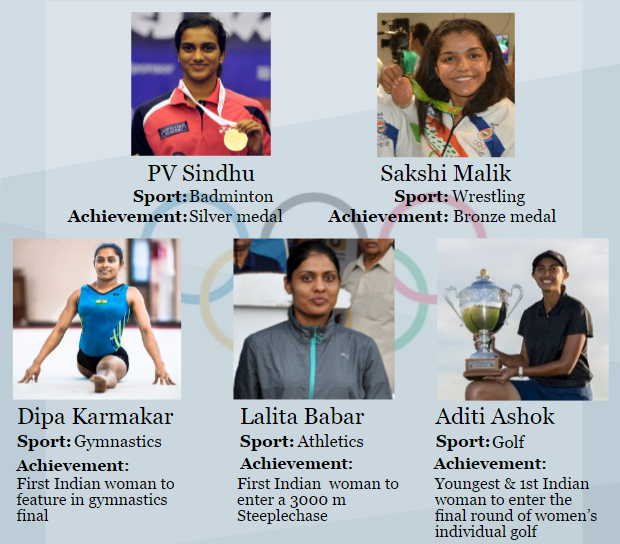 While those rising numbers indicate the progress made by Indian sportswomen – many from small towns and poor families – in particular, and Indian women in general, a quick look at five key parameters – working women, education, maternal health, age of marriage and abortion rates – reveals that India’s women are routinely denied opportunities at education, work and even being born.1. Working women: Lowest in BRICS, 25 million women leave workforce over a decadeWomen’s workforce participation in India is the lowest among BRICS nations. A host of other countries, such as Bahrain (39 percent), Malaysia (45 percent) and Somalia (37 percent), do much better, as IndiaSpend reported in March 2015, using World Bank data from 2014.No more than 26 percent of India’s women participated in the workforce, according to this 2013 Labour Bureau report. The rate improved to 27 percent in 2014, according to a 2015 International Monetary Fund (IMF) study that IndiaSpend reported in July 2016. This is a decline of up to 8 percent percentage point over 14 years; in 1999, up to 34 percent of women were a part of India’s workforce.While marginally more women work in India than in Pakistan (27 percent and 25 percent respectively), Pakistan’s female labour-force participation rate is growing – as India’s is declining. The percentage of women working in Bangladesh is two times that in India, IndiaSpend reported in March 2016.Despite the increasing number of women pursuing secondary and post-secondary education, India’s women keep dropping out of the workforce. Since 2005, more than 25 million Indian women have left the labour force.2. Higher education: More women enrolled, outperform men, but drop out laterWhile more young women are enrolled in higher education than ever before – and apparently more successful in clearing 10th standard board exams than young men – they are either marrying early or not finding or not looking for jobs, according to an IndiaSpend analysis of various data.The enrolment of girls in higher education increased from 39 percent to 46 percent from 2007 to 2014, but as data above show, female participation in India’s labour force declined to a low of 27 percent in 2014 from 34 percent in 1999.Almost 12 million women are enrolled in undergraduate courses, but few continue to professional courses; 600,000 women were enrolled for diploma courses, according to 2013 data, the latest available. Even fewer women sign on for PhDs and only 40 percent of PhD candidates are female.In 2016, girls were more successful than boys in clearing 10th standard exams of a national education board, a trend that has held over seven years, we reported.3. Maternal Health: Best ever, but worse than poorer countriesIndia’s maternal mortality ratio – the women who die during every 100,000 live births – was 167 in 2010-12, according to the latest government data available, a steady improvement.
Source: Press Information BureauIndia’s maternal mortality ratio – 174, according to World Bank estimates – is worse than countries in the neighbourhood, such as Sri Lanka (30), Bhutan (148) and Cambodia (161).India does worst among the BRICS countries: Russia (25), China (27), Brazil (44), and South Africa (138); according to the World Bank’s latest estimates, which differ somewhat from Indian sources’ 167 but confirm the trends.
Source: World Bank4. Median age of marriage: Rising, but 61 percent married before 16The average Indian woman is married at 21.2 years, according to Census 2011, an improvement from 19.3 years in 1990, according to a government report.The mean female age at marriage in rural areas is 20.7; in urban areas, 22.7, according to the latest census data from 2011.While education is an efficient contraceptive – Indian women with a college degree have 1.9 children during their lifetime, against 3.8 for illiterate woman – it appears to only marginally slow the inevitability of early marriage.Despite a 26 percentage point rise in female literacy over two decades to 2011, it is hard for a woman to stay single beyond 20, as we noted earlier.As many as 80 percent of illiterate children who married before 10 were girls – 5.4 million (44 percent) of married children under 10 were illiterate – indicating how lower levels of education correlate with early marriage. Education also correlates with fewer and healthier children and healthier mothers.Nearly 12 million Indian children were married before the age of 10 years, as IndiaSpend reported in June 2016; 7.84 million (65 percent) married children were female, reinforcing the fact that girls are significantly more disadvantaged. Eight in 10 illiterate children who were married were also girls.Also, as many as 1,403 females never attended any educational institution for every 1,000 males who have not, IndiaSpend reported in November 2015.5. India’s missing girls: Child sex ratio lowest in 60 yearsIndia’s child sex ratio – the number of girls per 1,000 boys aged 0-6 years – is the worst in 60 years, indicating that girls continue to be aborted, killed or otherwise fatally neglected.
Source: Census of IndiaIf India’s child sex ratio does not improve, there will be 23 million fewer women (aged 29-40) than there should be by 2030, according to this United Nations Population Fund projection.Sex selection was introduced in India to control population growth, based on the premise that since girls are hardier, all else being equal, more survive childbirth than boys. In 1975, a paper in the journal Indian Paediatrics argued that this excess of girls was “unnecessary fecundity and that elimination of girls would lead to population control”, wrote Sabu M George – a member of a committee to monitor a 1994 law that banned sex selection – in his February 2016 Indian Express column.But despite the law, rising education levels – and more female role models, such as India’s latest Olympian medallists – the child sex ratio continues to fall.(The author is an analyst with IndiaSpend)
First Published:Aug 23, 2016, 11:27:33 IST
Advertisement
Advertisement

Air India to cut Delhi-Toronto flight time by 3 hours, resume non-stop services from August 1
Air India will resume non-stop Delhi-Toronto flights from August 1, cutting travel time by nearly three hours and deploying its new Boeing 787-9 Dreamliner on the route
2 min read
J&K cop on Amarnath Yatra duty shot dead in Anantnag terror attack; TRF claims responsibility
The Resistance Front (TRF), a shadow outfit of Lashkar-e-Taiba, claimed responsibility for the attack through a social media post
2 min read
Jaishankar meets Canada's Anita Anand, discusses bilateral cooperation and shared interests
External Affairs Minister S Jaishankar on Wednesday held talks on bilateral ties with his Canadian counterpart Anita Anand, focusing on cooperation and common goals.
1 min read
Delhi, Bengaluru, Hyderabad... Neet paper leak protest spreads nationwide even as govt reaches out to CJP, Opposition
Protests over the alleged NEET paper leak intensified across multiple cities, while the Centre signalled talks with the Opposition and the Cockroach Janta Party. The Delhi High Court also stepped in, seeking preservation of CCTV footage related to police action.
3 min read
Why is India seeing 95% cloud cover despite a Super El Niño?
India is witnessing nearly 95 per cent cloud cover despite a Super El Niño, a climate event usually linked to weaker monsoons. Regional weather systems, cyclonic circulations, the monsoon trough and moisture from two seas are temporarily overpowering one of the world's strongest climate phenomena
5 min read
Advertisement
Advertisement