
Advertisement


Sections
Dense fog engulfs Delhi-NCR: Low visibility delays flights, trains; air quality drops to 'poor' after slight improvement over weekend
Delhi-NCR on Monday woke up to a thick blanket of fog that made transportation difficult in the National Capital Region and rendered visibility to dangerously low levels. Air quality also dipped to the 'poor' category again after a slight improvement over the weekend.

Delhi-NCR on Monday woke up to a thick blanket of fog that made transportation difficult in the National Capital Region and rendered visibility to dangerously low levels. Air quality also dipped to the 'poor' category again after a slight improvement over the weekend.As many as 27 trains running are running late, and several flights are delayed. Images shared on social media showed vehicles on Delhi roads barely visible through the dense fog. Several airlines have advised flyers from Delhi-NCR to check their flight status before heading to airports, cautioning them about likely delays due to bad weather and dense fog. A Vistara flight was also diverted.The India Meteorological Department has also warned of dense to very dense fog in Delhi-NCR due to the cold wave. According to Skymet Weather, The Palam Observatory reported visibility of around 50 metres to nil. The density of the fog was so deep that visibility did not even clear by 9 am.[caption id="attachment_6021111" align="alignnone" width="825"]![Fog at Crossings Republic Ghaziabad. Image courtesy: Aninda Ray/Firstpost]() Fog at Crossings Republic Ghaziabad. Image courtesy: Aninda Ray/Firstpost[/caption]With a cold wave gripping the region, a large number of homeless have been taking refuge at night shelters in various parts of Delhi to shield themselves from chilly winds. The maximum temperature in Delhi on Sunday was 19.9°C, two notches below the season's average. The minimum temperature was 9.4°C, a notch above the season's average. On Monday, the maximum and minimum temperatures are likely to be around 21°C and 11°C.Air Quality Index in the range of 51 to 100 is considered satisfactory; 101-200 is moderate; 201-300 falls under the category of poor; 300-400 is considered 'very poor'; and 401-500 falls under the 'hazardous' category.[caption id="attachment_6021101" align="alignnone" width="825"]
Fog at Crossings Republic Ghaziabad. Image courtesy: Aninda Ray/Firstpost[/caption]With a cold wave gripping the region, a large number of homeless have been taking refuge at night shelters in various parts of Delhi to shield themselves from chilly winds. The maximum temperature in Delhi on Sunday was 19.9°C, two notches below the season's average. The minimum temperature was 9.4°C, a notch above the season's average. On Monday, the maximum and minimum temperatures are likely to be around 21°C and 11°C.Air Quality Index in the range of 51 to 100 is considered satisfactory; 101-200 is moderate; 201-300 falls under the category of poor; 300-400 is considered 'very poor'; and 401-500 falls under the 'hazardous' category.[caption id="attachment_6021101" align="alignnone" width="825"]![Delhi's Dwarka under a blanket of fog. Image courtesy: Charu Gupta/Firstpost]() Delhi's Dwarka under a blanket of fog. Image courtesy: Charu Gupta/Firstpost[/caption]The Delhi Traffic Police has tweeted out a list of dos and don'ts and advised motorists to exercise caution while venturing out to the foggy roads of Delhi-NCR.According to the Central Pollution Control Board (CPCB) data, the overall Air Quality Index (AQI) of the city was at 291 on Sunday, which falls in the 'poor' category. Delhi's air quality had dipped to 'very poor' category due to rains, which increased the pollutant holding capacity of air.AQI between 0 and 50 is considered 'good', 51 and 100 'satisfactory', 101 and 200 'moderate', 201 and 300 'poor', 301 and 400 'very poor', and between 401 and 500 'severe'.The CPCB said 16 areas recorded 'very poor' air quality while 18 areas recorded 'poor' air quality. The level of PM2.5 (particles in the air with a diameter of less than 2.5 micrometres) was recorded at 145 and the PM10 level 227, it said.[caption id="attachment_6021091" align="alignnone" width="560"]
Delhi's Dwarka under a blanket of fog. Image courtesy: Charu Gupta/Firstpost[/caption]The Delhi Traffic Police has tweeted out a list of dos and don'ts and advised motorists to exercise caution while venturing out to the foggy roads of Delhi-NCR.According to the Central Pollution Control Board (CPCB) data, the overall Air Quality Index (AQI) of the city was at 291 on Sunday, which falls in the 'poor' category. Delhi's air quality had dipped to 'very poor' category due to rains, which increased the pollutant holding capacity of air.AQI between 0 and 50 is considered 'good', 51 and 100 'satisfactory', 101 and 200 'moderate', 201 and 300 'poor', 301 and 400 'very poor', and between 401 and 500 'severe'.The CPCB said 16 areas recorded 'very poor' air quality while 18 areas recorded 'poor' air quality. The level of PM2.5 (particles in the air with a diameter of less than 2.5 micrometres) was recorded at 145 and the PM10 level 227, it said.[caption id="attachment_6021091" align="alignnone" width="560"]![Walking through Gurugram is a blurry experience. Image courtesy: Rishika/Firstpost]() Walking through Gurugram is a blurry experience. Image courtesy: Rishika/Firstpost[/caption]Authorities said the slight improvement in air quality is due to minor improvement in wind speed. They further added that the air quality would continue to oscillate between 'poor' and 'very poor' category for the next three days.According to the Centre-run System of Air Quality and Weather Forecasting (SAFAR), moderate foggy conditions due to radiation fog and subtle effect of drizzle is still persisting and not allowing air quality to improve. "However, such conditions cannot get prolonged for long and AQI will start to improve faster after 3 days. there is a partial probability of occurrence of active western disturbance," the SAFAR said.
Walking through Gurugram is a blurry experience. Image courtesy: Rishika/Firstpost[/caption]Authorities said the slight improvement in air quality is due to minor improvement in wind speed. They further added that the air quality would continue to oscillate between 'poor' and 'very poor' category for the next three days.According to the Centre-run System of Air Quality and Weather Forecasting (SAFAR), moderate foggy conditions due to radiation fog and subtle effect of drizzle is still persisting and not allowing air quality to improve. "However, such conditions cannot get prolonged for long and AQI will start to improve faster after 3 days. there is a partial probability of occurrence of active western disturbance," the SAFAR said.
 Fog at Crossings Republic Ghaziabad. Image courtesy: Aninda Ray/Firstpost[/caption]With a cold wave gripping the region, a large number of homeless have been taking refuge at night shelters in various parts of Delhi to shield themselves from chilly winds. The maximum temperature in Delhi on Sunday was 19.9°C, two notches below the season's average. The minimum temperature was 9.4°C, a notch above the season's average. On Monday, the maximum and minimum temperatures are likely to be around 21°C and 11°C.Air Quality Index in the range of 51 to 100 is considered satisfactory; 101-200 is moderate; 201-300 falls under the category of poor; 300-400 is considered 'very poor'; and 401-500 falls under the 'hazardous' category.[caption id="attachment_6021101" align="alignnone" width="825"]
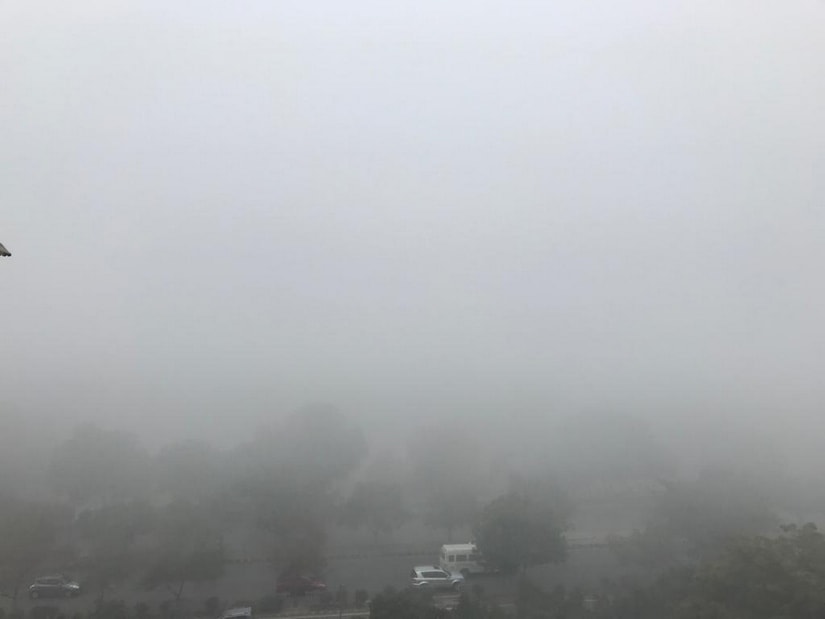 Delhi's Dwarka under a blanket of fog. Image courtesy: Charu Gupta/Firstpost[/caption]The Delhi Traffic Police has tweeted out a list of dos and don'ts and advised motorists to exercise caution while venturing out to the foggy roads of Delhi-NCR.According to the Central Pollution Control Board (CPCB) data, the overall Air Quality Index (AQI) of the city was at 291 on Sunday, which falls in the 'poor' category. Delhi's air quality had dipped to 'very poor' category due to rains, which increased the pollutant holding capacity of air.AQI between 0 and 50 is considered 'good', 51 and 100 'satisfactory', 101 and 200 'moderate', 201 and 300 'poor', 301 and 400 'very poor', and between 401 and 500 'severe'.The CPCB said 16 areas recorded 'very poor' air quality while 18 areas recorded 'poor' air quality. The level of PM2.5 (particles in the air with a diameter of less than 2.5 micrometres) was recorded at 145 and the PM10 level 227, it said.[caption id="attachment_6021091" align="alignnone" width="560"]
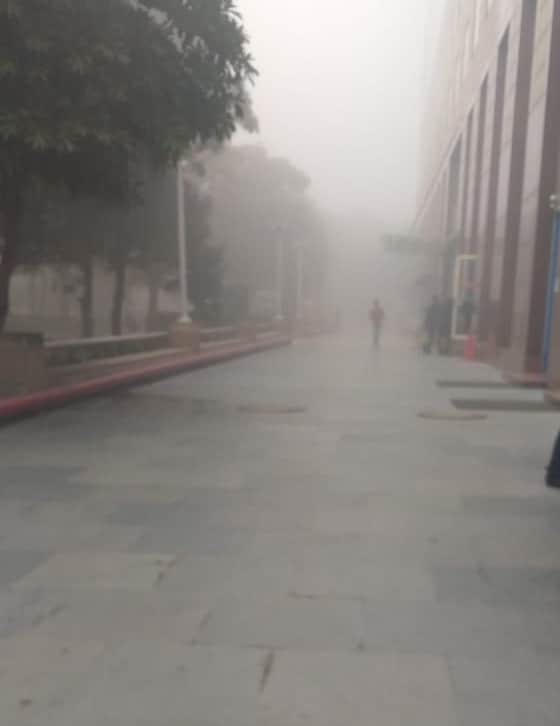 Walking through Gurugram is a blurry experience. Image courtesy: Rishika/Firstpost[/caption]Authorities said the slight improvement in air quality is due to minor improvement in wind speed. They further added that the air quality would continue to oscillate between 'poor' and 'very poor' category for the next three days.According to the Centre-run System of Air Quality and Weather Forecasting (SAFAR), moderate foggy conditions due to radiation fog and subtle effect of drizzle is still persisting and not allowing air quality to improve. "However, such conditions cannot get prolonged for long and AQI will start to improve faster after 3 days. there is a partial probability of occurrence of active western disturbance," the SAFAR said.
First Published:Feb 04, 2019, 08:59:48 IST
Advertisement
Advertisement

J&K cop on Amarnath Yatra duty shot dead in Anantnag terror attack; TRF claims responsibility
The Resistance Front (TRF), a shadow outfit of Lashkar-e-Taiba, claimed responsibility for the attack through a social media post
2 min read
Jaishankar meets Canada's Anita Anand, discusses bilateral cooperation and shared interests
External Affairs Minister S Jaishankar on Wednesday held talks on bilateral ties with his Canadian counterpart Anita Anand, focusing on cooperation and common goals.
1 min read
Delhi, Bengaluru, Hyderabad... Neet paper leak protest spreads nationwide even as govt reaches out to CJP, Opposition
Protests over the alleged NEET paper leak intensified across multiple cities, while the Centre signalled talks with the Opposition and the Cockroach Janta Party. The Delhi High Court also stepped in, seeking preservation of CCTV footage related to police action.
3 min read
Why is India seeing 95% cloud cover despite a Super El Niño?
India is witnessing nearly 95 per cent cloud cover despite a Super El Niño, a climate event usually linked to weaker monsoons. Regional weather systems, cyclonic circulations, the monsoon trough and moisture from two seas are temporarily overpowering one of the world's strongest climate phenomena
5 min read
Jaishankar, Rubio review trade, defence, AI cooperation at Manila meeting
Jaishankar and US Secretary of State Marco Rubio reviewed key pillars of the India-US Comprehensive Global Strategic Partnership, including trade, defence, energy, critical minerals and artificial intelligence, while also exchanging views on regional and global developments.
1 min read
Advertisement
Advertisement