
Advertisement


Sections
Dying man on Delhi road: Indians are voyeurs, they rarely help accident victims
If you think the shameful, inhuman behaviour caught on a CCTV camera in Delhi is an aberration, stand in front of a mirror and introspect.

A man hit by a tempo bled on a Delhi road for 90 minutes on Wednesday morning. Hundreds of people drove past the dying man, but not one person came forward to help. The only one who walked up to the injured man ended up helping himself: He walked away with the dying man's mobile phone.Let us puff our chests and say it out aloud, Bharat Mata ki Jai.If you think the shameful, inhuman behaviour caught on a CCTV camera in Delhi is an aberration, stand in front of a mirror and introspect. Ask yourself, when was the last time you stopped to help a road accident victim? How many of us just whizzed past after confirming that the victim was not a friend or a relative, silently telling ourselves, kaun lafde main parega (Why should we get into trouble?)[caption id="attachment_2827010" align="alignleft" width="380"]![A file photo of Delhi police.Reuters]() A file photo of Delhi police.Reuters[/caption]Unfortunately, most of us Indians are like this only. Self-centred insensitive quislings with a grossly exaggerated opinion of ourselves, with delusions and empty slogans of greatness. We are a country of tamaashbeens — fascinated spectators — not conscientious citizens ready to help.Remember Jyoti Singh Pandey and her friend? Remember their plight?"After raping Jyoti, the attackers threw us out. We were lying on the road without any clothes. I tried to get up and wave at the moving traffic. Some cars stopped, saw us and left without helping. Then the highway patrol van spotted us and called the police and we were taken to the hospital. People kept staring at me in the hospital. I was lying in a pool of blood on the floor without any clothes. I was pleading with them to call my father as I remember his phone number," her friend recounted his 90-minute ordeal on that fateful night of 16 December.Consider the hypocrisy: Not one person stopped by to help the victims while they were lying on the road, bleeding, unconscious and stripped of clothes. And a few days later, half of Delhi were on the roads, seeking justice for Jyoti. ''Saari Delhi yahan hai, Sheila Dixit kahan hai" — remember? Where was saari Delhi when Jyoti and her friend were seeking help?Remember Kanhiya Lal and his family? In 2013, Kanhaiya's wife and infant daughter were hit by a vehicle in Jaipur. For almost one hour, clutching their bodies to his chest, Kanhaiya and his son kept pleading for help. But nobody stopped and the victims bled to death. For the next few days, the media howled at the new low in public apathy, anchors screamed that India wants to know why its people have become so insensitive and shameless. Nothing changed.Remember Vinay Jindal? In July 2015, hundreds of spectators watched him bleed to death after an accident in east Delhi. His death and public apathy prompted even Prime Minister Narendra Modi to ask people to help road accident victims. But, we never learn. Nothing changes. Accidents keep happening, victims keep bleeding and spectators keep watching or driving away. Because, O darling! This is the real India.In 2013, a survey by Savelife Foundation — an NGO working on road safety — found that 74 percent of Indians were unlikely to help an accident victim, whether alone or with other bystanders. Much of this apathy is because of the fear of getting drawn into legal cases, being harassed by cops and mulcted by hospitals. The laws and the system, frankly, are loaded against anybody willing to help.Yet, what does it take to save a victim of a road accident? In many cases, just a phone call. Decades ago, when mobile phones were not around, it would have been understandable if people considered themselves helpless spectators of accidents. But now, with a penetration level of more than 80 percent, is it such a big deal to stop for a minute and summon an ambulance or inform the cops? But no, we would rather outrage on social media against a nation's apathy instead of taking timely action.No wonder, India has just a percent of the world's vehicles. But we contribute to 10 percent of total global deaths in accidents. Fifty percent victims die of injuries that could have been treated.So, think about this: Every year around 1.5 lakh Indians die in accidents. Every four minutes, one Indian is killed on the roads, every day 16 children die in accidents. Half of them could have been saved if someone would have provided timely help.Mera Bharat Mahaan?
A file photo of Delhi police.Reuters[/caption]Unfortunately, most of us Indians are like this only. Self-centred insensitive quislings with a grossly exaggerated opinion of ourselves, with delusions and empty slogans of greatness. We are a country of tamaashbeens — fascinated spectators — not conscientious citizens ready to help.Remember Jyoti Singh Pandey and her friend? Remember their plight?"After raping Jyoti, the attackers threw us out. We were lying on the road without any clothes. I tried to get up and wave at the moving traffic. Some cars stopped, saw us and left without helping. Then the highway patrol van spotted us and called the police and we were taken to the hospital. People kept staring at me in the hospital. I was lying in a pool of blood on the floor without any clothes. I was pleading with them to call my father as I remember his phone number," her friend recounted his 90-minute ordeal on that fateful night of 16 December.Consider the hypocrisy: Not one person stopped by to help the victims while they were lying on the road, bleeding, unconscious and stripped of clothes. And a few days later, half of Delhi were on the roads, seeking justice for Jyoti. ''Saari Delhi yahan hai, Sheila Dixit kahan hai" — remember? Where was saari Delhi when Jyoti and her friend were seeking help?Remember Kanhiya Lal and his family? In 2013, Kanhaiya's wife and infant daughter were hit by a vehicle in Jaipur. For almost one hour, clutching their bodies to his chest, Kanhaiya and his son kept pleading for help. But nobody stopped and the victims bled to death. For the next few days, the media howled at the new low in public apathy, anchors screamed that India wants to know why its people have become so insensitive and shameless. Nothing changed.Remember Vinay Jindal? In July 2015, hundreds of spectators watched him bleed to death after an accident in east Delhi. His death and public apathy prompted even Prime Minister Narendra Modi to ask people to help road accident victims. But, we never learn. Nothing changes. Accidents keep happening, victims keep bleeding and spectators keep watching or driving away. Because, O darling! This is the real India.In 2013, a survey by Savelife Foundation — an NGO working on road safety — found that 74 percent of Indians were unlikely to help an accident victim, whether alone or with other bystanders. Much of this apathy is because of the fear of getting drawn into legal cases, being harassed by cops and mulcted by hospitals. The laws and the system, frankly, are loaded against anybody willing to help.Yet, what does it take to save a victim of a road accident? In many cases, just a phone call. Decades ago, when mobile phones were not around, it would have been understandable if people considered themselves helpless spectators of accidents. But now, with a penetration level of more than 80 percent, is it such a big deal to stop for a minute and summon an ambulance or inform the cops? But no, we would rather outrage on social media against a nation's apathy instead of taking timely action.No wonder, India has just a percent of the world's vehicles. But we contribute to 10 percent of total global deaths in accidents. Fifty percent victims die of injuries that could have been treated.So, think about this: Every year around 1.5 lakh Indians die in accidents. Every four minutes, one Indian is killed on the roads, every day 16 children die in accidents. Half of them could have been saved if someone would have provided timely help.Mera Bharat Mahaan?
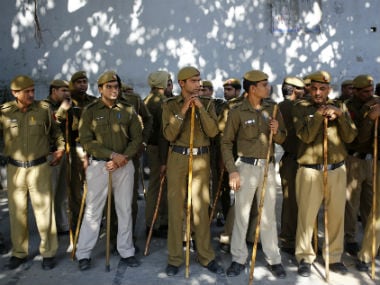 A file photo of Delhi police.Reuters[/caption]Unfortunately, most of us Indians are like this only. Self-centred insensitive quislings with a grossly exaggerated opinion of ourselves, with delusions and empty slogans of greatness. We are a country of tamaashbeens — fascinated spectators — not conscientious citizens ready to help.Remember Jyoti Singh Pandey and her friend? Remember their plight?"After raping Jyoti, the attackers threw us out. We were lying on the road without any clothes. I tried to get up and wave at the moving traffic. Some cars stopped, saw us and left without helping. Then the highway patrol van spotted us and called the police and we were taken to the hospital. People kept staring at me in the hospital. I was lying in a pool of blood on the floor without any clothes. I was pleading with them to call my father as I remember his phone number," her friend recounted his 90-minute ordeal on that fateful night of 16 December.Consider the hypocrisy: Not one person stopped by to help the victims while they were lying on the road, bleeding, unconscious and stripped of clothes. And a few days later, half of Delhi were on the roads, seeking justice for Jyoti. ''Saari Delhi yahan hai, Sheila Dixit kahan hai" — remember? Where was saari Delhi when Jyoti and her friend were seeking help?Remember Kanhiya Lal and his family? In 2013, Kanhaiya's wife and infant daughter were hit by a vehicle in Jaipur. For almost one hour, clutching their bodies to his chest, Kanhaiya and his son kept pleading for help. But nobody stopped and the victims bled to death. For the next few days, the media howled at the new low in public apathy, anchors screamed that India wants to know why its people have become so insensitive and shameless. Nothing changed.Remember Vinay Jindal? In July 2015, hundreds of spectators watched him bleed to death after an accident in east Delhi. His death and public apathy prompted even Prime Minister Narendra Modi to ask people to help road accident victims. But, we never learn. Nothing changes. Accidents keep happening, victims keep bleeding and spectators keep watching or driving away. Because, O darling! This is the real India.In 2013, a survey by Savelife Foundation — an NGO working on road safety — found that 74 percent of Indians were unlikely to help an accident victim, whether alone or with other bystanders. Much of this apathy is because of the fear of getting drawn into legal cases, being harassed by cops and mulcted by hospitals. The laws and the system, frankly, are loaded against anybody willing to help.Yet, what does it take to save a victim of a road accident? In many cases, just a phone call. Decades ago, when mobile phones were not around, it would have been understandable if people considered themselves helpless spectators of accidents. But now, with a penetration level of more than 80 percent, is it such a big deal to stop for a minute and summon an ambulance or inform the cops? But no, we would rather outrage on social media against a nation's apathy instead of taking timely action.No wonder, India has just a percent of the world's vehicles. But we contribute to 10 percent of total global deaths in accidents. Fifty percent victims die of injuries that could have been treated.So, think about this: Every year around 1.5 lakh Indians die in accidents. Every four minutes, one Indian is killed on the roads, every day 16 children die in accidents. Half of them could have been saved if someone would have provided timely help.Mera Bharat Mahaan?
First Published:Aug 11, 2016, 14:58:26 IST
Advertisement
Advertisement

J&K cop on Amarnath Yatra duty shot dead in Anantnag terror attack; TRF claims responsibility
The Resistance Front (TRF), a shadow outfit of Lashkar-e-Taiba, claimed responsibility for the attack through a social media post
2 min read
Jaishankar meets Canada's Anita Anand, discusses bilateral cooperation and shared interests
External Affairs Minister S Jaishankar on Wednesday held talks on bilateral ties with his Canadian counterpart Anita Anand, focusing on cooperation and common goals.
1 min read
Delhi, Bengaluru, Hyderabad... Neet paper leak protest spreads nationwide even as govt reaches out to CJP, Opposition
Protests over the alleged NEET paper leak intensified across multiple cities, while the Centre signalled talks with the Opposition and the Cockroach Janta Party. The Delhi High Court also stepped in, seeking preservation of CCTV footage related to police action.
3 min read
Why is India seeing 95% cloud cover despite a Super El Niño?
India is witnessing nearly 95 per cent cloud cover despite a Super El Niño, a climate event usually linked to weaker monsoons. Regional weather systems, cyclonic circulations, the monsoon trough and moisture from two seas are temporarily overpowering one of the world's strongest climate phenomena
5 min read
Jaishankar, Rubio review trade, defence, AI cooperation at Manila meeting
Jaishankar and US Secretary of State Marco Rubio reviewed key pillars of the India-US Comprehensive Global Strategic Partnership, including trade, defence, energy, critical minerals and artificial intelligence, while also exchanging views on regional and global developments.
1 min read
Advertisement
Advertisement